
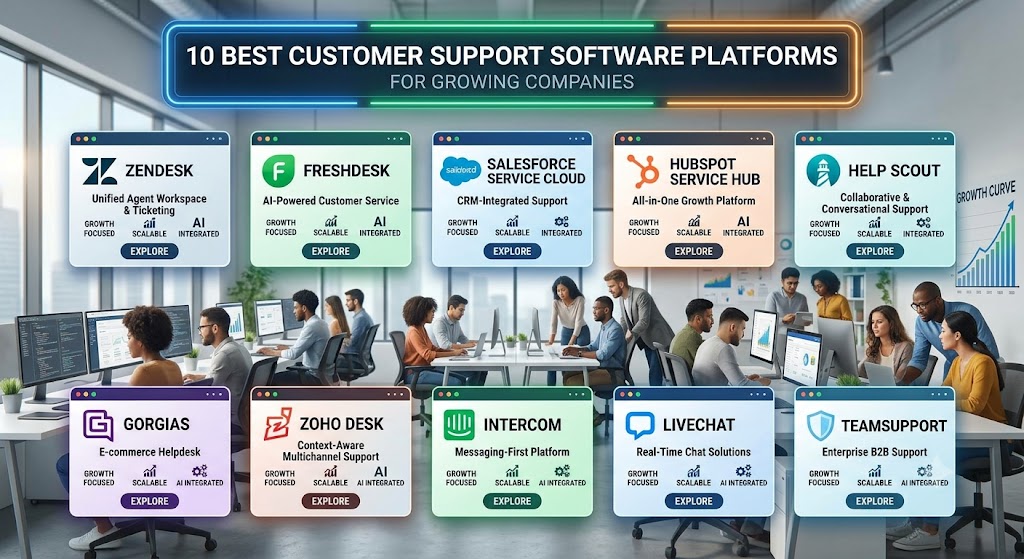
Customer expectations have shifted dramatically over the past few years. Customers no longer just want a reply to their email they expect fast, consistent, and personalized support across chat, email, social media, and self-service channels, often with AI resolving simple issues before a human ever gets involved. For growing companies, choosing the right customer support platform isn’t just about keeping up with ticket volume it’s about building a support operation that scales without forcing a costly, disruptive migration a year or two down the line.
This guide breaks down 10 of the best customer support software platforms for growing companies in 2026, covering what each one does well, who it’s best suited for, and the tradeoffs worth knowing before you commit.
What to Look for in Customer Support Software
Before diving into specific platforms, it helps to know what actually separates a good support tool from a great one for a growing team:
- Omnichannel support the ability to manage email, live chat, social media, and messaging apps from a single unified inbox
- AI and automation copilots that draft replies, summarize long ticket threads, and route tickets intelligently, plus AI agents that can resolve simple requests without human involvement
- Scalable pricing a cost structure (per-seat, per-resolution, or tiered) that grows sensibly with your team rather than forcing sudden, painful upgrade cliffs
- Integration ecosystem native or marketplace connections to your CRM, e-commerce platform, and internal tools like Slack or Microsoft Teams
- Knowledge base and self-service tools that let customers find answers on their own, reducing the volume that reaches a human agent
- Reporting and analytics visibility into resolution times, customer satisfaction, and agent performance to guide staffing and process decisions
With those criteria in mind, here are the platforms worth serious consideration.
1. Zendesk Best for Scaling Into Enterprise-Grade Support
Zendesk remains one of the most established names in customer support software, and for good reason. It unifies conversations, AI, knowledge management, automation, analytics, and integrations into a single platform, giving agents full customer context and workflow tools in one workspace. Its AI capabilities are built directly into the service experience, including AI agents that resolve routine requests on their own and a copilot that surfaces relevant context and suggests next steps for agents handling more complex tickets.
Zendesk is particularly strong for larger support teams that need omnichannel routing, deep customization, and proven reliability at scale. The tradeoff is complexity: its extensive feature set comes with a steeper learning curve, and workflows can become clunky as configurations pile up over time. Early-stage or lean teams may end up paying for capabilities they won’t fully use for a while.
Best for: Growing companies anticipating rapid scale who want a platform that won’t need replacing as they expand into enterprise territory.
2. Freshdesk Best Value for Growing Teams
Freshdesk consistently ranks as one of the best value options for growing businesses that need real multichannel capability without enterprise-level pricing. It offers a genuinely useful free tier supporting a handful of agents with email ticketing, a knowledge base, and basic reporting, with paid tiers adding multichannel support, deeper automation, and its Freddy AI assistant for chatbot conversations, response suggestions, and automatic ticket categorization.
One of Freshdesk’s standout strengths is its marketplace, which includes over a thousand integrations covering CRMs like Salesforce and HubSpot as well as e-commerce platforms like Shopify many of which are no-code, meaning support teams can connect tools without needing developer time. Its interface is also generally considered cleaner and more intuitive than Zendesk’s, which reduces onboarding time for new agents. Worth noting: free and entry-level plans include no AI features at all Freddy AI capabilities require a mid-tier plan or higher, and AI session credits don’t roll over between billing cycles.
Best for: Growing teams that need enterprise-style features multichannel support, automation, strong integrations without enterprise pricing.
3. Intercom Best AI-First Support for Product-Led Companies
Intercom has built a reputation as one of the strongest AI-first support platforms available, with its Fin AI agent capable of resolving a significant share of conversations before a human agent ever needs to step in. It combines customer messaging, chatbots, and help desk functionality into a single platform, with particular strength in proactive, in-app engagement.
This makes Intercom an especially good fit for SaaS and other digital product companies where customers interact primarily inside an app or web platform. Its in-app messenger is considered one of the most polished in the category, and its behavior-based messaging lets companies reach customers with contextual guidance based on what they’re doing inside the product, not just when they submit a support request.
Best for: SaaS and product-led companies that want AI to handle a large share of routine support automatically, with strong in-app messaging capabilities.
4. Help Scout Best for Human-Centric, Email-First Support
Help Scout takes a deliberately different approach from traditional enterprise ticketing systems. Its shared inbox feels much closer to a regular email client than a complex helpdesk, which means agents typically adopt it quickly and customers tend to receive responses that feel personal rather than automated and robotic.
Its AI features are thoughtfully integrated into the natural flow of inbox management rather than bolted on as a separate tool AI Drafts generates ready-to-send replies backed by your knowledge base, and AI Summarize can condense a long, back-and-forth thread into key context in seconds. Help Scout also includes Beacon, an in-app widget for surfacing help articles and live chat, and Docs, a clean, SEO-optimized knowledge base builder.
Best for: Small to mid-sized teams that want a collaborative, email-centric support experience without the complexity of a full enterprise ticketing system.
5. Salesforce Service Cloud Best for Companies Already in the Salesforce Ecosystem
Salesforce Service Cloud pairs customer support tools with the depth of Salesforce’s CRM functionality, giving support teams a genuinely 360-degree view of the customer alongside service tools, entitlements, and analytics. For companies already invested in the broader Salesforce platform, this integration is a major advantage customer data, sales history, and support tickets all live in one connected ecosystem.
The tradeoffs are real, though: Service Cloud requires a subscription to the larger Salesforce ecosystem, comes with a genuinely steep learning curve, and often requires admin support to configure properly. Its AI capabilities, branded Agentforce, can’t be purchased standalone and only exist as add-ons to existing licenses, with implementation costs that can range from tens of thousands of dollars to six figures for more complex deployments.
Best for: Growing companies already running on Salesforce that want support tightly integrated with sales and customer data.
6. Sprinklr Service Best for Large-Scale Omnichannel and Social Support
Sprinklr Service is built as a cloud-native, AI-powered platform designed to unify customer and agent experiences across a very wide range of digital, social, and voice channels. It’s particularly strong for organizations managing large volumes of conversations across social media platforms alongside more traditional channels like email and voice.
This makes it a strong fit for larger, brand-conscious companies that need centralized visibility across dozens of channels simultaneously, though its scale and feature depth are generally better suited to bigger organizations than early-stage or lean growing teams.
Best for: Larger, growth-stage companies with significant social media and multichannel support volume.
7. Gorgias Best for E-Commerce Support
Gorgias has built its reputation specifically around e-commerce support, with particularly deep integration for Shopify-based businesses. It organizes and streamlines communications across email, social media, and live chat including a built-in chatbot into a single workspace built around order data, customer purchase history, and revenue-focused support workflows.
Notably, Gorgias prices based on ticket volume rather than per agent seat, with unlimited users included on all plans. This can be an advantage for growing e-commerce teams that want to add support staff without proportional cost increases, though it does mean that costs scale with customer and order volume rather than headcount specifically.
Best for: E-commerce brands, especially those built on Shopify, that want support tightly connected to order and customer purchase data.
8. HappyFox Best All-in-One Simplicity for Startups and Growing Teams
HappyFox has built a reputation for balancing a genuinely powerful feature set with a user-friendly design, earning recognition as a top help desk platform across multiple consecutive years in independent rankings. It offers deep customization across ticketing, support centers, workflows, and reporting while avoiding the steep learning curve and overhead often associated with larger enterprise solutions.
Its AI-driven productivity tools include instant ticket summaries, smart response suggestions, and automatic resolution recommendations, alongside flexible pricing designed to scale without unexpected cost cliffs as a team grows.
Best for: Startups and growing companies that want an all-in-one solution combining ticketing, self-service, and automation without unnecessary complexity.
9. Front Best for Team Collaboration Across Communication Channels
Front is built around the idea of bringing high-volume, multi-channel customer communication into a shared, collaborative workspace, and it’s particularly popular in industries like tech, e-commerce, and professional services. Its collaboration-first design helps teams manage shared inboxes without conversations getting lost or duplicated across multiple people responding to the same customer.
Front’s AI features including copilot-style draft suggestions, automated conversation scoring, and AI-inferred satisfaction scoring are generally offered as add-ons on lower-tier plans and become bundled only at higher, enterprise-level tiers. Its per-seat pricing structure also includes upgrade thresholds at certain seat counts, which is worth planning around as a team scales past those points.
Best for: Growing teams that prioritize internal collaboration and visibility across shared customer communications.
10. Crisp Best Free Entry Point for Very Small or Early-Stage Teams
Crisp is one of the more accessible starting points for very small businesses, solo founders, or teams just beginning to formalize their support operations. Its free plan supports a small number of agents and includes live chat and a shared inbox, covering the essentials for a business in its earliest stages, with a clean, modern interface and a short learning curve.
As a company grows, Crisp’s paid plans unlock a visual chatbot builder, knowledge base functionality, and status page features without requiring an immediate jump to a significantly more expensive enterprise-tier platform.
Best for: Very early-stage companies or solo operators who need functional live chat and shared inbox support without any upfront cost.
How to Choose the Right Platform for Your Growth Stage
With this many strong options, the right choice comes down less to which platform is “best” in the abstract and more to matching a tool to your specific stage and needs:
- Very early stage, tight budget: Start with a generous free tier like Crisp or Freshdesk’s free plan, and avoid over-investing in features you won’t use for months.
- Formalizing support for the first time: Freshdesk or HappyFox offer a strong balance of structure and simplicity without a steep learning curve.
- Product-led SaaS with in-app engagement: Intercom’s messaging-first approach and strong AI resolution rates are hard to beat.
- E-commerce specifically: Gorgias’s order-data integration and ticket-based pricing model are purpose-built for the category.
- Anticipating enterprise scale: Zendesk or Salesforce Service Cloud provide the depth and customization needed to avoid a painful platform migration later, provided you’re prepared for the learning curve and cost.
- Collaboration-heavy, multi-person inboxes: Front’s shared workspace design solves coordination problems that simpler tools don’t address well.
Whatever you choose, invest seriously in your knowledge base regardless of platform. AI features and self-service tools are only as good as the underlying documentation feeding them the support teams getting the most value from modern platforms tend to be the ones with comprehensive, well-maintained help content behind the scenes.
Final Thoughts
The best customer support software for a growing company isn’t necessarily the most feature-rich option on the market it’s the one that matches your current team size, channel mix, and budget while leaving room to scale without a disruptive re-platforming down the road. Take advantage of free trials and free tiers to test real workflows before committing, pay close attention to how AI features are priced (many platforms charge per-resolution or per-session on top of base subscription costs), and prioritize the platform that your team will actually adopt quickly rather than the one with the longest feature list.
Frequently Asked Questions
What is customer support software? Customer support software is a platform that helps businesses manage, track, and resolve customer inquiries across channels like email, live chat, social media, and phone, typically combining ticketing, automation, knowledge base tools, and analytics into one system.
Which customer support software is best for small, early-stage companies? Crisp and Freshdesk both offer strong free tiers suited to very small teams, with Crisp being especially accessible for solo operators and HappyFox offering a slightly more feature-rich all-in-one option as teams start to grow.
Which platform is best for e-commerce businesses specifically? Gorgias is generally considered the strongest option for e-commerce, particularly for Shopify-based stores, due to its deep integration with order and customer purchase data and its ticket-based rather than per-seat pricing model.
Is Zendesk worth it for a growing company, or is it overkill? It depends on your growth trajectory. Zendesk is an excellent choice if you’re anticipating rapid scale into enterprise territory, but its complexity and learning curve can be more than a smaller or early-stage team actually needs right now.
How does AI factor into customer support software in 2026? AI is now central to most modern platforms, handling tasks like drafting replies, summarizing long ticket threads, routing conversations, and in many cases resolving simple customer requests entirely without human involvement. Pricing for these AI features varies significantly, with some platforms including it in base tiers and others charging per resolution or session.
What’s the difference between per-seat and per-resolution pricing? Per-seat pricing charges based on the number of agents using the platform, while per-resolution or per-ticket pricing charges based on support volume regardless of team size. Per-resolution models can be more cost-effective for teams with unlimited or growing agent counts but less predictable if support volume spikes unexpectedly.
Can I switch customer support platforms later without losing data? Most platforms offer data migration and export tools, though switching does involve some setup time and potential learning curve for your team. It’s worth choosing a platform with room to grow specifically to minimize the need for a disruptive migration down the line.
Do I need a knowledge base if I already have live chat and email support? Yes. A well-maintained knowledge base reduces the volume of routine tickets reaching your team and significantly improves the accuracy of AI-powered chatbots and copilots, which rely on that content to generate helpful responses.
How long does it typically take to set up customer support software? Basic implementation can often be completed within a few hours to a few days for smaller teams, though data migration and team training for larger or more complex setups can extend the process to a week or two.
What’s the biggest mistake growing companies make when choosing support software? Overpaying for enterprise-level complexity before it’s needed, or underestimating how AI-related costs like per-resolution fees can scale unpredictably as support volume grows. It’s worth carefully modeling expected ticket volume against a platform’s actual pricing structure before committing.
