
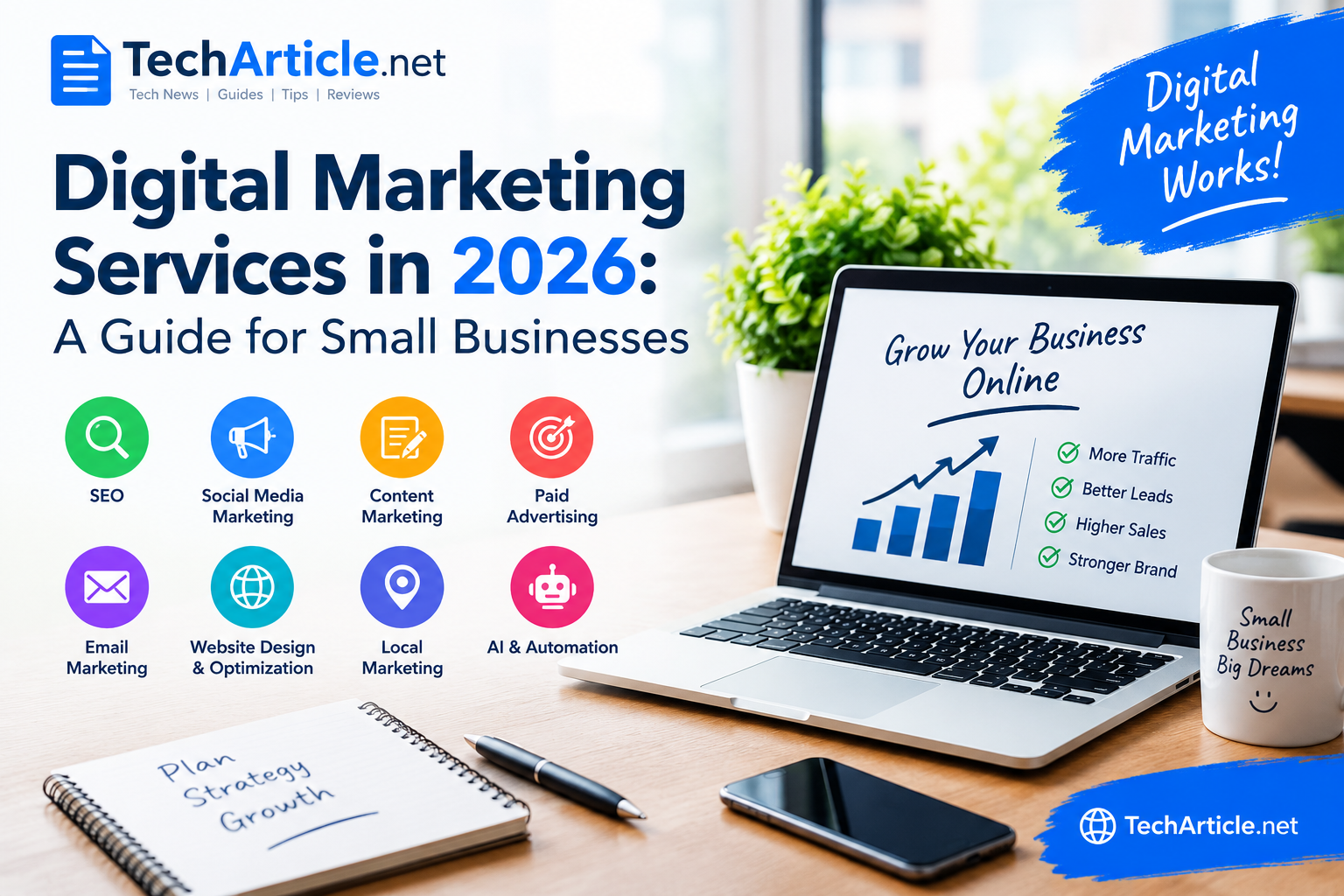
Running a small business means wearing many hats. You manage customers, suppliers, finances, and staff, and somewhere in between you are expected to find new customers too. Digital marketing is how most small businesses now do that, but the range of services, tools, and agencies on offer can feel overwhelming.
This guide explains the main digital marketing services available in 2026, what each one does, who it suits, and how to choose where to spend your limited budget. It also covers how to hire a provider wisely and how to measure whether your marketing is working. The advice is general, so adapt it to your industry, location, and goals.
Why Digital Marketing Matters for Small Businesses
Customers research before they buy. They search online, compare options, read reviews, and ask friends on social platforms or messaging apps. If your business is invisible in those moments, you lose sales to competitors who show up.
Digital marketing also gives small businesses something traditional advertising rarely did: control and clarity. You can start with a modest budget, target a specific audience or neighborhood, and see which efforts bring results. That makes it possible for a local shop to compete with a much larger brand in the areas that matter most.
That said, digital marketing is not magic. It works best when you have a good product or service, a clear message, and realistic expectations. No provider can guarantee overnight success, and results typically build over time.
1. Website Design and Optimization
Almost every other marketing effort points back to your website, which makes it the foundation. A strong small business website should:
- Explain clearly what you do, who you serve, and how to contact you.
- Load quickly and work well on mobile phones.
- Show trust signals such as real photos, customer testimonials, certifications, and clear policies.
- Make the next step obvious, whether that is calling, booking, requesting a quote, or buying.
You do not need a huge or complicated site. A simple, fast, honest website often outperforms an elaborate one that confuses visitors. Make sure you own your domain name and that your site is secure, backed up, and kept up to date.
2. Search Engine Optimization (SEO)
SEO helps your website appear when people search for what you offer. It remains one of the most valuable long-term services because it brings in people who are already looking for a solution.
SEO for small businesses usually involves:
- Keyword and topic research to understand what your customers actually search for.
- On-page improvements, such as clear page titles, helpful headings, and well-organized content.
- Technical fixes, including site speed, mobile usability, and a clean structure that search engines can crawl.
- Content creation that answers real customer questions.
- Link building through genuine relationships, such as local partnerships, directories, and press mentions.
Google’s guidance is clear that content should be helpful, reliable, and written for people rather than search engines. Tactics like keyword stuffing, buying links, or publishing masses of low-quality pages can violate spam policies and harm your visibility. Be skeptical of anyone promising a guaranteed first-place ranking, because no one outside Google can promise that.
SEO is a slow burn. It often takes months to see meaningful movement, but the benefits can last far longer than paid campaigns.
3. Local SEO and Google Business Profile Management
If you serve customers in a specific area, local visibility may be the single most important marketing service you can buy. When someone searches for a plumber, café, dentist, or tailor “near me,” local results and map listings often appear first.
Strong local SEO includes:
- A complete and accurate Google Business Profile with the right categories, hours, photos, services, and contact details.
- Consistent business name, address, and phone number across directories and your website.
- A steady flow of genuine customer reviews, along with polite, professional replies to all of them.
- Location-specific pages or content that reflect the areas you serve.
Never buy fake reviews or ask friends to post reviews for services they did not receive. This violates platform policies and can lead to removed listings or penalties.
4. Content Marketing
Content marketing means creating useful material that attracts and educates potential customers. That may be blog articles, how-to guides, videos, case studies, FAQs, or newsletters.
For a small business, the most effective content usually comes from real experience. A bakery can share how to store a celebration cake. An accountant can explain what records to keep before tax season. A mechanic can show warning signs of brake problems. This kind of content demonstrates expertise, builds trust, and gives people a reason to choose you.
A few principles keep content effective:
- Be specific. Answer one question thoroughly instead of writing vaguely about many topics.
- Show experience. Original photos, examples, and insights from your own work stand out.
- Keep it current. Review and update older pieces regularly.
- Use AI tools carefully. They can help with outlines, editing, and ideas, but unreviewed mass-produced text created only to manipulate rankings goes against Google’s spam policies. Always have a person check facts and add real value.
5. Social Media Marketing
Social platforms let you build awareness, show your personality, and talk directly with customers. The key is to choose platforms where your audience actually spends time rather than trying to be everywhere.
A restaurant or boutique may thrive on visual platforms with short videos and photos. A consultant or B2B service may do better on professional networks. A local service business may benefit from community groups and messaging apps.
Good social media management involves:
- A consistent look, tone, and posting rhythm that you can realistically maintain.
- A mix of helpful, entertaining, and promotional content, not just constant sales pitches.
- Prompt replies to comments and messages.
- Short-form video, which continues to be a highly engaging format.
- Paying attention to which posts spark real conversations, not just likes.
Authenticity matters more than polish. Behind-the-scenes content, staff introductions, and real customer stories often perform better than glossy advertisements.
6. Paid Advertising (PPC and Social Ads)
Paid advertising offers speed. While SEO builds slowly, ads can put your business in front of interested people almost immediately.
Common formats include search ads, social media ads, display and video ads, and local campaigns. Search ads tend to work well for businesses where people actively look for a service. Social ads are better for introducing your brand to people who match your ideal customer profile.
To avoid wasting money:
- Set a clear goal, such as phone calls, bookings, form submissions, or online sales.
- Start with a small, controlled budget and test different messages and audiences.
- Send people to a focused landing page, not just your homepage.
- Track conversions properly so you know which ads produce real customers.
- Review results regularly and pause what is not working.
Be careful with providers who take large management fees but do not share account access or reports. You should own your ad accounts and be able to see exactly where your money goes.
7. Email and SMS Marketing
Email remains one of the most cost-effective ways to stay in touch with customers because you are speaking to people who already know you. Unlike social media, you are not at the mercy of an algorithm.
Practical uses include welcome messages for new subscribers, appointment reminders, special offers for loyal customers, product updates, and helpful newsletters. Text message marketing can work for time-sensitive reminders and promotions, but it requires extra care.
Always follow the privacy and anti-spam rules that apply where your customers live. In general, that means getting clear permission before sending marketing messages, being honest in subject lines, and including an easy way to unsubscribe. Respecting these basics protects your reputation as well as your legal standing.
8. Online Reputation Management
Reviews and ratings strongly influence buying decisions. Reputation management is the process of encouraging honest feedback, monitoring what people say about you, and responding professionally.
A simple approach works well for most small businesses:
- Ask satisfied customers to leave a review after a completed job or purchase.
- Reply to positive reviews with thanks and to negative reviews with calm, constructive responses.
- Fix recurring issues that reviews reveal.
- Never argue publicly, and never write or buy fake reviews.
A negative review handled gracefully can actually build trust, because it shows prospective customers how you treat people when things go wrong.
9. Marketing Automation and AI Tools
Small teams can save significant time by automating repetitive tasks. Examples include scheduling social posts, sending follow-up emails after an inquiry, tagging leads in a customer database, and answering common questions through a chat assistant.
AI tools are increasingly built into marketing platforms, helping with drafting, analysis, and reporting. They are useful assistants, but they work best with human oversight. Check outputs for accuracy, keep your brand voice consistent, and be careful about entering private customer data into tools without understanding how that data is handled. Customers value being able to reach a real person, so keep that option available.

10. Analytics and Reporting
You cannot improve what you do not measure. Basic analytics should show how many people visit your site, where they come from, what they do, and how many take action. Search performance tools show which queries bring people to you, and advertising dashboards show costs and conversions.
For small businesses, a few key numbers are usually enough:
- Number of leads or sales generated.
- Cost to acquire each customer.
- Conversion rate of your website or landing pages.
- Return on ad spend.
- Which channels bring the best customers, not merely the most visitors.
A good provider will translate these numbers into plain language and explain what they mean for your business.
How to Decide Where to Start
Small budgets require focus. A sensible sequence for many businesses looks like this:
- Fix the foundation. Make sure your website is clear, mobile-friendly, and fast, and that your contact details are easy to find.
- Claim your local presence. Set up and optimize your Google Business Profile and collect reviews.
- Set up measurement. Install analytics and conversion tracking.
- Create helpful content and improve SEO. Build long-term visibility.
- Add paid ads for faster results. Start small and scale what works.
- Nurture customers. Use email and loyalty efforts to bring people back.
A local service company might put most of its effort into local SEO, reviews, and a small search ad budget. An online store might invest more in ads, email, and conversion improvements. A professional consultant might focus on content and professional networking. There is no universal formula, so match your spending to where your customers actually are.
How to Choose a Reliable Provider
Whoever you hire, look for these qualities:
- Transparency. They explain what they will do, how, and why, in plain language.
- Relevant examples. They can share case studies or references, ideally from similar businesses.
- Realistic promises. Be wary of guaranteed rankings, instant results, or claims that sound too good to be true.
- Clear reporting. You receive regular updates showing meaningful results.
- Ethical methods. They do not use spam, fake reviews, or paid-link schemes.
- Ownership. You keep control of your domain, website, ad accounts, and content.
- Fair contracts. Terms are clear, and you are not locked in without an easy way out.
Ask questions before signing. How will you measure success? Who will actually do the work? What happens if results fall short? Good providers welcome these questions.
Frequently Asked Questions
How much should a small business spend on digital marketing? There is no fixed number. It depends on your industry, goals, and margins. Start with an amount you can sustain, track results, and adjust.
How long before I see results? Paid ads can bring traffic quickly, while SEO and content often take several months. Local improvements, such as an optimized business profile, can sometimes show results sooner.
Is SEO still worth it as AI-generated answers grow? Yes. People continue to search, and helpful, trustworthy, well-structured content remains valuable both in traditional results and in AI-assisted experiences.
Can I do digital marketing myself? Yes, to a point. Many owners handle social media and reviews themselves, then outsource technical tasks as the business grows.
What is the most important first step? A clear, trustworthy website and an accurate local business listing. Everything else builds on those.
Conclusion
Digital marketing in 2026 is less about tricks and more about trust. Businesses that show up where customers search, explain what they offer honestly, respond quickly, and deliver on their promises tend to grow steadily.
You do not need every service in this guide. Start with the basics, measure what happens, and add new efforts one at a time. Choose providers who are transparent and realistic, keep ownership of your accounts, and focus on genuinely helping your customers. With a patient, practical approach, even a small business can build a strong and lasting online presence.
