


Not long ago, “automation” in a company mostly meant scripts that ran on a schedule or software that followed fixed, predictable rules. In 2026, that’s changed in a big way. Businesses are now deploying autonomous systems AI agents that can reason, make decisions, and take real action across company systems with very little human involvement at each step.
This shift is exciting because of what it enables: faster operations, fewer manual bottlenecks, and security teams that can finally keep pace with attackers who’ve been using automation for years. But it’s also creating a completely new category of risk that most companies are still figuring out how to manage. When software can act on its own logging into systems, moving data, making decisions, even talking to other AI systems the old rules of digital security don’t fully apply anymore.
This article looks at what’s actually changing, why autonomous systems are becoming such a big deal in security conversations, and what the “new rules” for protecting them actually look like.
What Makes a System “Autonomous,” and Why It’s Different
There’s an important difference between traditional automation and true autonomy. A traditional automated script does exactly what it’s told, in a fixed sequence, with no real judgment involved. An autonomous AI agent is different — it can interpret a goal, decide how to reach it, adapt when something unexpected happens, and interact with multiple systems along the way, often without a human checking each individual step.
This is often called “agentic AI.” Instead of just answering a question or generating text, an agentic system can actually do things access a database, send a message, adjust a setting, or trigger another process, chaining several actions together to complete a task. That’s incredibly useful for productivity, but it also means these systems now behave less like software and more like digital employees employees that never sleep, never get tired, and can act at machine speed.
Why This Is Becoming a Security Priority Right Now
The scale of this shift is bigger than most people realize. Some industry forecasts now describe workplaces where autonomous agents and machine identities significantly outnumber actual human employees. That means most of the “activity” happening inside a company’s digital systems today isn’t a person clicking around anymore — it’s software acting on a person’s behalf, or acting entirely on its own initiative within the boundaries it’s been given.
This creates a genuinely new kind of exposure. An autonomous agent that’s been given broad access to sensitive systems because it needed that access to do its job becomes a serious risk if it’s ever misconfigured, tricked, or hijacked. Unlike a single human making a single mistake, a compromised autonomous agent can carry out actions across many systems very quickly, and because it’s “supposed” to be operating there, its actions might not raise the same immediate red flags a suspicious human login would.
Autonomous Agents as a New Kind of Insider Threat
One of the more uncomfortable realities security teams are grappling with in 2026 is that autonomous agents essentially function as a new category of insider threat — not because they’re malicious, but because of what happens if they’re compromised or poorly controlled.
An autonomous agent is, by design, “always-on” and often trusted implicitly once it’s set up, since it was built to complete tasks without constant supervision. If that agent has been given privileged access to APIs, data, or critical systems, and something goes wrong — a bug, a manipulation attempt, or an attacker exploiting the agent’s own logic — the consequences can spread fast, and the human security team may not even notice right away, because everything the agent did technically fell within the access it was granted.
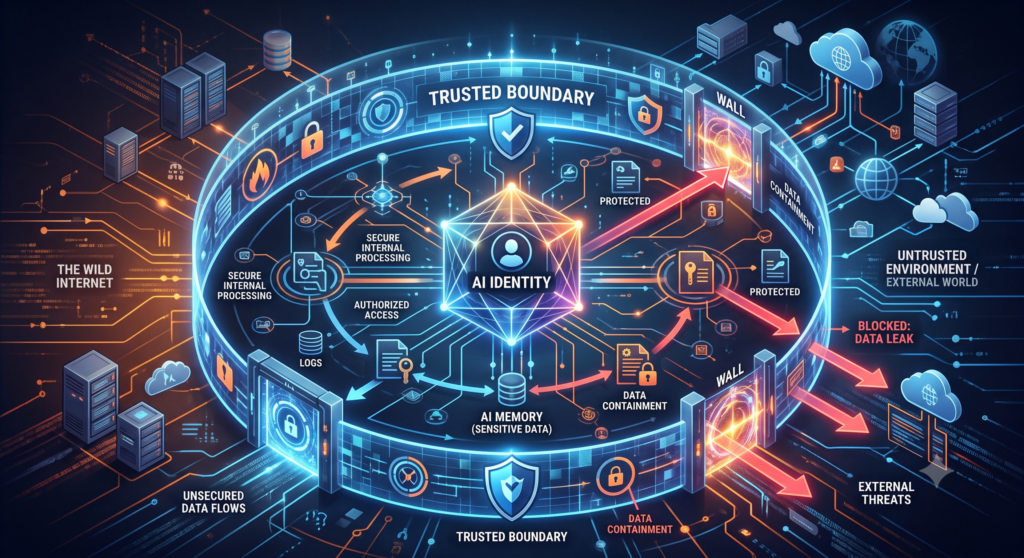
This is a fundamentally different risk model than traditional cybersecurity was built around, and it’s why security experts are pushing hard for organizations to treat every autonomous agent as its own identity that needs to be verified, restricted, and monitored not as a background tool that can be set up once and left alone.
The New Rule #1: Treat AI Agents as Identities, Not Tools
Traditional identity and access management was built with a simple assumption: a “user” is a human being, logging in with credentials, doing recognizably human things. That assumption breaks down completely with autonomous systems.
The emerging standard in 2026 is to treat every AI agent as its own distinct digital identity, with clearly defined permissions, activity logs, and access boundaries the same rigor that would be applied to a new employee, not a background process. This means agents don’t get broad, permanent access “just in case.” They get scoped access tied specifically to what they actually need to do, reviewed and adjusted regularly as their role changes.
The New Rule #2: Continuous Verification, Not One-Time Trust
Older security models often worked on a “trust once, allow forever” basis — once a device or account passed an initial check, it stayed trusted going forward. That doesn’t hold up when the thing you’re trusting can act thousands of times a minute.
This is part of why Zero Trust principles — where nothing is automatically trusted and everything is continuously verified — have become central to securing autonomous systems specifically. Every action an agent takes, every system it touches, gets evaluated in real time based on context: is this normal behavior for this agent, is this access request consistent with its role, does anything here look off. It’s a shift from “checking the door once” to “watching every room, all the time.”
The New Rule #3: Govern the Agents, Not Just the Data
A newer concept gaining traction is sometimes described as an “AI firewall” — a dedicated layer of security specifically built to monitor and restrict what AI systems and AI agents are allowed to do, separate from traditional data-focused security tools. The idea is straightforward: since autonomous systems can take actions, not just access information, they need governance around their behavior, not just their data access.
This includes things like setting hard boundaries on what actions an agent is allowed to take without human approval, flagging unusual sequences of actions (even if each individual action looks fine on its own), and building in “kill switches” that can immediately pause or shut down an agent’s activity if something looks wrong.


The Speed Advantage And Why It Cuts Both Ways
Here’s something worth sitting with: research comparing organizations shows that companies using AI-driven security automation identify and contain breaches dramatically faster than those relying on manual processes — differences measured in months, not days, and translating into millions of dollars saved per incident on average. Autonomous security operations are quickly becoming the standard for large enterprises, not because it’s trendy, but because manual, human-only monitoring simply can’t keep up with attacks that are themselves increasingly automated.
But this speed advantage cuts both ways. Attackers are deploying their own autonomous agents to scan for vulnerabilities, craft convincing social engineering attempts, and execute multistep attacks with very little human involvement on their end either. Some security researchers now describe this as an arms race between autonomous attackers and autonomous defenders, where the organizations that fall behind on adopting and properly governing their own autonomous defenses are at a real structural disadvantage.
Post-Quantum and Long-Term Risk Planning
Alongside the rise of autonomous systems, another “new rule” shaping digital security in 2026 is preparing for long-term cryptographic risk — specifically, the eventual arrival of quantum computers powerful enough to break today’s standard encryption. This isn’t an immediate crisis, but forward-looking organizations are already beginning to assess which of their systems will need to be upgraded to quantum-resistant standards, since the transition itself will take years to complete properly.
This matters for autonomous systems specifically because so much of their operation depends on secure authentication and encrypted communication between agents, systems, and data sources. If that underlying cryptography weakens over time, the entire trust structure autonomous systems rely on weakens with it.
What Organizations Are Actually Doing Differently
Pulling these threads together, a few practical shifts stand out in how security-conscious organizations are approaching autonomous systems in 2026:
They’re building dedicated governance frameworks specifically for AI agents, separate from traditional IT policy, since the risks and behaviors are genuinely different. They’re limiting agent permissions tightly, following the same “least privilege” principle long used for human employees, rather than granting broad access for convenience. They’re investing in continuous monitoring tools built to understand agent behavior patterns, not just human login patterns. And critically, they’re keeping humans in the loop for high-stakes decisions, even as more routine work gets handed over to autonomous systems treating full autonomy as something to earn gradually through demonstrated reliability, not something to grant by default.
The Bottom Line
Autonomous systems are becoming a permanent, central part of how businesses operate and the security models built for a world of human users and static software simply weren’t designed for software that can think, decide, and act on its own. The organizations succeeding in 2026 aren’t the ones avoiding autonomous systems out of caution, nor the ones deploying them recklessly for speed. They’re the ones building real governance around agent identity, access, and behavior from the start treating autonomy as a powerful capability that has to be earned and continuously verified, not something to hand over blindly.

FAQs
Q1: What’s the real difference between traditional automation and autonomous AI agents? Traditional automation follows a fixed set of rules with no real decision-making involved. Autonomous AI agents can interpret goals, adapt to unexpected situations, and take multiple actions across different systems with little to no human input at each step — which is what makes them powerful, and also what makes them a new kind of security risk.
Q2: Why are autonomous agents considered a security risk if they’re not malicious? The risk usually isn’t the agent’s intent — it’s what happens if the agent is misconfigured, manipulated, or compromised. Since agents often have real access to sensitive systems and act quickly and continuously, a single compromised agent can cause widespread damage before anyone notices, especially if its actions technically fall within the access it was given.
Q3: What does it mean to treat an AI agent as an “identity”? It means giving each autonomous agent its own defined access permissions, activity logs, and boundaries — similar to how a company manages a human employee’s account — instead of treating it as a background tool with broad, unmonitored access.
Q4: Are autonomous security systems actually faster at stopping attacks than human teams? Yes, generally. Research comparing organizations shows that companies using AI-driven security automation identify and contain breaches significantly faster than those relying on manual monitoring, which also tends to reduce the financial cost of incidents.
Q5: Should smaller companies worry about autonomous system security, or is this only a big enterprise issue? It’s relevant to any company using AI agents or automation tools connected to sensitive systems, regardless of size. Smaller companies may have fewer resources for dedicated governance, which makes it even more important to keep agent permissions limited and reviewed regularly rather than granting broad access for convenience.