
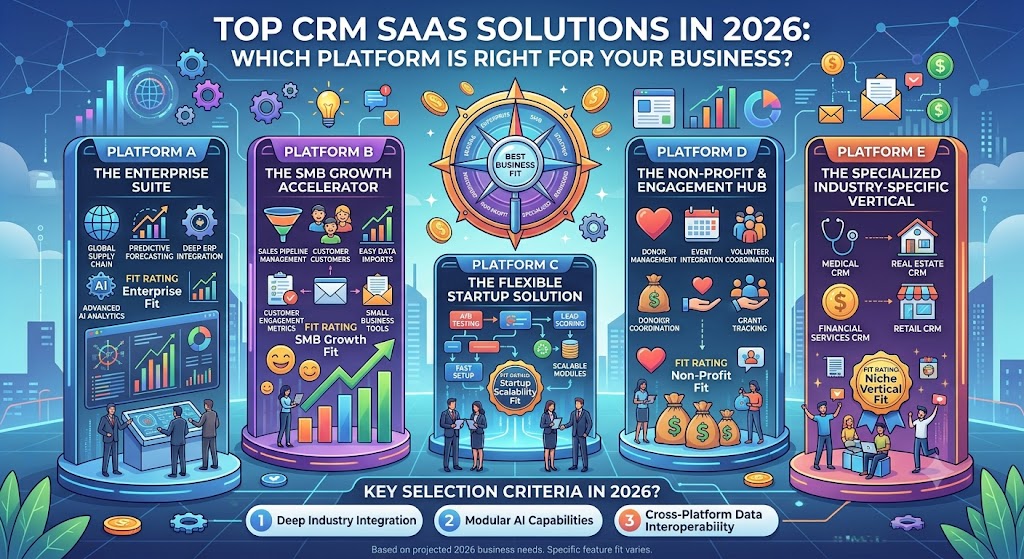
Choosing a CRM used to be a straightforward decision: pick the tool with the most features and the biggest brand name. That approach doesn’t work anymore. The global CRM market is projected to reach roughly $88.7 billion in 2026, which means hundreds of platforms now offer broadly similar core functionality contact management, pipeline tracking, and reporting but very different operating logic underneath.
The real differentiator in 2026 isn’t feature count. It’s fit. AI copilots, predictive forecasting, and workflow automation are now standard across nearly every serious CRM. What separates a good choice from a bad one is whether the platform matches how your business actually sells and serves customers not how impressive the demo looked.
This guide compares the CRM platforms that matter most in 2026, breaks down pricing and ideal use cases, and gives you a practical framework for choosing the right one.
What Actually Matters When Choosing a CRM in 2026
Before comparing specific platforms, it helps to understand the criteria that separate a CRM that gets adopted from one that quietly dies six months after rollout:
- Fit with your sales model. A high-touch enterprise sales team has completely different needs than an ecommerce brand or a solo agency owner. The “best” CRM is the one built around your actual customer journey.
- Total cost of ownership. Per-seat pricing looks simple until you factor in add-ons, premium automation tiers, and implementation costs all of which vary enormously between platforms.
- Native integrations. A CRM that doesn’t talk to your email platform, calendar, or existing tools creates data silos that undermine the entire point of having one system of record.
- AI and automation depth. Lead scoring, deal summaries, predictive forecasting, and next-best-action recommendations are now expected features, not premium extras but the quality of these tools varies significantly by vendor.
- Adoption and ease of use. CRM implementations most commonly fail not because of the software itself, but because of poor planning, weak training, and low user adoption. A powerful CRM your team won’t use is worse than a simple one they will.
1. Salesforce Best for Large, Complex Sales Organizations
Salesforce remains the most recognized name in CRM, and for good reason: it is a fully customizable, cloud-based platform that unifies sales, service, marketing, and commerce data in one system, backed by deep AI and analytics capabilities. With roughly 150,000 direct customers and over 300,000 organizations using some form of Salesforce product, it has the largest ecosystem of any CRM on the market.
Why it’s a strong choice: Salesforce’s depth in sales automation, lead scoring, forecasting, and configure-price-quote (CPQ) functionality is generally considered unmatched among competitors. Its App Exchange marketplace offers thousands of third-party integrations and add-ons, meaning there’s almost no business process you can’t eventually build inside it.
Where it falls short: That depth comes at a cost both financially and in implementation complexity. Entry-level plans start around $25 per user per month, but pricing climbs quickly as you add advanced modules, and enterprise-grade plans can run $150–$350 per user per month. Implementation typically requires dedicated administrators or outside consultants.
Best for: Large enterprises and fast-scaling companies that need extensive customization and can invest in proper implementation.
2. HubSpot Best for Growing B2B Companies
HubSpot has evolved from a marketing tool into a full CRM platform that unifies sales, marketing, and customer service under one roof, connected by its Smart CRM. Its biggest strength is how naturally sales and marketing data flow together, since both live in the same system rather than being stitched together through integrations.
Why it’s a strong choice: For B2B companies with defined sales pipelines and a sales team that needs deep visibility into prospect behavior, HubSpot’s pipeline management and CRM functionality are considered among the best in the mid-market. The platform scales from a genuinely useful free tier up to enterprise-grade functionality without requiring a full platform migration as you grow.
Where it falls short: Costs rise substantially once you move beyond the free and starter tiers, particularly if you need marketing, sales, and service hubs simultaneously.
Best for: B2B companies with active sales teams that want deep CRM functionality tightly integrated with marketing.
3. Zoho CRM Best Value for Small and Mid-Sized Businesses
Zoho CRM consistently ranks as one of the most affordable full-featured CRMs on the market, with entry-level plans starting around $9–$14 per user per month. Despite the low price point, it includes AI-assisted lead scoring, workflow automation, and a large library of native integrations across Zoho’s broader software suite.
Why it’s a strong choice: For cost-conscious small and mid-sized businesses, Zoho offers a rare combination of genuine functionality and low total cost of ownership. If your business already uses other Zoho products (finance, HR, project management), the integration between them is especially seamless.
Best for: Small to mid-sized businesses that want strong core CRM functionality without enterprise pricing.
4. Microsoft Dynamics 365 Sales Best for Microsoft-Centric Organizations
Dynamics 365 Sales has matured considerably and, in 2026, shines brightest for organizations already embedded in the Microsoft ecosystem. Its native integration with Teams, Outlook, SharePoint, Power BI, and LinkedIn Sales Navigator creates a level of connectivity that’s difficult for other CRMs to match in Microsoft-heavy environments.
Why it’s a strong choice: Copilot AI is built directly into the workflow, generating deal summaries and predictive forecasts inside tools your team is already using daily, which meaningfully reduces the friction of adopting a new system. Mid-tier pricing typically runs $65–$105 per user per month.
Best for: Enterprises and mid-sized businesses already standardized on Microsoft 365, Teams, and Outlook.

5. Pipedrive Best for Sales-Focused Teams That Want Simplicity
Pipedrive was built specifically around the sales pipeline, and it shows the interface is visual, intuitive, and focused almost entirely on moving deals forward rather than managing every possible business process. It includes AI-powered sales assistance, automated correspondence, and real-time forecasting.
Why it’s a strong choice: Teams that find Salesforce or HubSpot overwhelming often gravitate toward Pipedrive because it does fewer things, but does them well. Setup time is typically much shorter than more complex platforms.
Best for: Small to mid-sized sales teams that want a fast, visual pipeline tool without a heavy learning curve.
6. Freshsales Best for Fast, Affordable Sales Automation
Freshsales (part of the Freshworks suite) offers a strong balance of affordability and built-in AI, with entry-level pricing similar to Zoho’s typically in the $9–$14 per user per month range. It includes built-in phone and email, AI-based lead scoring, and deal insights out of the box.
Best for: Small businesses and startups that want sales automation without a long setup process or a large budget.
7. GoHighLevel Best for Agencies and Multi-Client Businesses
GoHighLevel has carved out a distinct niche as the CRM of choice for marketing agencies and service-based businesses managing multiple clients or brands from a single account. It offers a highly customizable, white-label-friendly platform at a fraction of the cost of enterprise alternatives.
Why it’s a strong choice: Agencies can build and resell CRM functionality under their own brand, run automated client workflows, and manage multiple pipelines without needing separate accounts per client. It trades some polish and native integration breadth for flexibility and cost efficiency.
Best for: Marketing agencies and multi-client service businesses that need flexible, resellable CRM workflows.
8. Klaviyo (as a CRM layer) Best for Ecommerce and DTC Brands
While best known as an email and SMS marketing platform, Klaviyo increasingly functions as a lightweight CRM for ecommerce and direct-to-consumer brands by unifying customer data, purchase history, and lifecycle segmentation in one place.
Why it’s a strong choice: For ecommerce businesses, a traditional sales-pipeline CRM often creates friction because customers don’t move through a linear sales process the way B2B leads do. Klaviyo’s data model is built around actual purchase behavior instead, which tends to match how ecommerce businesses really operate.
Best for: Ecommerce and DTC brands that need unified customer data and lifecycle marketing more than a traditional sales pipeline.
Quick Comparison Table
Platform |
Best For |
Starting Price (per user/month) |
Standout Strength |
|---|---|---|---|
Salesforce |
Large, complex enterprises |
~$25 (rises steeply) |
Unmatched customization and depth |
HubSpot |
Growing B2B companies |
Free tier; paid tiers scale up |
Native sales + marketing integration |
Zoho CRM |
Small/mid-sized businesses |
~$9–$14 |
Best value for full features |
Microsoft Dynamics 365 |
Microsoft-centric organizations |
~$65–$105 |
Deep Teams/Outlook/Power BI integration |
Pipedrive |
Sales-focused small teams |
Mid-range |
Visual, simple pipeline management |
Freshsales |
Startups and small businesses |
~$9–$14 |
Fast setup, built-in AI |
GoHighLevel |
Agencies, multi-client businesses |
Flat-rate, budget-friendly |
White-label, resellable workflows |
Klaviyo |
Ecommerce and DTC brands |
Usage-based |
Unified customer + purchase data |
How to Choose the Right CRM for Your Business
- Map your customer journey first. Understand how customers actually move from lead to sale (or first purchase to repeat purchase) before evaluating any platform. The right CRM should match that journey, not force you into someone else’s sales model.
- Calculate total cost of ownership, not just sticker price. Factor in per-seat costs at your expected team size, premium automation tiers, implementation support, and any required add-ons.
- Prioritize integrations with your existing stack. A CRM that doesn’t connect cleanly to your email, calendar, or ecommerce platform will create more manual work than it saves.
- Don’t overbuy complexity. Many businesses pay for enterprise-grade CRM capability they’ll never fully use, then spend months trying to force their operations into the platform’s assumptions. Match the tool to your current scale, with room to grow not your five-year aspirational scale.
- Plan for adoption, not just implementation. Since most CRM failures come down to poor training and low user adoption rather than the software itself, budget time and resources for onboarding your team properly, regardless of which platform you choose.
Final Verdict
There’s no universal “best” CRM in 2026 only the best fit for your specific business model:
- Large enterprises with complex sales processes: Salesforce remains the deepest, most customizable option.
- Growing B2B companies: HubSpot offers the strongest balance of sales and marketing integration.
- Cost-conscious small and mid-sized businesses: Zoho CRM and Freshsales deliver strong functionality without enterprise pricing.
- Microsoft-based organizations: Dynamics 365 Sales provides integration no competitor can fully replicate.
- Simplicity-focused sales teams: Pipedrive keeps the pipeline front and center without unnecessary complexity.
- Agencies and multi-client businesses: GoHighLevel offers flexible, resellable workflows at a reasonable cost.
- Ecommerce and DTC brands: Klaviyo’s unified customer data model fits non-linear buying behavior better than traditional pipeline CRMs.
The businesses that get the most value from a CRM in 2026 aren’t the ones with the most expensive platform — they’re the ones that chose a tool matching how they actually work, then committed to proper adoption and training.
Frequently Asked Questions (FAQ)
Q1. What is the best CRM software for small businesses in 2026? Zoho CRM and Freshsales are generally the best starting points for small businesses, with entry-level pricing around $9–$14 per user per month and strong core functionality including AI-assisted lead scoring and workflow automation, without the complexity or cost of enterprise platforms.
Q2. Which CRM is best for large enterprises? Salesforce remains the top choice for large, complex sales organizations due to its unmatched customization, depth in sales automation and forecasting, and its extensive App Exchange marketplace of third-party integrations. However, it requires a bigger budget and typically dedicated administrators to implement well.
Q3. Is HubSpot or Salesforce better for a growing business? It depends on complexity and budget. HubSpot tends to be easier to adopt and offers tighter native integration between sales and marketing, making it a strong fit for growing B2B companies. Salesforce offers greater long-term customization and depth but comes with a steeper learning curve and higher cost, making it better suited to businesses with more complex, established sales operations.
Q4. How much does CRM software typically cost in 2026? Pricing varies widely by tier: entry-level plans typically run $9–$14 per user per month (Zoho, Freshsales), mid-tier plans run $65–$105 per user per month (Microsoft Dynamics 365), and enterprise-grade plans can reach $150–$350 per user per month (Salesforce), not including implementation or add-on costs.
Q5. Which CRM integrates best with Microsoft 365 and Teams? Microsoft Dynamics 365 Sales is the strongest option for Microsoft-centric organizations. It natively integrates with Teams, Outlook, SharePoint, Power BI, and LinkedIn Sales Navigator, and includes Copilot AI for deal summaries and predictive forecasting directly inside tools teams already use daily.
Q6. Why do CRM implementations fail? CRM implementations most commonly fail due to poor planning, inadequate user training, and low adoption not because of flaws in the platform itself. Choosing the right tool matters, but budgeting time and resources for proper onboarding is just as important to long-term success.
Q7. Is a traditional CRM necessary for an ecommerce business? Not always in the traditional sense. Many ecommerce and DTC brands get more value from unified customer-data platforms like Klaviyo, which are built around actual purchase behavior and lifecycle segmentation rather than a linear B2B sales pipeline that doesn’t reflect how online shoppers actually buy.
Q8. Which CRM is best for agencies managing multiple clients? GoHighLevel is specifically built for this use case, offering a customizable, white-label-friendly platform that lets agencies manage multiple client pipelines and automated workflows from a single account, at a significantly lower cost than enterprise alternatives.
