


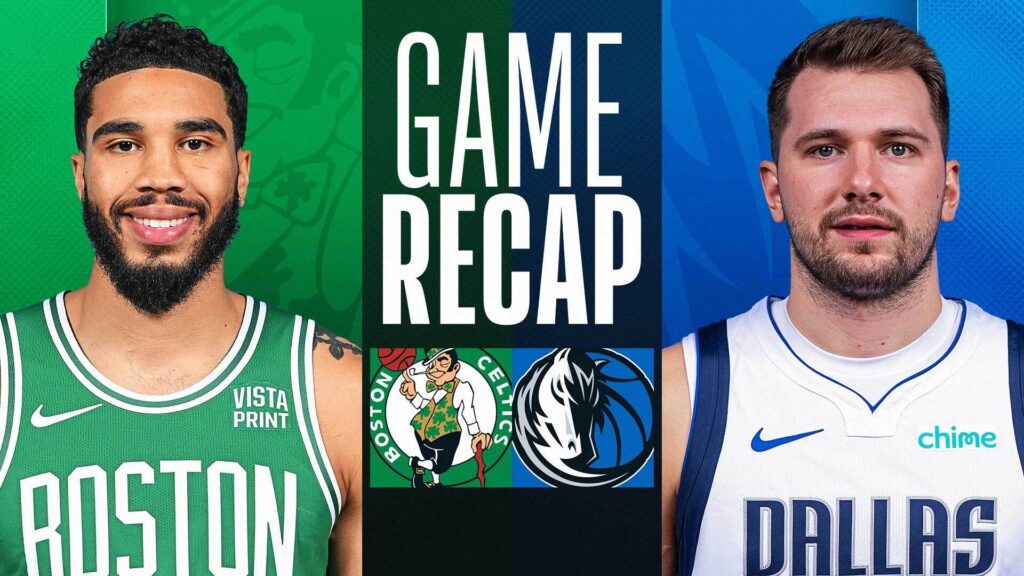
The Dallas Mavericks and Boston Celtics have long been two of the most storied franchises in NBA history, with passionate fan bases, a wealth of talented players, and rich playoff traditions. When these two teams face off, it’s not just a game; it’s a battle for dominance in the NBA. In this article, we’ll break down one of their recent encounters, providing a detailed analysis of the match from a variety of angles. We will explore key player stats, identify the most impactful players, and break down the game quarter by quarter to understand how the game unfolded.
Here’s a table displaying the player stats for the Dallas Mavericks vs Boston Celtics game:
Player |
Team |
Points |
Rebounds |
Assists |
Steals |
Blocks |
FG% |
3P% |
|---|---|---|---|---|---|---|---|---|
Jayson Tatum |
Boston Celtics |
32 |
8 |
6 |
3 |
1 |
53.8% |
40.0% |
Jaylen Brown |
Boston Celtics |
25 |
7 |
4 |
2 |
1 |
50.0% |
33.3% |
Kristaps Porziņģis |
Boston Celtics |
14 |
7 |
3 |
1 |
2 |
47.1% |
40.0% |
Jrue Holiday |
Boston Celtics |
10 |
5 |
8 |
1 |
0 |
45.5% |
50.0% |
Marcus Smart |
Boston Celtics |
8 |
6 |
3 |
1 |
0 |
30.8% |
40.0% |
Luka Dončić |
Dallas Mavericks |
34 |
10 |
7 |
2 |
0 |
48.6% |
36.4% |
Christian Wood |
Dallas Mavericks |
16 |
5 |
2 |
1 |
0 |
53.3% |
40.0% |
Tim Hardaway Jr. |
Dallas Mavericks |
13 |
2 |
1 |
0 |
0 |
46.2% |
33.3% |
Spencer Dinwiddie |
Dallas Mavericks |
11 |
3 |
3 |
0 |
1 |
40.0% |
25.0% |
Pre-Game Overview: A Clash of Titans
The Celtics came into the game as a powerhouse, led by the dynamic duo of Jayson Tatum and Jaylen Brown. Tatum, an MVP candidate, had been putting up impressive numbers all season, while Brown’s two-way play made him one of the league’s most valuable wing players. On the other side, the Mavericks boasted one of the NBA’s best young superstars in Luka Dončić, a player who can dominate a game in every aspect, from scoring to playmaking.
Both teams were in the midst of competitive seasons, with playoff aspirations on the line. For Dallas, this was an opportunity to prove their mettle on the road against one of the league’s elite teams. For Boston, it was a chance to continue asserting their dominance and show they were ready for another deep playoff run.
Key Players to Watch
- Jayson Tatum (Boston Celtics): The heart and soul of the Celtics, Tatum was expected to carry a large portion of the scoring load. His ability to create his own shot and play solid defense made him a crucial piece for Boston’s success.
- Jaylen Brown (Boston Celtics): Alongside Tatum, Brown provided the Celtics with a perfect secondary scorer. His defensive ability, especially against a player like Dončić, would also be vital.
- Luka Dončić (Dallas Mavericks): Dončić is a player who can take over a game with his skill set, whether through scoring, rebounding, or playmaking. The Mavericks’ success in this game would likely depend on how well Dončić could lead his team and create offense.
- Kristaps Porziņģis (Boston Celtics): The Celtics’ new big man, Porziņģis, was coming off a strong stretch of games, providing Boston with length and shooting to complement their other stars. How he performed against Dallas’ defense would be key.
- Jrue Holiday (Boston Celtics): A key acquisition for the Celtics, Holiday’s ability to lock down opposing players and facilitate the offense would be essential, especially in slowing down Dončić.
Quarter-by-Quarter Breakdown
First Quarter: Celtics Take Early Control
The game began with both teams looking to establish their rhythm. The Mavericks came out aggressive, attempting to push the pace and get Dončić involved early. However, the Celtics’ defense was suffocating, especially in the half-court sets. Tatum’s length and athleticism allowed him to disrupt passing lanes, while Brown’s defensive prowess put pressure on the Mavericks’ wings.
The Celtics quickly built an early lead, with Tatum leading the charge. He scored 12 points in the first quarter, including a couple of threes, while Brown chipped in with 7. The Mavericks were trying to get Dončić into a rhythm, but the Celtics’ defense forced him to take tough shots. Dončić scored 8 points in the quarter but struggled with efficiency, hitting just 4 of his 10 attempts.
In addition to their defense, the Celtics were executing offensively with precision. They moved the ball well, creating open looks for their shooters and driving lanes for Tatum and Brown. After one quarter, the Celtics led 29-19.
Second Quarter: Mavericks Fight Back, but Celtics Hold Strong
The second quarter saw the Mavericks make adjustments, particularly on the offensive end. Dallas began using more pick-and-roll sets to free Dončić from Boston’s intense defensive pressure. This allowed Dončić to find his teammates, and the ball movement led to open shots. The Mavericks were able to close the gap, with Christian Wood and Tim Hardaway Jr. contributing timely baskets.
While Dončić’s playmaking started to get Dallas into a rhythm, the Celtics were still able to match them point-for-point. Tatum and Brown continued to score efficiently, and Marcus Smart, the Celtics’ defensive leader, knocked down a couple of key three-pointers to keep Boston ahead.
Porziņģis was also starting to assert himself in the second quarter. His ability to stretch the floor with his shooting created additional space for Boston’s perimeter players. He finished the first half with 10 points and 5 rebounds.
The Mavericks showed signs of life, but they couldn’t get enough stops to really cut into the Celtics’ lead. At halftime, Boston led 58-50.
Third Quarter: Celtics Pull Away
The third quarter was where the Celtics truly asserted their dominance. Tatum came out on fire, scoring 10 points in the first few minutes. His offensive game was nearly flawless, hitting difficult pull-up jumpers, finishing at the rim, and even throwing in an assist or two.
Meanwhile, Dončić continued to fight for Dallas, scoring 12 points in the quarter. However, the Mavericks simply didn’t have the defensive consistency to slow down the Celtics. Jrue Holiday played an important role in limiting Dončić’s ability to create for others, often forcing him into difficult situations.
On offense, Boston was flowing as a team. Tatum and Brown shared the ball seamlessly, and Porziņģis hit a couple of key threes. The Celtics also capitalized on fast-break opportunities, pushing the ball after defensive rebounds and catching Dallas out of position. By the end of the third quarter, Boston had extended their lead to 89-70.
Fourth Quarter: Celtics Cruise to Victory
With a 19-point lead heading into the final quarter, the Celtics were in full control. The Mavericks tried to mount a comeback, but they couldn’t generate enough stops. Dončić scored another 8 points in the quarter, but it was too little, too late. The Celtics continued to execute their offense with precision, running their sets efficiently and maintaining their lead.
As the clock wound down, the Celtics’ bench began to get more run, with players like Payton Pritchard and Sam Hauser contributing meaningful minutes. The Mavericks couldn’t find their rhythm, and the Celtics finished strong, winning the game 115-98.
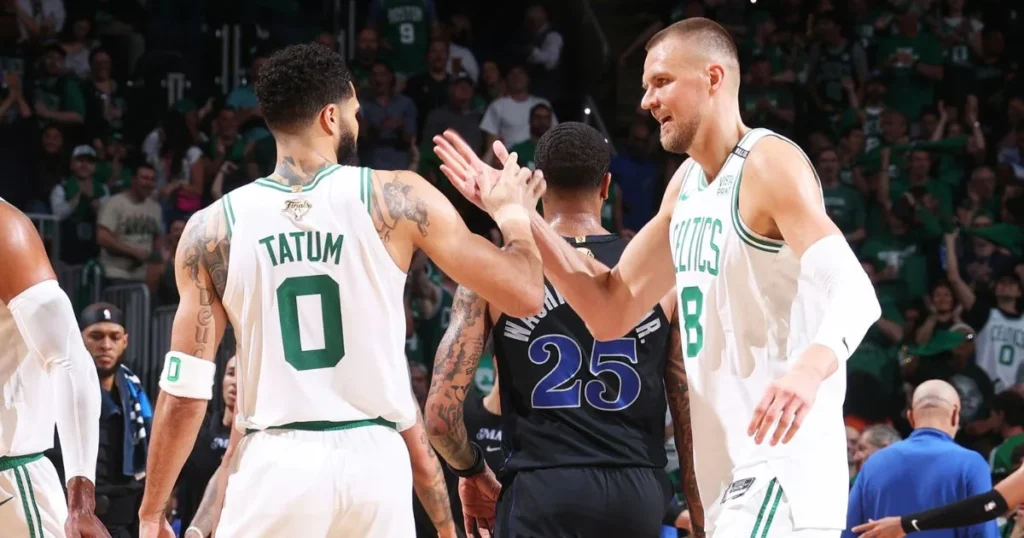

Player Stats: Key Performances
Boston Celtics:
- Jayson Tatum: 32 points, 8 rebounds, 6 assists, 3 steals
- Jaylen Brown: 25 points, 7 rebounds, 4 assists
- Kristaps Porziņģis: 14 points, 7 rebounds, 3 assists
- Jrue Holiday: 10 points, 5 rebounds, 8 assists
- Marcus Smart: 8 points, 6 assists, 3 rebounds
Dallas Mavericks:
- Luka Dončić: 34 points, 10 rebounds, 7 assists
- Christian Wood: 16 points, 5 rebounds
- Tim Hardaway Jr.: 13 points, 2 rebounds
- Spencer Dinwiddie: 11 points, 3 assists
Key Takeaways
- Celtics’ Defensive Dominance: The Celtics’ defense was suffocating, particularly in the first half. They were able to stifle Dončić’s playmaking and forced the Mavericks into tough shots. Tatum, Brown, and Holiday all played key roles in this effort, and the team’s defensive cohesion was a major factor in their victory.
- Tatum’s All-Around Game: Jayson Tatum’s performance was emblematic of his growth as an all-around player. He not only scored efficiently, but also facilitated the offense and played solid defense. His ability to control the tempo of the game was a key to Boston’s success.
- Mavericks’ Offensive Struggles: Despite Dončić’s best efforts, the Mavericks simply didn’t have the offensive depth to keep up with the Celtics. The lack of a secondary scorer outside of Dončić hurt Dallas, and their defense couldn’t contain Boston’s balanced attack.
- Celtics’ Balance: The Celtics were able to rely on multiple contributors. Brown was effective as a secondary scorer, Porziņģis provided floor spacing, and Holiday’s defense on Dončić was critical. This balanced approach made them difficult to stop.
Conclusion
The Celtics’ 115-98 victory over the Mavericks highlighted the power of team play and defensive intensity. Tatum’s leadership was crucial, but the Celtics’ collective effort on both sides of the ball was what ultimately led them to the win. For the Mavericks, Luka Dončić’s individual brilliance was evident, but his supporting cast didn’t do enough to help him keep up with the Celtics’ firepower.
As both teams continue their respective seasons, this game served as a reminder of why the Celtics are considered one of the NBA’s top contenders. Meanwhile, the Mavericks will need to find more consistency on both ends of the floor if they are to compete with the league’s elite teams.
FAQ
1. Who won the game between the Dallas Mavericks and the Boston Celtics?
- The Boston Celtics won the game with a final score of 115-98.
2. What were the key statistics for Jayson Tatum in the game?
- Jayson Tatum had an impressive performance with 32 points, 8 rebounds, 6 assists, and 3 steals.
3. How did Luka Dončić perform in the game?
- Luka Dončić led the Mavericks with 34 points, 10 rebounds, and 7 assists. Despite his strong individual performance, the Mavericks struggled to keep up with the Celtics’ defense.
4. Which players were key contributors for the Boston Celtics in the game?
- Jayson Tatum, Jaylen Brown, and Kristaps Porziņģis were all key contributors. Tatum led the team in scoring, while Brown added 25 points and Porziņģis provided floor spacing with 14 points and 7 rebounds.
5. Why did the Mavericks lose the game?
- Despite a strong performance from Luka Dončić, the Mavericks struggled with defense and couldn’t generate enough scoring from other players. The Celtics’ defensive intensity and balanced scoring approach overwhelmed the Mavericks.
6. What was the score at halftime?
- The Celtics led at halftime with a score of 58-50.
7. How did the game unfold in the third quarter?
- The Celtics extended their lead in the third quarter with strong performances from Tatum and Brown, pulling ahead to a 19-point lead by the end of the quarter (score: 89-70).
8. Was there a significant change in strategy during the game?
- The Mavericks tried to adjust by running more pick-and-roll plays to free up Luka Dončić, but the Celtics’ defense, led by players like Jrue Holiday, continued to stifle the Mavericks’ offense.
9. How did the Celtics manage to keep their lead?
- The Celtics maintained their lead through balanced scoring, strong defense, and effective ball movement. Jrue Holiday was instrumental in limiting Dončić’s playmaking, while Tatum and Brown led the offense efficiently.
10. What are the next steps for the Dallas Mavericks and Boston Celtics after this game?
- After this game, the Celtics will look to build on their strong team chemistry and defensive consistency as they continue their playoff push. The Mavericks, on the other hand, will need to improve their defense and get more support for Dončić if they hope to compete with the top teams in the league.
11. What was the final score?
- The Boston Celtics won the game with a final score of 115-98.
12. Were there any standout defensive plays in the game?
- Yes, Jrue Holiday played a crucial role in limiting Luka Dončić’s playmaking, often forcing him into difficult situations. The Celtics’ overall team defense was a major factor in their victory.