


A two-person software startup turned down a $500,000 seed offer in their second year. It wasn’t because the offer was bad, the terms were actually fair. It was because the founders had already gotten their product to $30,000 in monthly recurring revenue using nothing but their own savings, a few early customers, and a lot of patience. They didn’t need the money to survive anymore, they needed it to grow faster, and that’s a very different negotiating position to be in. Eighteen months later, they raised a much larger round, on much better terms, because they’d proven the business worked before anyone else’s money was involved.
That story captures something a lot of founders miss early on: bootstrapping and fundraising aren’t opposites, and they don’t have to be an either-or decision made once and never revisited. The smartest founders treat bootstrapping as a strategy in itself, one that can make future fundraising, if it happens at all, dramatically more successful.
This article breaks down what a real bootstrap fundraising strategy looks like in 2026, how to grow a startup without early outside capital, when it actually makes sense to raise money, and how to do it from a position of strength instead of desperation.
What Bootstrapping Actually Means
Bootstrapping means building and growing a company using personal savings, revenue from the business itself, and resourcefulness, rather than relying on venture capital, angel investors, or large loans. It doesn’t mean refusing all outside help forever. It means proving the business can generate real value before handing over equity or control to anyone else.
Many successful companies started this way, not because their founders were against raising money on principle, but because bootstrapping forced early discipline that shaped how the business operated for years afterward.
Why Bootstrapping First Often Leads to Better Fundraising Later
You Negotiate From Strength, Not Need
Investors can tell the difference between a founder who needs money to survive and one who wants money to grow faster. The second position gets dramatically better terms, higher valuations, less pressure to accept unfavorable conditions, and more room to say no to bad offers.
You Keep More Ownership
Every round of funding dilutes ownership. Founders who bootstrap through the early, riskiest stage of the business, before it’s clear the idea even works, avoid giving away equity at the point when the company is worth the least. By the time they do raise, if they choose to, they’re giving up a smaller percentage for a much larger amount of money.
You Build Real Discipline Around Spending
Companies that start with someone else’s money sometimes develop loose spending habits early, hiring too fast, spending heavily on marketing before the product is ready, or building features nobody asked for. Bootstrapped founders learn to be resourceful by necessity, and that habit tends to stick around even after outside funding eventually comes in.
You Have Proof, Not Just a Pitch
A bootstrapped company that’s already generating revenue, retaining customers, and showing steady growth has something far more convincing than a slide deck. Real numbers change the entire fundraising conversation from “trust our vision” to “look at what we’ve already built.”
Practical Bootstrap Strategies That Actually Work
1. Start With a Service, Then Build the Product
Many bootstrapped founders begin by offering a service related to their eventual product idea, consulting, freelance work, or custom projects. This generates immediate cash flow while giving direct insight into what customers actually need, insight that often shapes the product in ways a founder wouldn’t have guessed on their own.
2. Charge Customers From Day One
It’s tempting to offer a product for free to build an audience first, but charging early, even a small amount, forces clarity about whether people genuinely value what’s being built. Free users rarely behave the same way paying customers do, and free adoption numbers can be misleading when it’s time to evaluate real demand.
3. Keep the Team Small and Focused
Every hire adds cost and complexity. Bootstrapped startups tend to stay lean longer than funded ones, relying on a small core team, freelancers for specific projects, and automation wherever it reasonably replaces manual work. This isn’t just about saving money, it also keeps decision-making fast and communication simple.
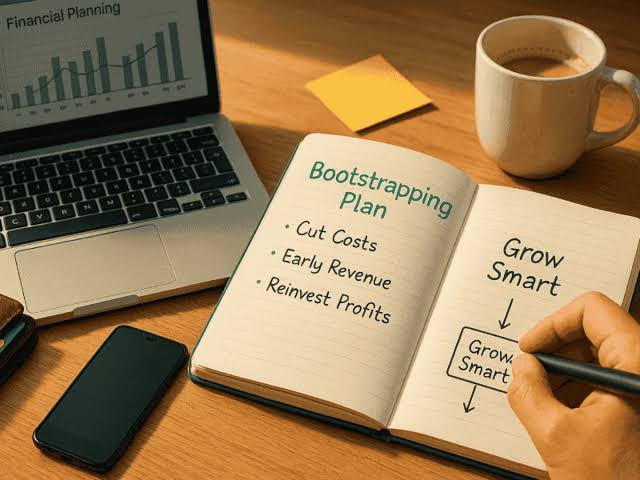
4. Reinvest Revenue Deliberately
Rather than taking profits out early, successful bootstrapped founders reinvest revenue back into the parts of the business that are working, whether that’s product development, a marketing channel that’s proving effective, or hiring one key person at the right moment.
5. Use Customer Feedback as Your Roadmap
Without a large budget for market research, bootstrapped founders often rely directly on conversations with early customers to decide what to build next. This keeps development closely tied to real demand, rather than speculation about what the market might want.
6. Explore Non-Dilutive Funding Options
Bootstrapping doesn’t mean avoiding all outside money. Grants, startup competitions, revenue-based financing, and small business loans can provide capital without giving up equity. These options are often overlooked simply because they take more effort to find than a straightforward investor pitch.
When It Actually Makes Sense to Raise Money
Bootstrapping isn’t the right long-term path for every business, and recognizing when to raise capital is just as important as knowing how to bootstrap in the first place.
When growth requires speed the market won’t wait for. Some opportunities are genuinely time-sensitive. If competitors are racing to capture the same market and moving slowly would mean losing that opportunity permanently, outside funding to scale quickly can make sense.
When the business model requires heavy upfront investment. Certain types of startups, particularly in hardware, biotech, or infrastructure, simply require more capital than personal savings or early revenue can reasonably provide, regardless of how disciplined the founders are.
When you’ve proven the model and want to scale what’s already working. This is the strongest position to raise from. The business already demonstrates real demand, and funding is being used to accelerate something proven, not to discover whether the idea works at all.
When the right strategic partner brings more than money. Sometimes an investor offers valuable industry connections, expertise, or credibility that meaningfully accelerates growth beyond what the capital alone would provide.

How to Approach Fundraising After Bootstrapping
Know Your Numbers Cold
Investors will ask about revenue, growth rate, customer retention, and unit economics. A bootstrapped founder who has been managing these numbers closely for their own decision-making will already have answers most fundraising founders have to scramble to prepare.
Raise Only What You Actually Need
Just because a large round is available doesn’t mean it’s the right choice. Raising more than necessary often leads to the same undisciplined spending habits bootstrapping was meant to avoid in the first place, along with unnecessary dilution.
Be Clear About What the Money Is For
Investors respond well to specificity. “We’re raising this amount to hire two engineers and expand into a new market we’ve already validated” is a far stronger pitch than a vague plan to “grow the business.”
Don’t Rush the Process
Founders who bootstrapped successfully already know how to be patient. That same patience applies to fundraising, taking time to find investors who genuinely understand the business, rather than accepting the first offer out of urgency.
Common Mistakes in Bootstrap Fundraising Strategy
A few patterns come up again and again among bootstrapped founders who eventually raise money. Some wait too long, staying bootstrapped well past the point where outside capital could have accelerated growth meaningfully, out of an emotional attachment to full control rather than a clear business reason. Others raise too early, giving up significant equity before they had leverage, simply because an offer appeared and felt validating. Some also underestimate how much time fundraising takes, treating it as a quick side project rather than the months-long process it usually becomes, which pulls focus away from the business at a critical moment.
What This Looks Like in Practice
Going back to the software startup from the beginning, after that eighteen-month gap between the rejected offer and their eventual raise, they used the time to refine their product, grow revenue steadily, and build a customer base that gave them real proof points. When they did raise, they negotiated from a position most founders never get to experience, multiple interested investors, a business that was already working, and the ability to choose a partner rather than simply accept whoever said yes first.
That’s the real value of a bootstrap-first approach. It’s not about avoiding investors altogether. It’s about entering that conversation, if and when it happens, with leverage instead of urgency.


Conclusion
A strong bootstrap fundraising strategy isn’t about choosing between self-funding and venture capital once and sticking with that decision forever. It’s about using the bootstrapped period to prove the business works, build financial discipline, and create real leverage, so that if fundraising happens later, it happens on the founder’s terms rather than out of necessity. The startups that navigate this well aren’t the ones that avoid funding entirely or rush toward it immediately. They’re the ones that treat bootstrapping as a deliberate strategy, not just a lack of other options.
Frequently Asked Questions (FAQs)
Q1: What does it mean to bootstrap a startup? Bootstrapping means growing a business using personal savings, revenue generated by the company itself, and resourcefulness, rather than relying on outside investors early on.
Q2: Is bootstrapping better than raising venture capital? Neither is universally better. Bootstrapping works well for businesses that can grow steadily with limited capital, while venture capital makes more sense for businesses that need to scale quickly or require heavy upfront investment.
Q3: How long should a startup bootstrap before raising money? There’s no fixed timeline. Many founders bootstrap until they have clear proof the business works, steady revenue, customer retention, or consistent growth, before considering outside funding.
Q4: Does bootstrapping mean avoiding all outside funding? No. Bootstrapping mainly refers to avoiding early equity funding. Founders can still use non-dilutive options like grants, small business loans, or revenue-based financing while still being considered bootstrapped.
Q5: Why do investors prefer funding bootstrapped startups? A bootstrapped startup that already shows real revenue and customer demand presents less risk than an idea-stage company, which often leads to better funding terms and higher valuations.
Q6: What are the biggest risks of bootstrapping for too long? Growing too slowly in a competitive market, missing time-sensitive opportunities, or burning out founders who are stretching limited resources further than they can reasonably sustain.
Q7: How much equity should a founder expect to give up when raising after bootstrapping? This varies widely based on the amount raised and company valuation, but bootstrapped founders with proven revenue generally give up less equity than founders raising at the idea stage, since the company is worth more by the time they raise.
Q8: Can a bootstrapped startup still scale quickly? Yes, especially if it reinvests revenue strategically and stays lean. Scaling may be slower than a well-funded competitor initially, but it often comes with stronger fundamentals and less financial pressure.
Q9: What’s the difference between bootstrapping and being underfunded? Bootstrapping is a deliberate strategy chosen to maintain control and discipline. Being underfunded usually means a business genuinely lacks the resources it needs to operate effectively. The difference lies in whether the limited capital is a strategic choice or an unavoidable constraint.
Q10: How do I know if my startup is ready to raise funding after bootstrapping? Signs include consistent revenue growth, strong customer retention, a clear understanding of your unit economics, and a specific, well-justified plan for how the funding will accelerate something that’s already working.