


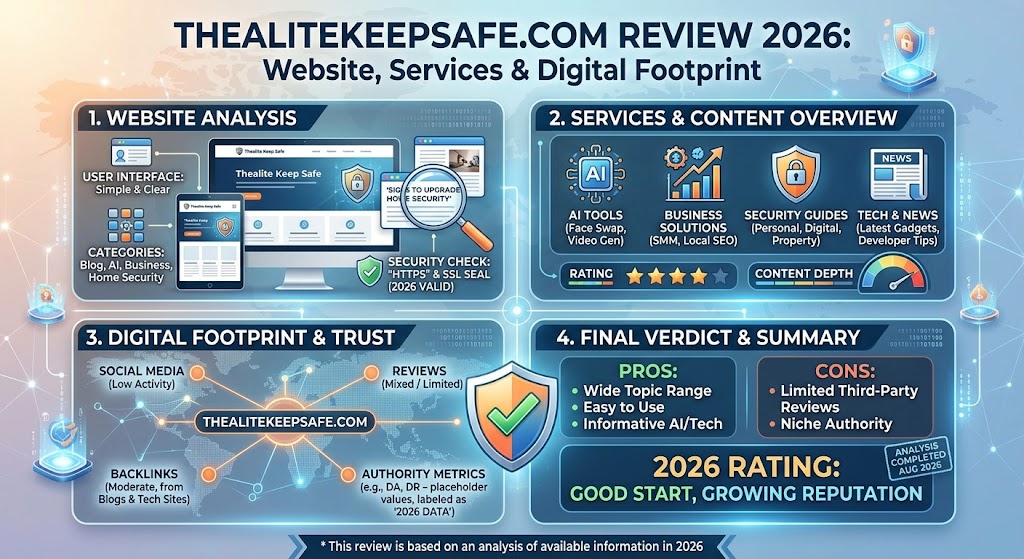
Some websites build a digital footprint through original reporting, a loyal readership, and years of consistent editorial focus. Others build it through a very different mechanism entirely one based on search engine metrics, guest post marketplaces, and a steady stream of loosely related filler content designed to keep a domain looking active. Thealitekeepsafe.com falls much more clearly into the second category, and understanding exactly how that works is genuinely useful, both for anyone considering the site as a content destination and for anyone evaluating it as a place to buy or place a backlink.
This article looks at what thealitekeepsafe.com actually publishes, how it’s positioned in the guest-posting and SEO marketplace world, and what “building a digital footprint” really means for a site like this in practice.
What the Site Actually Publishes
Despite its name suggesting a focus on safety or security, thealitekeepsafe.com’s actual published content covers a scattered, largely unrelated mix of topics. Recent articles span subjects like AI-generated face swaps and lip-sync video technology, whether SMM (social media marketing) panels are safe to use, local SEO problems facing small businesses, the changing video production industry, how software companies expand into Asian markets, and roundups of “best tech tools for developers.” None of these topics connect to each other in any obvious thematic way, and none particularly connect to the site’s own name.
This kind of scattered, keyword-driven topic spread is a recognizable pattern. It typically shows up on sites whose primary purpose is generating a large volume of published pages each one built around a specific search term or client request — rather than serving a defined readership with a consistent editorial focus. The site also shows no visible reader engagement, with articles consistently showing no comments, which further suggests a publishing model built around search visibility and marketplace listings rather than cultivating an actual audience.
The Real Business Model: Selling Guest Posts and Backlinks
Here’s where the picture becomes much clearer. Thealitekeepsafe.com is actively listed and sold as a guest-posting destination across multiple backlink marketplace platforms. One marketplace lists it with a Domain Authority of 38, a Domain Rating of 10, and around 30,000 monthly visits, offering dofollow, permanent backlinks with a stated four-day delivery time. Another platform sells guest post placement on the site for a flat rate of $12, explicitly advertising dofollow backlinks as the product being sold.
This is worth being direct about: the primary commercial function of thealitekeepsafe.com, based on how it’s marketed, is providing backlinks for search engine optimization purposes — not building a readership around original journalism or expertise. The published articles exist largely as vehicles for those paid links, and the topic mix reflects whatever clients have purchased placements for, rather than any coherent editorial vision from the site itself.
The Rules Behind the Guest Post Process
Interestingly, the marketplace listings for this site do include some specific editorial guidelines, which is worth noting since it shows a degree of process, even within a link-selling model. According to the seller’s listing, the site does not allow titles or anchor text using promotional words like “Best,” “Review,” “Buy,” “Cheap,” or “Top,” a restriction explicitly described as following recent Google search-quality guidance, since these kinds of words are strongly associated with low-quality, commercially manipulative content in search rankings.
The listing also states that footer or sidebar links are not accepted on the site, though homepage banner links are permitted above the footer, provided they’re ordered for a minimum of three months. The seller notes that their editorial team may modify submitted titles, images, or content to maintain quality and match the site’s design — meaning buyers don’t have full control over the final published version of their content.
This combination of restrictions is a familiar pattern in the paid-link and guest-post industry: enough surface-level “editorial standards” to make the arrangement look more legitimate, while the core transaction remains straightforwardly a paid link placement rather than a genuine editorial partnership based on content merit.
What the DR and DA Numbers Actually Mean Here
The seller’s own listing is fairly candid about what these metrics indicate: a Domain Rating of 10 is explicitly described as indicating a site that’s either newly created or hasn’t built up much backlink authority of its own. The listing frames this modest authority as still useful for “diversifying a link portfolio” and maintaining “a natural SEO footprint” — marketplace language for buyers who want a mix of higher- and lower-authority sites linking to their own content, since an unnaturally uniform backlink profile (all extremely high-authority sites, for example) can itself look suspicious to search engines.
In plain terms, this means thealitekeepsafe.com isn’t being sold as a high-value, authoritative placement — it’s being sold as a supporting piece in a larger, deliberately varied link-building strategy, which is a meaningfully different value proposition than a genuinely influential publication with real editorial reach.
Google’s Own Stance on This Kind of Arrangement
It’s worth being clear about where arrangements like this stand with search engines themselves. Google’s publicly stated guidelines explicitly prohibit buying or selling links that pass ranking credit without clear disclosure (such as marking paid links as “nofollow” or “sponsored”), specifically because these schemes are designed to manipulate search rankings rather than reflect genuine editorial endorsement. Marketplace listings openly advertising “dofollow, permanent backlinks” for a flat fee without any visible disclosure requirement on the buyer’s end — sit squarely in the category of arrangement Google’s guidelines are aimed at discouraging.
This doesn’t necessarily mean immediate or automatic penalties for every site involved, since enforcement varies and detection isn’t perfect. But it does mean that anyone purchasing a placement here should understand they’re participating in exactly the kind of scheme search engines have explicitly stated they try to detect and devalue, which carries real risk for the buyer’s own site if discovered.
What “Building a Digital Footprint” Actually Means for a Site Like This
Given all of this, it’s worth revisiting what “building a digital footprint” really describes in this specific context. For a genuine publication, digital footprint typically means growing readership, brand recognition, and search visibility earned through consistently valuable original content. For a site like thealitekeepsafe.com, the footprint being built looks different: a domain accumulating enough published pages, enough basic domain metrics, and enough marketplace listings to remain a viable, sellable link-placement product.
That’s not necessarily illegal, and it’s a genuinely common business model across a large segment of the SEO services industry. But it’s a fundamentally different kind of “footprint” than the one implied by a site name suggesting safety, security, or trustworthy guidance and readers or potential guest-post buyers should go in with realistic expectations about what they’re actually engaging with.
What This Means If You’re a Reader
If you land on thealitekeepsafe.com looking for genuine safety or security guidance based on its name, it’s worth knowing upfront that the actual published content doesn’t consistently focus on that theme at all — it’s a broad, scattered mix of tech, SEO, and business topics assembled largely around whatever guest content has been purchased. Treat any individual article the way you’d treat content on any thin, multi-topic site: check the author, look for supporting sources on factual claims, and don’t assume editorial rigor simply because the site is live and indexed by search engines.

What This Means If You’re Considering Buying a Placement
If you’re evaluating thealitekeepsafe.com as a potential guest-post or backlink purchase, it’s worth going in with clear eyes about what you’re buying: a placement on a newer, lower-authority domain, explicitly marketed as a link-diversification tool rather than a high-value editorial placement. Given Google’s explicit guidelines against undisclosed paid links, it’s worth weighing that risk against the modest SEO value being offered, and considering whether investing instead in genuine content marketing or properly disclosed sponsored content (marked nofollow or sponsored, in line with search engine guidelines) might serve your site better in the long run.
The Bottom Line
Thealitekeepsafe.com’s digital footprint isn’t being built the way a genuine publication builds one — through consistent editorial focus and an engaged readership. It’s being built through a recognizable, fairly transparent link-marketplace model: a scattered mix of unrelated, seemingly AI-assisted filler articles, sold as guest-post placements through backlink marketplaces, with modest domain authority explicitly marketed as useful for “diversifying” a larger link portfolio rather than as a standout, influential source in its own right. Understanding this model clearly rather than taking the site’s name or surface-level appearance at face value — is the most useful thing anyone evaluating it, whether as a reader or a potential buyer, can walk away with.
FAQs
Q1: Does thealitekeepsafe.com actually focus on safety or security topics, based on its name? No. Its actual published content covers a scattered mix of unrelated topics — AI video technology, SMM panels, local SEO, software expansion strategies, and developer tools — with no consistent focus on safety or security despite what the name might suggest.
Q2: What is thealitekeepsafe.com’s real business model? Based on how it’s listed across multiple guest-post and backlink marketplaces, its primary function is selling paid guest post placements and backlinks for SEO purposes, rather than operating as a genuine, independently focused editorial publication.
Q3: Is buying a backlink from a site like this against Google’s guidelines? Buying or selling links that pass ranking credit without proper disclosure (such as marking them “nofollow” or “sponsored”) is explicitly against Google’s publicly stated webmaster guidelines, since these schemes are designed to manipulate search rankings. Marketplace listings advertising undisclosed “dofollow” links for a fee fall into exactly this category.
Q4: What does a Domain Rating of 10 actually indicate about this site? According to the site’s own marketplace listing, a Domain Rating of 10 signals a domain that’s either newly created or hasn’t accumulated much backlink authority yet. It’s explicitly marketed as useful for diversifying a broader link portfolio, rather than as a high-authority, high-value placement on its own.
Q5: Should I trust individual articles on thealitekeepsafe.com as reliable information sources? It’s worth applying real caution. Given the site’s scattered topic focus, apparent lack of consistent editorial oversight, and its primary function as a link-selling vehicle, individual articles shouldn’t be treated as authoritative — checking sources and cross-referencing important claims elsewhere is a sensible approach.