

A couple of years ago, “AI governance” was mostly a conversation happening in policy circles and a handful of large tech companies. Now it’s showing up in board meeting agendas at mid-size manufacturers, regional banks, healthcare clinics, and marketing agencies with fifteen employees. That shift didn’t happen because everyone suddenly got excited about compliance paperwork it happened because AI adoption moved faster than most businesses’ internal policies did, and the regulatory landscape finally caught up.
If a business is using AI tools anywhere in its operations customer service chatbots, hiring screening software, content generation, fraud detection, internal analytics it now has some level of governance obligation, whether it’s fully aware of it or not. This isn’t limited to companies building AI models from scratch. Using someone else’s AI tool still puts responsibility on the business deploying it.
This guide walks through what AI governance actually means in practice in 2026, why it matters beyond just avoiding fines, and what a reasonable starting point looks like for a business that hasn’t built any formal structure around this yet.
What AI Governance Actually Means
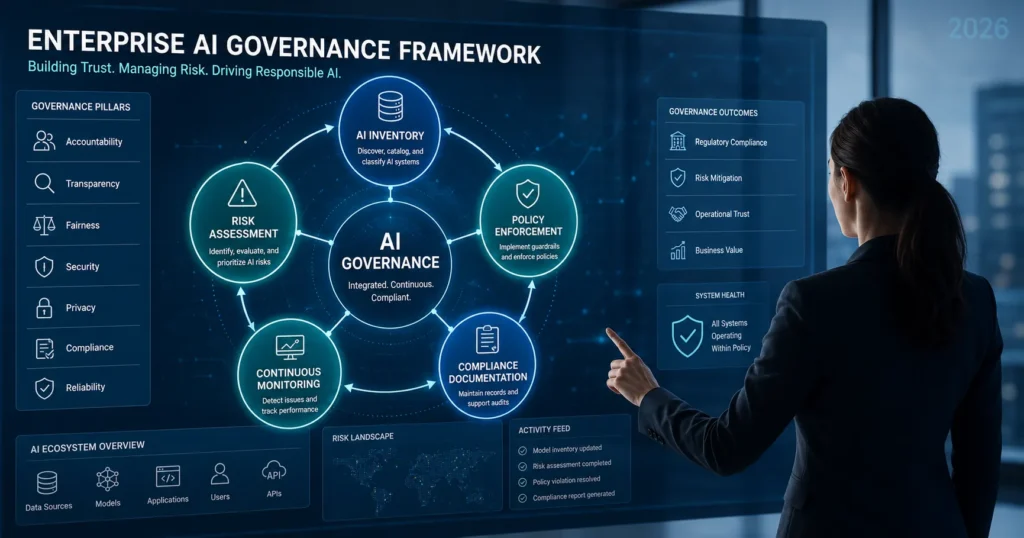
Strip away the jargon, and AI governance is really just a set of internal practices and rules that answer a handful of basic questions: What AI tools are we using, and for what? Who’s responsible for how they’re used? What happens if the AI gets something wrong? Are we being transparent with customers and employees about where AI is involved in decisions that affect them?
It’s not a single document or a one-time checklist. It’s an ongoing practice, similar to how businesses already handle data privacy or financial controls a mix of policy, oversight, and process that gets revisited as tools and regulations change.
Why 2026 Is a Turning Point
A few specific developments have pushed this from “nice to have” to something businesses genuinely can’t ignore anymore.
The EU AI Act is now in active enforcement, with different compliance deadlines having passed for different risk categories of AI systems. Businesses operating in or selling into the EU even those based elsewhere are subject to its requirements if their AI systems affect EU residents.
In the U.S., there’s no single federal AI law, but a patchwork of state-level regulations has grown substantially. Colorado’s AI Act, California’s various AI-related statutes, and similar laws in other states have created overlapping obligations, particularly around automated decision-making in hiring, lending, and insurance.
Beyond formal law, there’s been a wave of litigation and regulatory action around AI-driven hiring discrimination, biased lending algorithms, and chatbots giving customers incorrect information that the business was then held accountable for. These cases have made clear that “the AI did it” is not a legal defense the business deploying the tool bears responsibility for its outcomes.
And customers themselves have gotten more AI-literate and more skeptical. Surveys consistently show people want to know when they’re interacting with AI versus a human, and want some assurance that automated decisions affecting them can be reviewed or appealed.
Start With an Honest Inventory
The single most useful first step, and one a huge number of businesses skip, is simply figuring out what AI is actually being used across the organization. This sounds basic, but it’s genuinely common for leadership to be unaware of AI tools individual departments or employees have adopted on their own a marketing team using an AI writing tool, a hiring manager using an AI resume screener, a customer service team relying on an AI chatbot plugin nobody formally approved.
A basic inventory should capture:
- What AI tools or features are in use, including ones embedded inside other software (many SaaS platforms have quietly added AI features to existing products).
- What decisions or outputs each tool influences is it just drafting emails, or is it screening job applicants, setting prices, or approving loans?
- Who owns or manages each tool internally.
- What data each tool has access to, and where that data goes.
This inventory alone often surfaces risks nobody had previously flagged an AI hiring tool with no documented bias testing, or a customer-facing chatbot that’s been giving inconsistent or incorrect answers without anyone reviewing transcripts.
Classify AI Use by Risk Level
Not every use of AI carries the same stakes, and treating a low-risk tool with the same scrutiny as a high-risk one wastes effort while potentially under-scrutinizing what actually matters. A useful way to think about risk levels:
Low risk — AI used for internal efficiency with no direct impact on customers or employees’ rights: drafting internal documents, summarizing meeting notes, generating first-draft marketing copy that a human reviews before publishing.
Medium risk — AI that shapes customer-facing interactions or business decisions but with human oversight built in: a chatbot handling initial customer inquiries with an easy handoff to a human, AI-assisted content recommendations, fraud flagging that a human reviews before acting.
High risk — AI making or heavily influencing decisions that materially affect people’s lives with limited human review: automated hiring screening, credit or loan decisions, insurance underwriting, healthcare-related recommendations, or anything explicitly labeled high-risk under a relevant regulation like the EU AI Act.
High-risk uses deserve the most governance attention documented testing for bias, clear human review steps, and audit trails. Low-risk uses still need some oversight, but it can be lighter.
Build Actual Human Oversight, Not Just a Policy Document
A policy stating “a human will review all AI decisions” means very little if nobody’s actually checking. Real oversight means specific people are assigned responsibility for reviewing AI outputs at defined intervals, with actual authority to override or halt use of a tool if something looks wrong.
For high-risk applications especially, this often means:
- A named person or team responsible for periodically auditing AI decisions for accuracy and fairness.
- A clear, documented process for someone affected by an AI decision to request human review.
- Regular testing of AI tools against known problem patterns for hiring tools, this might mean checking whether the tool disproportionately screens out candidates from particular demographic groups; for chatbots, checking whether responses are giving customers accurate information.
This doesn’t need to be elaborate for a small business, but it does need to be real. A monthly spot-check of AI-driven decisions by an actual person is far more valuable than a policy nobody follows.

Transparency With Customers and Employees
A growing number of regulations, and simply good practice, require disclosing when AI is involved in a decision or interaction that affects someone. This can look like:
- A clear disclosure when a customer is chatting with a bot rather than a human, along with an easy way to reach a person.
- Notifying job applicants when AI is used in screening resumes or conducting interview analysis.
- Explaining, at least at a high level, how automated decisions are made when they affect pricing, credit, or service eligibility.
Businesses sometimes worry that disclosure will make customers trust them less. In practice, the opposite tends to be more common vague or hidden AI use that gets discovered later tends to damage trust far more than upfront transparency.
Vendor Due Diligence Matters More Than Businesses Realize
Most businesses using AI aren’t building models themselves they’re using tools built by vendors. That doesn’t remove responsibility; it shifts part of the governance work into vetting those vendors properly. Before adopting an AI tool from a third party, it’s worth asking:
- What data does this tool use to make decisions, and where does customer or employee data go once it’s fed into the tool?
- Has the vendor documented bias testing or fairness audits for the tool, especially for anything touching hiring, lending, or similar high-stakes decisions?
- What happens if the tool makes a costly error does the vendor’s contract include any liability protection, or does responsibility sit entirely with the business using it?
- Does the vendor comply with relevant regulations in the markets the business operates in?
A lot of AI governance failures trace back to a business assuming a reputable-looking vendor had already handled compliance, when in fact the vendor’s terms of service explicitly pushed that responsibility onto the customer.
Data Privacy and AI Overlap More Than People Expect
AI governance and data privacy compliance aren’t separate tracks they overlap heavily, since most AI tools run on customer or employee data. Businesses already handling data privacy obligations under frameworks like GDPR or various U.S. state privacy laws need to extend that same thinking to how data flows into and out of AI systems.
Key questions worth revisiting specifically because of AI: Is customer data being used to train a third-party AI model, potentially exposing it in ways customers didn’t consent to? Are employees feeding sensitive company or customer information into public AI tools like consumer chatbots, without any oversight of where that data ends up? Does the business have a clear policy on what data can and can’t be entered into AI tools, and is that policy actually communicated to staff?
This last point trips up a surprising number of businesses employees pasting sensitive client information into a public AI chatbot to get help drafting something, with no awareness that the data might be stored, logged, or even used for further model training depending on the tool’s terms.
Building a Governance Policy That Isn’t Just a Formality
A written AI governance policy works best when it’s specific rather than aspirational. Vague language like “we are committed to responsible AI use” doesn’t help anyone make an actual decision. A more useful policy typically covers:
- Which AI tools are approved for use, and a clear process for requesting approval of new ones.
- What data can and can’t be entered into AI tools, especially public, non-enterprise versions.
- Who’s responsible for reviewing high-risk AI decisions, and how often.
- What disclosure is required to customers or employees when AI is involved in a decision affecting them.
- A clear escalation path if an AI tool produces a harmful, biased, or clearly incorrect outcome.
This should be a living document, revisited at least annually or whenever a significant new AI tool gets adopted, not something written once and forgotten in a shared drive.
The Bottom Line
AI governance in 2026 isn’t optional bureaucracy tacked onto AI adoption — it’s become a basic part of using these tools responsibly, similar to how data privacy and financial controls became standard practice once the risks and regulations around them matured. Businesses that treat this seriously now, even with a fairly lightweight starting structure, are in a much better position than those waiting for a regulatory action or a public incident to force the issue. Start with an honest inventory, focus real oversight where the risk is highest, be transparent with the people affected, and treat vendor relationships as a governance responsibility rather than someone else’s problem. None of this eliminates the risk of AI tools making mistakes, but it puts a business in a defensible position when they do.
FAQs
Do small businesses actually need to worry about AI governance, or is this just for large companies? Regulatory obligations generally scale with risk, not company size, which means a small business using high-risk AI applications — hiring screening or lending decisions, for example — can face the same obligations as a large company. Lower-risk uses, like AI-assisted internal drafting, warrant a lighter approach. Size affects how formal the governance structure needs to look, not whether it’s needed at all.
What’s the difference between AI governance and data privacy compliance? They overlap significantly but aren’t identical. Data privacy focuses on how personal data is collected, stored, and used. AI governance covers that plus additional concerns specific to automated decision-making — bias, transparency about AI involvement, human oversight of AI decisions, and accountability when an AI system gets something wrong.
Are we responsible for problems caused by an AI tool we bought from a vendor, rather than built ourselves? In most cases, yes, at least partially. Regulators and courts have generally held that the business deploying an AI tool bears responsibility for its outcomes, even when the underlying technology was built by a third party. This is why vendor due diligence and contract terms matter so much before adopting a tool.
What happens if we don’t have any AI governance policy in place at all? Consequences vary by jurisdiction and the type of AI use involved. In regulated high-risk categories, this can mean regulatory fines or legal liability if something goes wrong. Even outside formal regulation, the absence of any oversight increases the odds that problems — bias, errors, data mishandling — go unnoticed until they cause real damage or become public.
How do we know if our AI use counts as “high-risk”? Generally, AI that materially affects people’s access to things like jobs, credit, housing, insurance, or healthcare tends to fall into high-risk categories under most current frameworks, including the EU AI Act. AI used purely for internal efficiency with human review before anything customer-facing happens is typically lower risk. When in doubt, checking against the specific regulations applicable to the business’s industry and location is worth the effort.
Do employees need to be trained on AI governance specifically? Yes, at least at a basic level. A lot of governance failures come down to employees using AI tools in ways leadership never anticipated — pasting sensitive data into public chatbots, relying on AI outputs without verification, or adopting new tools without going through an approval process. Even brief, practical training on what’s allowed and why tends to prevent a lot of avoidable problems.
How often should an AI governance policy be updated? At minimum, annually, but realistically whenever a significant new AI tool is adopted or a relevant regulation changes. AI governance is a much faster-moving area than most compliance topics businesses are used to, so treating the policy as a static document rather than a living one tends to leave gaps quickly.
