
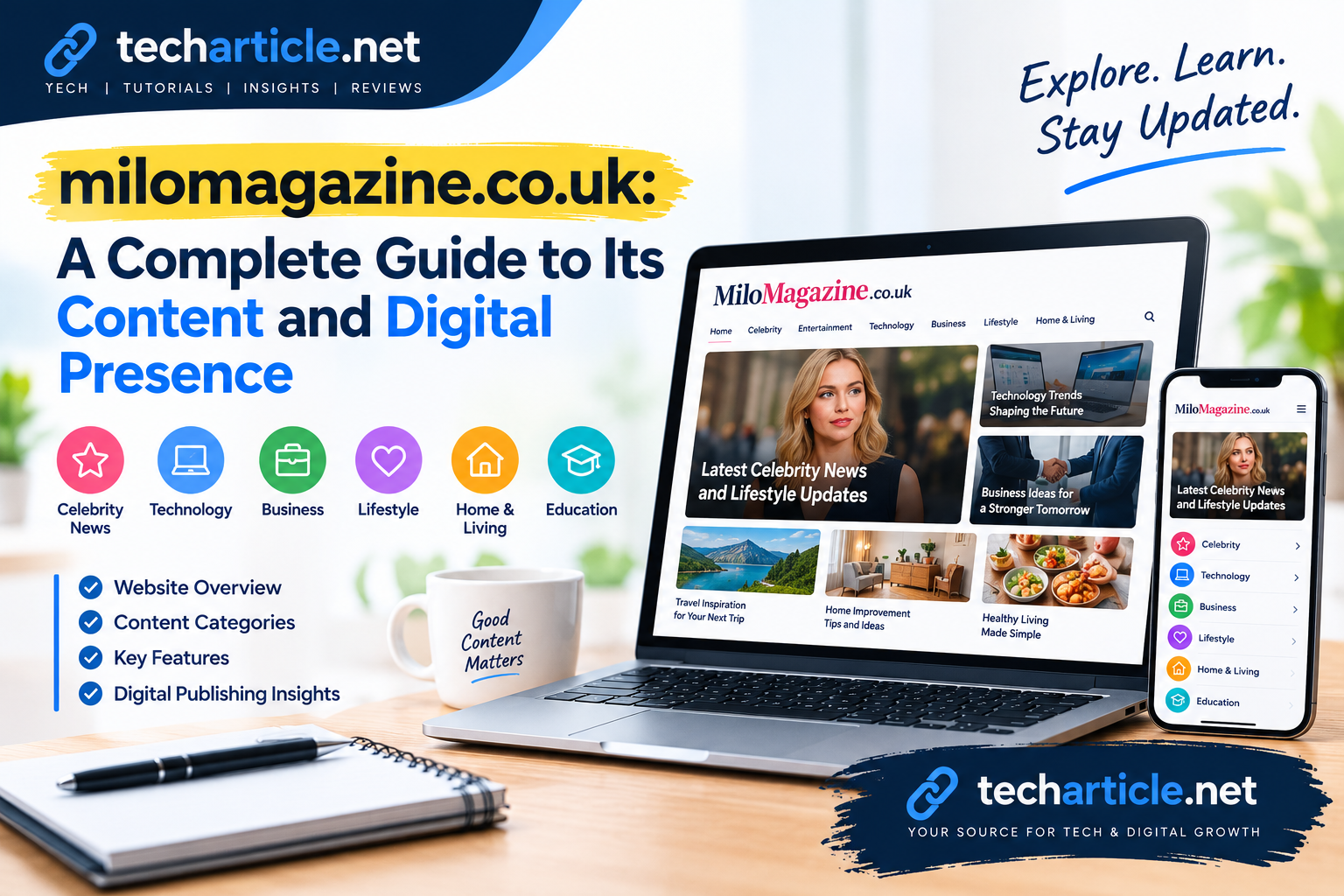
The internet has changed how people discover news, explore new interests, and find answers to everyday questions. Online magazines make this process easier by bringing different subjects together in one place. Instead of visiting several websites, readers can explore articles about entertainment, technology, lifestyle, business, and other areas through a single digital publication.
One website that readers may encounter while searching for online magazine content is milomagazine.co.uk. The website presents itself as Milo Magazine and describes its purpose as providing information about celebrities and other subjects through online articles. Its homepage also features a variety of recently published stories across different categories.
But what exactly is milomagazine.co.uk, what type of information can readers find there, and how does a general-interest magazine fit into the digital publishing landscape in 2026?
This guide explores the website’s visible content, its potential value for readers, the characteristics of online magazines, and important SEO considerations for publishers. It also explains how readers can evaluate online information before relying on it.
What Is milomagazine.co.uk?
milomagazine.co.uk is the website address of Milo Magazine, an online publication accessible through a web browser. Its homepage introduces the publication as a place where visitors can find information about their favourite celebrities.
The website also displays articles covering a broader range of subjects. Recent homepage content includes topics connected with technology, education, business, lifestyle, home improvement, and general informational guides.
This variety gives the website characteristics commonly associated with a general-interest digital magazine. Rather than requiring readers to follow one specific subject, a publication of this type can present different topics to audiences with different interests.
For example, one visitor might be interested in entertainment-related stories, while another may be looking for information about a business service, a technology tool, or a practical everyday problem.
The exact experience depends on the articles available when a visitor accesses the site. Readers should therefore explore the current homepage and article categories to understand the publication’s latest content.
What Type of Content Can You Find on Milo Magazine?
Content variety is an important part of the online magazine experience. Milo Magazine’s visible publishing activity includes several broad subject areas.
1. Celebrity and Entertainment Content
Celebrity-related information is part of the website’s stated identity. Readers interested in public figures, entertainment, and popular culture may find this type of content relevant.
Entertainment articles can cover public appearances, professional achievements, film and television projects, and developments in the wider entertainment industry.
However, readers should distinguish between confirmed information and speculation. Claims about a person’s private life, relationships, earnings, or personal background should be checked against credible sources before being treated as facts.
Responsible entertainment publishing focuses on verifiable information and avoids misleading headlines that promise more than an article can deliver.
2. Technology and Digital Trends
Technology is another subject represented in the website’s published articles. This area can include software, digital services, artificial intelligence, online shopping, and changes in how people use technology.
Technology articles are particularly useful when they explain a complicated subject in straightforward language.
For example, a useful guide to a digital tool should explain what the tool does, who may benefit from it, what limitations users should consider, and whether any costs or technical requirements apply.
Since technology changes quickly, readers should also check publication dates and verify important product details through official documentation.
3. Business and Entrepreneurship
Business content can help readers understand commercial activities, workplace decisions, marketing approaches, and changes affecting companies.
Small business owners may be interested in topics such as customer service, online visibility, business planning, and digital operations.
The value of a business article depends on its accuracy and practical usefulness. General advice becomes more helpful when it includes realistic examples, clear explanations, and relevant sources.
Readers should also be careful with financial or legal recommendations. A general online article cannot replace personalised advice from a suitably qualified professional when a decision involves significant risk.
4. Lifestyle and Everyday Information
Lifestyle content addresses subjects connected with everyday choices, personal interests, and daily routines.
Depending on the available articles, this broad area can include practical guides, leisure topics, home-related information, and general-interest features.
The most useful lifestyle articles help readers answer a particular question. They provide understandable explanations, discuss relevant options, and make it easier to identify the next step.
For subjects involving health, safety, or other important personal decisions, reliable sources and appropriate professional guidance remain essential.
5. Home Improvement and Practical Guides
Home-related information is another topic readers may encounter across the wider range of content published on the website.
Home improvement articles can explain maintenance considerations, renovation choices, energy efficiency, and the factors homeowners should evaluate before purchasing products or hiring services.
Good guides explain the difference between general information and recommendations that depend on a property’s condition, local requirements, or a professional inspection.
Readers should verify prices, building requirements, and technical specifications before making decisions based on an online article.
How Does an Online Magazine Work?
A digital magazine publishes articles through a website instead of relying exclusively on a printed publication. Readers can access its content using computers, tablets, or mobile phones.
The basic process involves selecting a topic, preparing an article, publishing it online, and making it accessible through the website’s navigation and search engines.
A well-organised digital publication generally benefits from several features.
Clear navigation: Readers should be able to locate relevant articles without unnecessary searching.
Readable formatting: Short paragraphs, descriptive headings, and useful lists make long articles easier to understand.
Relevant images: Images can illustrate a subject, explain a process, or provide context when they genuinely support the article.
Working internal links: Links between related articles help visitors explore additional information.
Accessible contact information: Readers should have a reasonable way to contact the publisher about corrections, questions, or other legitimate concerns.
These are useful standards for evaluating any online magazine. Their presence and quality should be assessed directly on the website rather than assumed simply because a publication has an active homepage.
User Experience: What Should Readers Look For?
User experience affects how comfortably people can read and navigate a website. A publication may contain useful information, but visitors can struggle to benefit from it if pages are difficult to use.
When exploring milomagazine.co.uk, readers can evaluate several practical factors.
Website Navigation
A clear homepage helps visitors understand what the publication covers and where to find relevant stories.
Article titles should describe their subjects accurately. Navigation labels should also make sense without requiring visitors to guess where a particular topic is located.
Mobile Readability
Many readers access online magazines using smartphones. Text should remain readable on smaller screens, images should fit the display, and important information should not require excessive horizontal scrolling.
Visitors can check these elements directly by opening articles on their preferred devices.
Page Loading and Functionality
Pages should load reliably, links should work, and navigation elements should respond as expected.
Unnecessary pop-ups, intrusive advertising, or repeated interruptions can make it harder to read an article. A useful publication balances its commercial requirements with the needs of its audience.
Content Organisation
A good article should answer its main question early and then provide supporting details.
Readers should not have to navigate several unrelated sections before finding the information promised by a headline. Relevant examples, clear explanations, and useful sources generally contribute more than unnecessary repetition.
Is milomagazine.co.uk Useful for Readers in 2026?
The answer depends on the subject a reader wants to explore and the quality of the particular article.
A general-interest publication can be convenient because it brings different subjects together. Readers who enjoy exploring varied topics may appreciate being able to move between entertainment, technology, business, and everyday information.
However, a broad range of subjects does not automatically make every article authoritative. The usefulness of individual pages depends on the accuracy of their claims, the quality of their sources, and how well they answer the reader’s question.
Before relying on an article, consider the following questions:
- Does the article answer the question stated in its headline?
- Are important facts supported by credible sources?
- Is the author identified where appropriate?
- Is the information recent enough for the subject?
- Does the article explain limitations or uncertainty?
- Can important claims be confirmed independently?
These checks are particularly important for legal, financial, medical, and safety-related subjects.
Readers should also remember that search engine visibility is not a guarantee of accuracy. It is sensible to compare important information with official sources or qualified professionals when necessary.
SEO Insights: How Online Magazines Can Improve Visibility
Search engine optimisation helps search engines discover, understand, and present useful pages to people searching for relevant information.
For a publication such as Milo Magazine, sustainable SEO begins with creating articles that serve a clear audience and provide genuine value.
Google’s published guidance emphasises helpful, reliable, people-first content rather than material created primarily to manipulate rankings.
The following practices are relevant to online magazines in 2026.
1. Focus on Search Intent
Search intent refers to the reason behind a search query.
Someone searching for a website’s name may want to identify the publication, while someone searching for a specific technology problem may want step-by-step instructions.
Articles should address the intended question directly. A page that answers a reader’s main question clearly is more useful than one that repeatedly inserts the same keyword without providing additional information.
2. Use Descriptive Titles and Headings
A clear title helps readers understand what a page contains before opening it.
Headings should organise the article into meaningful sections. They should describe the information that follows rather than exist solely to include additional search terms.
For example, a section titled “How to Evaluate an Online Magazine” communicates its purpose more clearly than a vague heading filled with promotional language.
The main title should also match the actual content. Avoid promising a comprehensive review if the article contains only a brief introduction.
3. Publish Original and Helpful Information
Originality is more than changing a few words in an existing article.
Useful content may include new analysis, practical examples, carefully checked facts, firsthand observations, comparisons, or explanations that address gaps in existing coverage.
When discussing milomagazine.co.uk, a publisher can add value by examining the website directly, documenting its visible features, and distinguishing verified observations from opinions.
Simply rewriting competing articles without adding meaningful information offers little benefit to readers.
4. Maintain Accuracy and Trust
Trust is important for any publication. Articles should use credible sources, identify authors appropriately, and correct significant mistakes when they are discovered.
Claims about website ownership, editorial procedures, security, traffic, or business performance should not be presented as confirmed unless supporting evidence exists.
For sensitive topics, writers should apply appropriate levels of fact-checking and rely on authoritative sources.
5. Use Internal Links Naturally
Internal links connect one page on a website to another relevant page on the same website.
For example, an article about digital publishing could link to a separate guide explaining content management systems, provided that the second article offers useful additional information.
Links should help readers explore related subjects. Adding many unrelated links simply to increase the number of internal links can make navigation less helpful.
6. Optimise Images and Page Performance
Images can improve an article when they illustrate a real subject or provide useful context.
Publishers should use descriptive image filenames, relevant alternative text, and appropriately sized image files. Alternative text should describe the image’s meaningful content rather than repeat a long list of keywords.
Fast, responsive pages also make content more comfortable to access. Publishers can use tools such as Google Search Console and PageSpeed Insights to identify technical problems and monitor performance.
7. Avoid Search Manipulation
Google’s spam policies address practices such as cloaking, doorway abuse, and scaled content abuse.
Using AI as a writing or research assistant is not automatically a violation. The important issue is whether the resulting content is useful, original, accurate, and created for people.
Publishing large volumes of low-value pages merely to attract search traffic can create serious quality and policy problems.
A more sustainable approach is to publish fewer, stronger articles where appropriate, review them carefully, and improve them when new information becomes available.
Can AI Help Online Magazines Create Better Content?
AI tools can support research, brainstorming, outlining, editing, and the organisation of information.
For example, a writer may use AI to develop an initial outline for an article about digital publishing. The writer should then verify facts, consult reliable sources, add relevant analysis, and edit the draft to meet the publication’s standards.
AI-generated text should not be treated as automatically accurate. It can contain outdated information, unsupported claims, or repetitive explanations.
Publishers should also avoid producing large numbers of similar pages without meaningful review or additional value.
The objective should be to use technology to improve the publishing process, not to replace editorial responsibility.
Where readers would reasonably want to understand how content was produced, appropriate transparency can help establish trust.

What Makes a Digital Magazine Worth Revisiting?
Readers return to a publication when it consistently provides information that meets their needs.
Several qualities can contribute to that experience.
Consistency: Publishing relevant material regularly helps readers understand what to expect, although frequency alone does not determine quality.
Relevance: Articles should address subjects that matter to the intended audience.
Accuracy: Important claims should be checked, and corrections should be handled responsibly.
Readability: Clear writing and sensible organisation help visitors understand complex subjects.
Transparency: Honest author information, appropriate sourcing, and clear distinctions between advertising and editorial content help readers evaluate what they are reading.
These qualities are useful evaluation criteria for Milo Magazine and other digital publications. They should be judged through actual pages and observable practices rather than assumed from a website’s name or appearance.
Final Verdict
milomagazine.co.uk is an online publication that presents itself as Milo Magazine and features a range of general-interest articles. Its stated focus includes celebrity information, while its visible homepage also contains stories on subjects such as technology, business, education, lifestyle, and home-related topics.
This broad approach may appeal to readers who prefer exploring different subjects through one website. However, the value of the publication ultimately depends on the quality, accuracy, relevance, and usefulness of its individual articles.
For readers, the best approach is to explore the content that matches their interests and verify important claims when necessary.
For publishers and SEO professionals, Milo Magazine also provides a useful context for considering broader questions about digital publishing: how websites organise varied topics, how readers evaluate information, and why originality and trust matter.
In 2026, long-term search visibility is best approached through helpful content, clear navigation, sound technical practices, and responsible editorial decisions. No article or SEO technique can guarantee a particular ranking, but focusing on genuine reader needs provides a stronger foundation for a sustainable online publication.
Frequently Asked Questions
1. What is milomagazine.co.uk?
milomagazine.co.uk is the website address of Milo Magazine, an online publication that introduces itself as a source of celebrity-related information and also displays articles on other general-interest subjects.
2. What topics does Milo Magazine cover?
Its stated description mentions celebrity information. Its visible homepage also features articles related to technology, education, business, lifestyle, home improvement, and other informational topics.
3. Is milomagazine.co.uk an online or print magazine?
The website is accessible as a digital publication through a web browser. Its homepage provides online articles for readers to explore.
4. Is milomagazine.co.uk useful in 2026?
It may be useful for readers interested in the subjects covered by its articles. Its value depends on the relevance, accuracy, and quality of the individual pages.
5. How can readers evaluate information published online?
Readers should check the publication date, examine the author’s information where available, review supporting sources, and compare important claims with reliable references.
6. Does SEO guarantee that a magazine will rank on Google?
No. SEO can improve discoverability and help search engines understand pages, but rankings depend on many factors and cannot be guaranteed.
7. Is AI-generated content allowed by Google?
AI assistance is not automatically prohibited. Content should provide genuine value, be accurate and original, and comply with Google’s Search Essentials and spam policies.
8. How can an online magazine improve its SEO?
A publication can focus on reader needs, clear titles, helpful original articles, natural internal links, accessible pages, image optimisation, and regular quality checks.
9. Should readers trust every article they find through Google?
No. Search visibility does not guarantee that every statement is correct. Readers should verify important claims, especially when they concern health, money, legal matters, or safety.
10. What is the most important lesson for digital publishers in 2026?
Create content for people first. Original analysis, reliable sourcing, clear explanations, and a positive reading experience are more sustainable goals than producing pages solely to target search keywords.
