
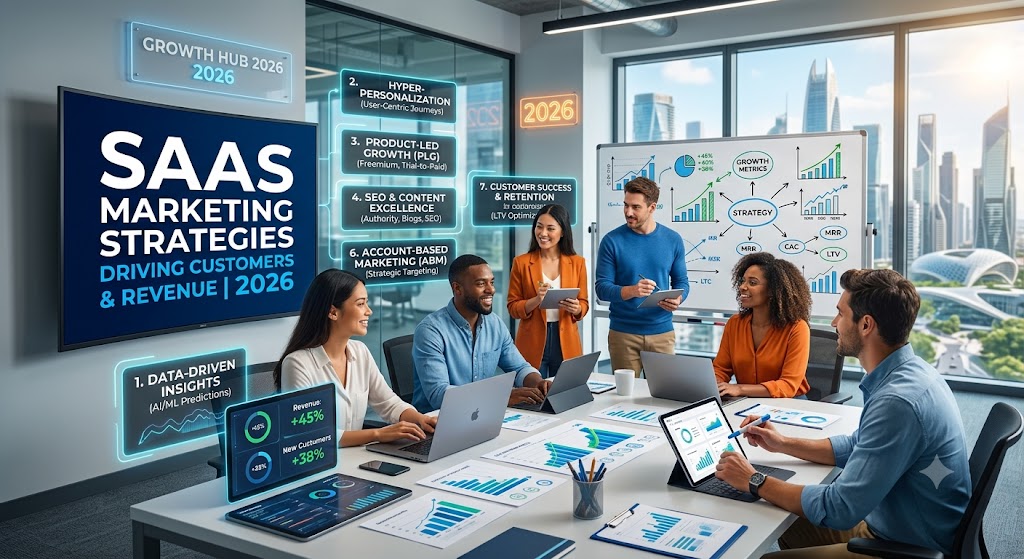
The SaaS industry has never been more competitive. With thousands of software solutions available for nearly every business need imaginable, simply having a great product is no longer enough to drive sustainable growth. In 2026, successful SaaS companies are the ones that combine product excellence with sharp, data-driven marketing strategies tailored to how modern buyers research, evaluate, and purchase software.
Buyers today are more informed, more skeptical of generic sales pitches, and increasingly influenced by AI-powered search tools, peer reviews, and community recommendations rather than traditional advertising. This shift means SaaS marketing strategies that worked five years ago need significant updates to remain effective.
This article covers the most effective SaaS marketing strategies in 2026 from content and SEO to AI-driven personalization, community building, and retention-focused growth tactics that are proven to drive more customers and revenue.
1. Content Marketing Built Around Buyer Intent
Content marketing remains one of the highest-ROI strategies for SaaS companies, but the approach has matured significantly. Instead of publishing generic blog posts hoping to rank on Google, successful SaaS marketers in 2026 map content directly to buyer intent stages:
- Awareness stage: Educational content addressing broad industry pain points
- Consideration stage: Comparison guides, “alternatives to X” pages, and use-case-specific content
- Decision stage: Case studies, ROI calculators, and detailed product walkthroughs
Because AI-powered search engines and chatbots now summarize and answer queries directly, SaaS companies also need to optimize content for AI-driven search visibility often called Generative Engine Optimization (GEO) ensuring their brand and product get referenced when users ask AI assistants for software recommendations.
2. SEO Focused on Bottom-of-Funnel and Comparison Keywords
While top-of-funnel SEO still matters for brand awareness, SaaS companies generating the most revenue in 2026 prioritize bottom-of-funnel keywords with high purchase intent, such as:
- “[Competitor] alternatives”
- “Best [category] software for [industry/use case]”
- “[Your category] pricing comparison”
These keywords attract prospects who are actively evaluating solutions and closer to making a purchase decision, resulting in higher conversion rates compared to broad informational content.
Additionally, structured data, clear pricing pages, and well-organized comparison tables help both search engines and AI tools understand and surface product information accurately.
3. Product-Led Growth (PLG) Strategies
Product-Led Growth continues to be one of the most powerful SaaS growth models in 2026. Instead of relying solely on sales teams to close deals, PLG lets the product itself drive acquisition, conversion, and expansion.
Key PLG tactics include:
- Free trials or freemium plans that let users experience core value before paying
- In-app onboarding flows that guide new users to their “aha moment” quickly
- Usage-based upgrade prompts that nudge free users toward premium features exactly when they need them
- Self-service upgrade paths that don’t require talking to a sales rep for smaller accounts
Companies combining PLG with a sales-assisted motion for larger enterprise accounts (a hybrid model) are seeing particularly strong results, capturing both self-serve small business customers and higher-value enterprise deals.
4. AI-Powered Personalization
Personalization has moved well beyond simply inserting a customer’s name into an email. In 2026, AI-driven personalization enables SaaS companies to:
- Tailor website content and messaging dynamically based on visitor industry, company size, or browsing behavior
- Send personalized in-app messages and email sequences based on how a user is actually using the product
- Predict churn risk and proactively trigger retention campaigns for at-risk accounts
- Recommend relevant features or upgrade paths based on usage patterns
This level of personalization increases engagement and conversion rates significantly compared to generic, one-size-fits-all marketing campaigns.
5. Community-Led Marketing
Building an engaged user community has become a major growth driver for SaaS brands. Communities create organic advocacy, reduce support costs, and provide valuable product feedback loops.
Effective community-led marketing tactics include:
- Hosting branded communities on platforms like Slack, Discord, or dedicated forums
- Encouraging user-generated content, such as tutorials, templates, and use-case showcases
- Running ambassador or champion programs that reward power users for advocacy
- Hosting virtual and in-person events, webinars, and AMAs (Ask Me Anything sessions)
Peer recommendations and community validation often carry more weight with prospective buyers than traditional marketing messages, especially in a market saturated with paid advertising.
6. Video and Short-Form Content
Video content, particularly short-form video, has become essential for SaaS marketing in 2026. Buyers increasingly prefer watching a 60-90 second product demo over reading a lengthy blog post.
Effective video strategies include:
- Quick product demo clips showcasing specific features solving specific problems
- Customer testimonial videos highlighting real results and ROI
- Founder-led or team-led content on platforms like LinkedIn and YouTube Shorts, building trust through authentic, less polished storytelling
- Webinar recordings repurposed into shorter, digestible clips for social media
This content performs particularly well on LinkedIn, which remains a dominant platform for B2B SaaS marketing, as well as YouTube and increasingly on platforms like TikTok for SaaS products targeting younger business owners and solopreneurs.
7. Account-Based Marketing (ABM) for Enterprise Deals
For SaaS companies targeting larger enterprise accounts, Account-Based Marketing remains one of the most effective strategies for driving high-value deals. ABM involves creating highly targeted marketing campaigns for specific, high-value target accounts rather than broad audience targeting.
In 2026, ABM has become more sophisticated with AI-assisted tools that help:
- Identify accounts showing “buying intent” signals based on their online research behavior
- Automatically personalize outreach content and ad campaigns for specific target accounts
- Coordinate marketing and sales efforts around key accounts through shared dashboards and alerts
This precision targeting results in higher win rates and shorter sales cycles for enterprise SaaS deals compared to generic outbound campaigns.
8. Customer Success as a Growth Engine
Retention and expansion revenue have become just as important as new customer acquisition for sustainable SaaS growth. Since it’s significantly cheaper to retain and upsell existing customers than acquire new ones, customer success has evolved into a core marketing and growth function rather than just a support department.
Strategies driving revenue through customer success include:
- Proactive onboarding programs that ensure customers reach value quickly, reducing early churn
- Regular business reviews with key accounts to identify expansion opportunities
- Customer marketing campaigns that turn happy customers into case studies, reviews, and referral sources
- Churn prediction models that flag at-risk accounts for proactive intervention before cancellation
Companies with strong customer success programs consistently show higher net revenue retention (NRR), a metric increasingly scrutinized by investors and a strong indicator of sustainable SaaS growth.
9. Influencer and Creator Partnerships
B2B SaaS marketing has increasingly adopted influencer marketing tactics traditionally associated with consumer brands. Partnering with industry experts, niche content creators, and respected voices in specific verticals can significantly boost credibility and reach.
Effective approaches include:
- Sponsoring content from creators who already have an engaged audience of your target customer
- Co-hosting webinars or podcasts with industry thought leaders
- Offering affiliate or referral partnerships to creators who genuinely use and recommend the product
This strategy works particularly well for SaaS products targeting freelancers, solopreneurs, and small business owners who often trust creator recommendations over traditional advertising.

10. Transparent, Value-Based Pricing Pages
Pricing pages have become a critical conversion tool rather than just an informational page. SaaS companies driving strong conversion rates in 2026 design pricing pages that:
- Clearly communicate value at each pricing tier, not just feature lists
- Include social proof (customer logos, testimonials, ratings) directly on the pricing page
- Offer transparent pricing rather than requiring a sales call for basic information (where feasible)
- Use interactive pricing calculators for usage-based pricing models
Transparency builds trust with increasingly research-driven buyers who prefer to self-educate before engaging with a sales team.
11. Retargeting and Multi-Touch Ad Campaigns
While organic strategies are crucial, paid advertising still plays an important role in SaaS marketing, particularly for retargeting website visitors who didn’t convert on their first visit.
Effective paid strategies include:
- Retargeting campaigns across LinkedIn, Google, and programmatic display networks for visitors who viewed pricing or demo pages
- Multi-touch attribution models that recognize buyers often need 6-10+ touchpoints before converting
- Intent-based advertising targeting users actively searching for comparison or alternative keywords
Given longer B2B SaaS sales cycles, patience and consistent retargeting often yield better results than expecting immediate conversions from single ad exposures.
12. Data-Driven Experimentation Culture
The most successful SaaS marketing teams in 2026 operate with a strong culture of experimentation, using data to continuously refine strategies rather than relying on assumptions or one-time campaign launches.
This includes:
- A/B testing landing pages, email subject lines, and onboarding flows
- Regularly reviewing marketing analytics dashboards to identify what’s actually driving pipeline and revenue, not just vanity metrics like website traffic
- Using cohort analysis to understand how different customer segments respond to various marketing channels and messaging
This data-driven approach allows SaaS marketing teams to allocate budget toward the highest-performing channels and continuously improve conversion rates over time.

Conclusion
SaaS marketing in 2026 requires a multi-faceted approach that blends content and SEO fundamentals with modern tactics like AI-driven personalization, community building, and product-led growth. The most successful SaaS companies no longer rely on a single marketing channel or tactic; instead, they build an integrated strategy that nurtures prospects from initial awareness through purchase decision, and then continues driving value through customer success and retention efforts.
As buyer behavior continues to evolve with AI tools increasingly influencing how people discover and evaluate software SaaS marketers who stay adaptable, prioritize genuine customer value, and continuously experiment with new channels and tactics will be best positioned to drive sustainable customer and revenue growth in the years ahead.
Frequently Asked Questions (FAQs)
1. What is the most effective SaaS marketing strategy in 2026? There isn’t a single “best” strategy — the most successful SaaS companies combine several approaches, particularly content marketing targeted at buyer intent, product-led growth, and strong customer success programs to drive both acquisition and retention.
2. What is Product-Led Growth (PLG) and why does it matter for SaaS marketing? PLG is a growth model where the product itself drives user acquisition and conversion, typically through free trials or freemium plans. It matters because it reduces reliance on expensive sales teams and lets users experience value before committing to pay.
3. How important is SEO for SaaS companies in 2026? SEO remains important, but the focus has shifted toward bottom-of-funnel, high-intent keywords like “[competitor] alternatives” and comparison searches, along with optimizing content for AI-driven search tools that summarize and recommend software directly.
4. Is paid advertising still worth it for SaaS companies? Yes, particularly for retargeting website visitors who didn’t convert on their first visit. Given long B2B sales cycles, paid ads work best as part of a multi-touch strategy rather than expecting immediate conversions from a single campaign.
5. Why is customer success considered part of marketing now? Because retaining and expanding existing customers is far cheaper than acquiring new ones. Strong customer success programs improve net revenue retention (NRR) and turn happy customers into case studies and referral sources, directly fueling growth.
6. Does community building really impact SaaS revenue? Yes. Engaged communities create organic advocacy and peer validation, which often influences buying decisions more than traditional advertising, especially in a crowded software market where buyers are skeptical of sales messaging.
7. What is Account-Based Marketing (ABM) and when should SaaS companies use it? ABM is a targeted marketing approach focused on specific high-value accounts rather than broad audiences. It works best for SaaS companies targeting enterprise deals, where personalized outreach and coordinated sales-marketing efforts can significantly improve win rates.
8. How is AI changing SaaS marketing strategies? AI enables deeper personalization (tailored messaging based on user behavior), predictive churn detection, and content optimization for AI-powered search tools. It also helps identify high-intent accounts for ABM campaigns more accurately than manual research.
9. Should small SaaS startups focus on content marketing or paid ads first? Most SaaS startups with limited budgets get better long-term ROI from content marketing and SEO, since paid ads require ongoing spend to sustain results. However, a combination — light paid retargeting alongside organic content — often works well once there’s initial traffic to retarget.
10. What metrics matter most for measuring SaaS marketing success? Beyond website traffic, key metrics include conversion rate from trial to paid, customer acquisition cost (CAC), net revenue retention (NRR), and pipeline generated from marketing-sourced leads — metrics tied directly to revenue rather than vanity metrics.
