
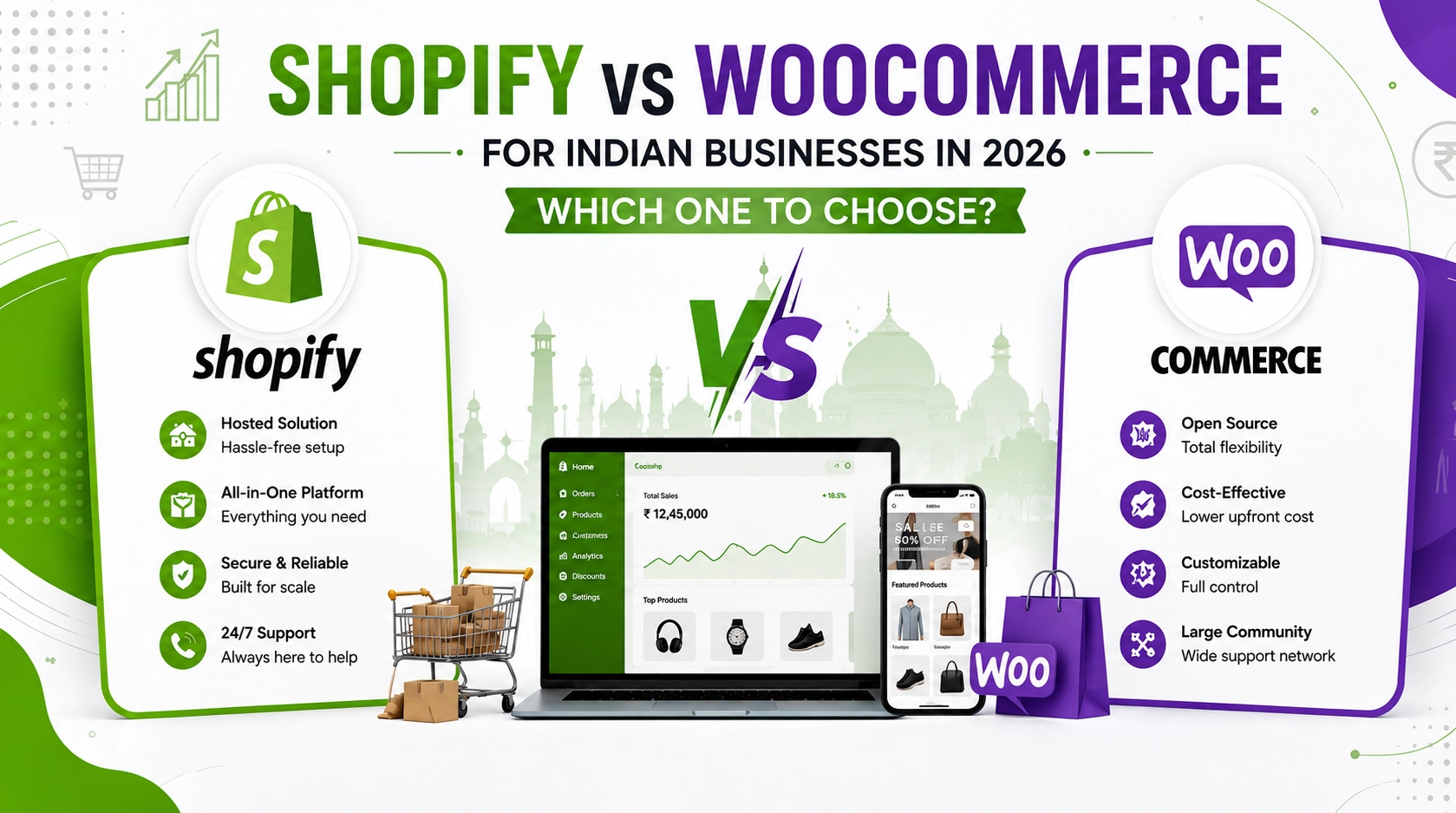
A founder I talked to recently had already built her store twice once on Shopify, then migrated to WooCommerce chasing lower fees, then found herself quietly pricing out a move back to Shopify eighteen months later because the “free” WooCommerce setup had quietly turned into a part-time job managing plugins, hosting, and security updates. Neither platform was wrong for her business at different points. What went wrong was picking based on sticker price alone, without really understanding what each platform actually asks of the business running on it.
This is the recurring theme in the Shopify versus WooCommerce decision. Both platforms power millions of stores between them, both are entirely capable of running a serious e-commerce business, and both get recommended constantly by people whose experience doesn’t necessarily match the business asking the question. The right answer depends heavily on technical comfort, growth trajectory, and how a business actually wants to spend its time building product and marketing, or managing infrastructure.
This guide breaks down what genuinely separates the two platforms in 2026, where the real costs hide beyond the advertised price, and a practical way to decide which one actually fits.
The Fundamental Difference
Shopify is a fully hosted, all-in-one platform a business signs up, picks a plan, and gets a working store without touching a server, installing software, or managing hosting. Everything from security patches to uptime is handled by Shopify itself.
WooCommerce is a free, open-source plugin that turns a WordPress site into an online store. The software itself costs nothing, but it requires a business to find and manage its own hosting, handle its own security and updates, and generally take on the technical responsibility that Shopify bundles into its monthly fee.
This isn’t a minor technical footnote it’s the single biggest factor shaping almost every other difference between the two platforms, from setup time to ongoing cost to who needs to be involved in running the store day to day.
Setup Time and Technical Effort
Shopify stores can realistically go live within a few hours of signing up, using built-in themes and a guided setup process that doesn’t require any coding. Shopify has also added AI-assisted store design tools that can generate a starting layout from a short description, further shortening the path from signup to a functioning store.
WooCommerce setup takes considerably longer realistically somewhere in the range of 20 to 80 hours depending on the complexity of the store, since it involves securing hosting, installing and configuring WordPress and WooCommerce itself, choosing and customizing a theme, and setting up the various plugins needed for payment processing, shipping, and other core functionality. Businesses without in-house technical skill typically hire a developer for this phase, and developer rates for this kind of setup work commonly run in the range of $75 to $150 an hour.
For a business wanting to launch quickly with minimal technical involvement, this gap alone is often decisive.
What Each Platform Actually Costs
This is where the comparison gets genuinely complicated, because neither platform’s advertised price reflects what a real, functioning store actually costs to run.
Shopify’s pricing in 2026 spans several tiers a Basic plan around $39 a month, a mid-tier Grow plan around $105, an Advanced plan around $399, and a Plus tier for larger enterprises starting somewhere around $2,300 to $2,500 a month on contract. Each tier also reduces the card processing rate slightly, from roughly 2.9% plus 30 cents per transaction on the entry plans down to around 2.15% plus 30 cents on the higher tiers, which rewards stores that grow into more expensive plans with somewhat better payment economics.
Beyond the plan fee, most real Shopify stores also spend meaningfully on apps — for reviews, subscriptions, upsells, email marketing, and other functionality not included in the base plan. Mid-market stores commonly spend several hundred to over a thousand dollars a month once a typical app stack is added, which is a cost easy to underestimate when comparing bare plan prices.
WooCommerce’s software itself is free, but a realistic total includes hosting (roughly $10 to $80 a month for a store that can actually handle real traffic and load), a properly licensed and maintained theme, and extensions for functionality Shopify bundles into its apps subscriptions, product bundles, bookings, and membership features typically each cost somewhere in the range of $80 to $250 a year individually, and each one needs to stay compatible with WordPress core and the store’s theme over time.
WooCommerce now ships with its own built-in payment processor, offering standard card processing rates functionally similar to Shopify’s around 2.9% plus 30 cents for US transactions with no additional platform surcharge, which has narrowed a cost gap that used to favor WooCommerce more clearly on payment processing specifically.
Putting realistic totals together, a typical small-to-mid-size store running a normal app stack on Shopify commonly spends somewhere in the range of $7,000 to $12,000 a year all-in. A comparable WooCommerce store, once managed hosting and at least some developer time for maintenance are factored in, often lands in a similar or slightly higher range, commonly $8,000 to $15,000 a year, once the true cost of keeping the store secure, updated, and running smoothly is counted rather than just the software and hosting fees.
The crossover point that changes this calculation is transaction volume. Above roughly $30,000 a month in revenue, WooCommerce’s lack of a platform-level transaction fee (beyond standard payment processing) starts to meaningfully outweigh Shopify’s percentage-based fees, but only if the business genuinely accounts for the ongoing developer and maintenance cost WooCommerce requires rather than assuming the “free” platform stays free at scale.
Customization and Control
WooCommerce’s biggest advantage is genuine, largely unrestricted customization. Because it’s built on WordPress and fully self-hosted, a business has complete access to the underlying code, can build essentially any custom functionality a developer is capable of creating, and owns its data and infrastructure outright rather than depending on a third-party platform’s roadmap and policies.
Shopify can be customized too, particularly through its app ecosystem and theme editing tools, and its higher tiers offer more technical flexibility through its own development framework. But it remains a hosted platform with real boundaries — a business is ultimately building within Shopify’s infrastructure and rules, which is a meaningful constraint for a business with genuinely unusual technical requirements that don’t fit neatly into the standard e-commerce mold.
For most standard retail and e-commerce use cases, this difference matters less than it might seem, since Shopify’s app ecosystem covers the vast majority of common needs. It matters considerably more for businesses with unusual product configurations, complex B2B requirements, or a specific vision for the buying experience that standard e-commerce platforms don’t naturally support.
Sales Features and In-Person Selling
Shopify has a meaningful edge for businesses selling in person alongside online, since it offers native point-of-sale hardware and software that integrates directly with the same inventory and order system as the online store. WooCommerce can support in-person sales through third-party plugins, but it doesn’t have anything built natively to match Shopify’s integrated POS offering, which makes Shopify the more straightforward choice for any business with a genuine retail or event-based in-person selling component.
SEO and Content Capabilities
Both platforms are capable of strong SEO results when properly configured, and the historical gap between them has narrowed. Shopify addressed a longstanding technical SEO weakness around duplicate URL structures in its collections pages, closing one of the more commonly cited disadvantages it used to carry.
WooCommerce still offers more granular control over URL structure and broader technical SEO customization, largely because it inherits WordPress’s mature content management and plugin ecosystem — tools like Yoast and Rank Math give genuinely deep control over technical SEO details. For a business where organic search and content marketing are a central growth channel, this flexibility can be a meaningful advantage, though it requires someone with the expertise to actually take advantage of it rather than delivering better SEO automatically just by choosing the platform.
Ongoing Maintenance and Who Needs to Be Involved
This is arguably the most underappreciated difference between the two platforms. Shopify requires essentially no ongoing technical maintenance from the business updates, security, and infrastructure are entirely Shopify’s responsibility, which is a genuine advantage for a business without dedicated technical staff.
WooCommerce places that responsibility squarely on the business (or whoever it hires to handle it), including keeping WordPress core, the WooCommerce plugin, the theme, and every installed extension updated and compatible with each other, along with handling security monitoring and backups. This is a real, ongoing time or money commitment, not a one-time setup cost, and it’s the most common source of surprise expense for businesses that chose WooCommerce primarily because the software itself was free.
A Practical Way to Decide
For a business trying to choose between the two, a few honest questions clarify the decision better than comparing feature lists in the abstract.
Does the business have in-house technical resources, or access to affordable ongoing developer support? Without this, WooCommerce’s maintenance burden becomes a real operational drag. With it, WooCommerce’s control and customization become genuinely accessible rather than a theoretical advantage the business can’t actually use well.
How much does the business value predictable, all-in monthly costs versus potentially lower costs at scale with more variability? Shopify’s pricing is more predictable and transparent, even with app costs added. WooCommerce’s total cost is more variable and depends heavily on how well its ongoing maintenance is managed.
Does the business sell in person as well as online? Shopify’s native POS integration is a meaningful practical advantage here that WooCommerce doesn’t natively match.
Is organic search and content-driven growth a central strategy? WooCommerce’s deeper WordPress-based SEO and content tools offer more room to grow into over time, assuming the business has the expertise to use that flexibility well.
What’s the realistic revenue trajectory? Below roughly $30,000 a month, the cost difference between the two platforms tends to be fairly close once real costs are accounted for on both sides. Above that threshold, WooCommerce’s lack of a percentage-based transaction fee starts to matter more, provided the business has a genuine plan for managing its ongoing technical maintenance rather than letting it become an unbudgeted burden.
The Bottom Line
Neither platform is universally better they represent genuinely different tradeoffs between convenience and control. Shopify trades some flexibility and, at high volume, some transaction cost, for a fully managed platform that lets a business focus on products and marketing rather than infrastructure. WooCommerce trades that convenience for full ownership, deeper customization, and potentially lower costs at scale, in exchange for taking on real, ongoing technical responsibility. The businesses that end up happy with their choice are usually the ones that honestly assessed their own technical resources and growth trajectory before deciding, rather than choosing based on the advertised sticker price of either platform alone.
FAQs
Which platform is cheaper overall, Shopify or WooCommerce? It depends heavily on store size and how maintenance costs are accounted for. For many small-to-mid-size stores, realistic total costs land in a similar range on both platforms once app costs on Shopify and hosting plus developer time on WooCommerce are included. Above roughly $30,000 a month in revenue, WooCommerce’s lack of a percentage-based transaction fee often starts to make it the cheaper option, provided its maintenance is genuinely well managed.
Is WooCommerce really free? The core software is free, but a functioning store realistically requires paid hosting, often a paid theme, and typically several paid extensions for functionality that Shopify includes through its app ecosystem, plus either time or money spent on ongoing maintenance. “Free” describes the software license, not the total cost of running a real store.
Which platform is easier for a non-technical business owner to manage? Shopify is significantly easier for non-technical users, since it requires no server management, no plugin compatibility maintenance, and no manual security updates. WooCommerce offers more control but expects the business to either develop technical skill in-house or budget for ongoing developer support.
Does Shopify or WooCommerce have better SEO? Both platforms can achieve strong SEO results when properly configured, and the gap has narrowed considerably. WooCommerce still offers somewhat more granular technical SEO control through WordPress’s mature plugin ecosystem, which can be a real advantage for content-heavy SEO strategies, provided the business has the expertise to use that flexibility effectively.
Can I switch from WooCommerce to Shopify later, or vice versa, without starting over? Migration between the two platforms is possible and reasonably common, but it’s a real project involving moving products, customer data, and order history, along with rebuilding the store’s design and functionality on the new platform. It’s a meaningful undertaking, which is exactly why choosing carefully upfront based on realistic long-term needs matters more than treating the decision as easily reversible.
Is Shopify or WooCommerce better for selling in person as well as online? Shopify has a clear advantage here, with native point-of-sale hardware and software that integrates directly with the same online inventory and order system. WooCommerce can support in-person sales through third-party plugins, but doesn’t offer anything built natively to match Shopify’s integrated point-of-sale ecosystem.
How much revenue should a business be doing before WooCommerce becomes clearly cheaper than Shopify? Roughly $30,000 a month in revenue is commonly cited as the point where WooCommerce’s lack of a percentage-based transaction fee starts to meaningfully outweigh Shopify’s fees, though this depends heavily on how efficiently the business is managing its WooCommerce hosting and maintenance costs rather than being a fixed, universal threshold.
