
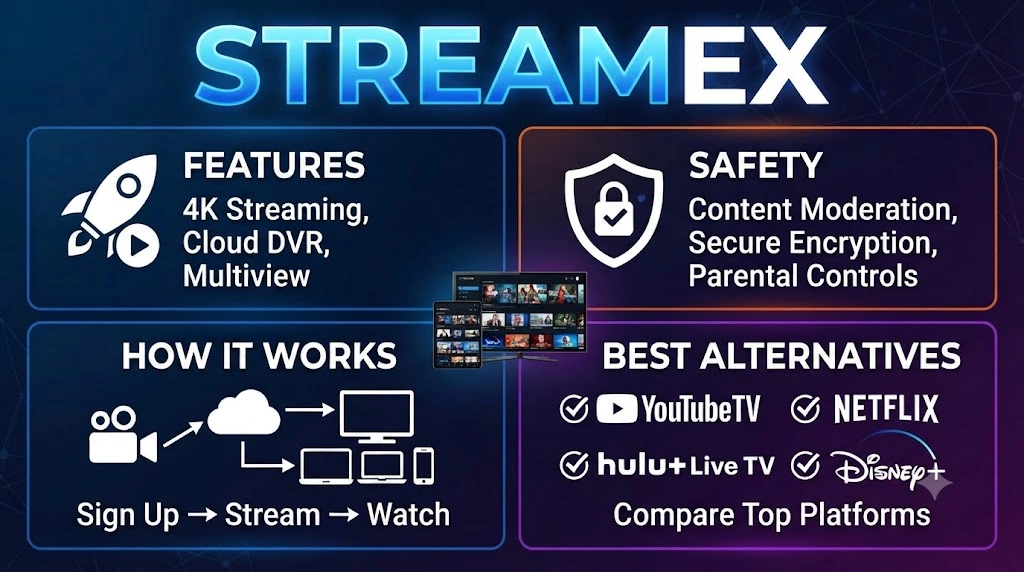
If you’ve searched for a way to watch movies and TV shows without paying for a subscription, you’ve likely come across “Streamex” or more accurately, a cluster of similarly named websites and apps (streamex.us, streamex.baby, streamex.pro, 1streamex.to, and others) that advertise free, no-signup access to a large library of films, series, anime, and even live sports. Before you click play, it’s worth understanding exactly what these sites are, how they actually work, what risks they carry, and what better options exist. This article breaks all of that down in plain terms.
What Is Streamex?
“Streamex” isn’t a single, unified company or app in the way Netflix or Disney+ is. It’s a name used by several unrelated or loosely related free-streaming websites, each with nearly identical marketing language: no account required, no subscription fee, instant playback, adaptive video quality, and a large, frequently updated catalog spanning Hollywood blockbusters, regional and international cinema, anime, and live sports.
This pattern the same promotional copy reused across multiple domains with different top-level extensions (.us, .pro, .baby, .to, .sh) is common among free streaming aggregators. These sites typically don’t produce or license any content themselves. Instead, they index or embed video streams hosted elsewhere, often pulled from a rotating set of third-party servers, and present them through a clean, ad-supported interface designed to look and feel like a legitimate on-demand platform.
It’s important to be upfront about what this means: sites in this category are, in the overwhelming majority of cases, unlicensed. They stream copyrighted movies and TV shows without authorization from the studios, distributors, or rights holders that own them. That single fact should shape how you think about every other claim these platforms make about themselves, including their advertised features and their safety.
How Streamex-Style Sites Say They Work
According to the marketing pages for these platforms, the experience is built around three core promises: no friction, adaptive playback, and broad content discovery. Here’s how each is typically described.
No-Signup Access
The headline feature across every version of Streamex is that you don’t need to create an account, verify an email address, or enter payment information to start watching. You land on the homepage, search or browse for a title, click it, and playback begins. For anyone who has been annoyed by a streaming service that forces registration before showing so much as a trailer, this is the core appeal.
In practice, this works because the site isn’t handling billing, DRM-protected licensing, or a personalized subscription relationship with you at all there’s no account system to build because there’s no legitimate distribution agreement requiring one. Legitimate paid and even free ad-supported services require sign-in largely because of licensing terms, regional rights management, and viewing analytics tied to content deals. A site with no licensing obligations has no structural reason to gate access behind an account.
Adaptive Streaming Quality
These sites claim to automatically adjust video resolution based on your connection speed, stepping down to a lower resolution if your bandwidth drops and stepping back up to as high as 4K when conditions improve, without requiring you to touch a settings menu. This is a standard, well-understood video delivery technique (adaptive bitrate streaming) that’s used industry-wide, including by legitimate platforms. The technology itself isn’t unique to Streamex it’s a baseline expectation for any modern video site.
Multi-Server Content Delivery
To reduce buffering, these platforms describe routing video through “multiple global servers” so that streams are served from a location closer to the viewer. Again, content delivery networks (CDNs) are standard practice across the internet. What’s different here is that instead of one licensed source with predictable uptime and quality, free aggregator sites often pull from several different embed sources or mirrors for the same title, meaning quality, subtitle availability, and reliability can vary dramatically from one server option to the next, and links frequently break or get taken down.
Broad, Frequently Updated Catalog
Marketing pages for these sites emphasize a wide-ranging library: action, comedy, anime, regional/international film, and “trending” titles added often. Because the sites aren’t bound by licensing windows (the negotiated periods during which a legitimate platform is allowed to carry a given title), they can nominally offer far more content, more recently released, than any single legal service. This is one of the most attractive-sounding features and also one of the clearest signs of the underlying legal issue no licensed platform can offer everything, all the time, for free, because rights holders are compensated for authorized distribution.
Live Sports Streaming
Some versions of these sites (for example, ones branded “StreameX”) also advertise live sports streaming football, basketball, and other events again without a subscription or verified access. Live sports rights are some of the most expensive and tightly controlled licensing agreements in media. Free, unauthorized live sports streams are a well-documented piracy category and tend to carry a particularly high concentration of unreliable links, forced redirects, and intrusive ads, since these streams are often taken down quickly and re-hosted elsewhere.
Safety: What You Should Actually Know
This is the section that matters most, and it’s where the marketing language and the practical reality diverge the furthest.
Legality
In most countries, streaming copyrighted content from an unauthorized source exists in a legal gray-to-red zone. Laws vary: in some jurisdictions, merely streaming (as opposed to downloading or uploading) infringing content carries little practical enforcement risk for an individual viewer, while in others it can expose you to liability. Operating or hosting such a site is unambiguously illegal in virtually every jurisdiction with copyright law, which is why these sites tend to migrate between domains (.us, .to, .pro, .baby, .sh) they’re frequently seized, blocked by ISPs, or abandoned after takedown pressure and relaunched under a new address. If a “streaming site” you found six months ago now redirects somewhere else or has vanished entirely, that’s a normal part of this category’s lifecycle, not an anomaly.
Malware and Malicious Ads
Free unlicensed streaming sites make money almost entirely through advertising, and because legitimate, reputable ad networks generally won’t work with sites hosting infringing content, these platforms frequently rely on lower-quality ad networks that are far more tolerant of or actively complicit in malicious ad campaigns. Commonly reported issues include:
- Malvertising: ads that redirect you to scam pages, fake software updates, or drive-by download attempts simply from loading the page or clicking anywhere on it.
- Fake “download” or “play” buttons: buttons designed to look like the actual video player but that instead trigger a download of an unwanted program, browser extension, or executable file.
- Popup and redirect chains: clicking anywhere on the page including areas that look like they’re part of the video player — opens new tabs or windows, sometimes several in a row, often leading to adult content, fake prize pages, or phishing attempts.
- Browser notification hijacking: prompts asking you to “allow notifications,” which, if accepted, can be used to push a continuous stream of ad and scam content to your device even after you’ve left the site.
- Fake antivirus or “your device is infected” scares: designed to panic users into downloading rogue security software that is itself malware.
Not every free streaming site delivers every one of these, and severity varies a lot from one mirror or domain to another. But this cluster of risks is well-documented and consistent enough across the free-streaming-aggregator category that it’s reasonable to treat it as a default expectation rather than a worst-case scenario.
Data and Privacy
Because there’s no formal account system, these sites generally aren’t collecting the kind of profile data a legitimate streaming service would. However, that doesn’t mean you’re anonymous or unexposed. Ad networks on these pages often use tracking scripts, fingerprinting, and third-party cookies just as aggressively as (or more aggressively than) mainstream ad-supported sites, and the operators of the site itself are typically anonymous, meaning there’s no accountable entity handling whatever data is collected, and no meaningful privacy policy enforcement if something goes wrong.
No Quality or Reliability Guarantee
Even setting aside legal and safety concerns, the practical viewing experience on these platforms tends to be inconsistent. Because content is pulled from third-party embeds rather than a single controlled source, you may encounter:
- Mislabeled or wrong videos
- Missing or poorly synced subtitles
- Sudden mid-stream ads or interruptions
- Broken links that require switching to a different “server” option
- Lower actual resolution than advertised, especially during peak load
A Practical Safety Checklist
If you choose to use a site like this despite the above (which we’d generally discourage), a few habits meaningfully reduce though don’t eliminate risk:
- Use an ad blocker and a script blocker. This cuts down significantly on malvertising and popup chains.
- Never click “Allow” on notification prompts from any site you don’t fully trust.
- Don’t download anything the site suggests, including “extensions,” “codecs,” or “players” legitimate video streams never require you to install software.
- Use updated antivirus/anti-malware software and keep your browser current.
- Avoid entering any personal information, including email addresses, on these sites.
- Consider a dedicated browser profile or sandboxed environment for casual browsing of unverified sites, separate from the one you use for banking, email, or work.
Best Alternatives to Streamex
The good news is that the “no friction, no cost” experience Streamex-style sites advertise is at least partly achievable through fully legal channels you just won’t get every new release for free. Here’s a realistic breakdown of legitimate options, organized by what you’re actually looking for.
Free, Ad-Supported Legal Streaming (No Subscription Required)
These services are legally licensed, genuinely free, and don’t require a paid plan, though they do show ads and typically require at least a free account:
- Tubi — A large, licensed library of movies and TV shows, owned by Fox, fully free with ads, and does not put content behind a paywall.
- Pluto TV — Combines on-demand titles with live, channel-style streaming (including themed movie and sports channels), owned by Paramount.
- The Roku Channel — Free ad-supported movies and shows, accessible via the Roku app or website even without owning a Roku device.
- Freevee (Amazon) — Amazon’s free, ad-supported movie and TV service, accessible through a free Amazon account.
- Crackle — A long-running free ad-supported service with a smaller but rotating movie catalog.
These platforms won’t have this week’s new theatrical release, but they legally license a genuinely large back-catalog, and they’re safe from the malware and legal exposure concerns above.

Free Legal Content With No Account Needed
If avoiding an account entirely is your top priority:
- YouTube’s free movie section YouTube legally hosts a rotating selection of ad-supported free movies that can be watched without signing in (though signing in improves the experience).
- Public library streaming access Many public libraries offer free access to services like Kanopy or Hoopla using just a library card, giving you a legal, curated, and often surprisingly deep catalog including independent and classic film.
Live Sports, Legally
- Official league and broadcaster apps/sites — Most major leagues (NFL, NBA, FIFA, etc.) and broadcasters offer some free live content, highlights, or ad-supported condensed games.
- Pluto TV and Tubi — Both carry some free live sports channels.
- Free trial periods on services like ESPN+, Peacock, or Paramount+ for one-off events, which is legal and safe, if you’re organized about canceling before being charged.
Low-Cost Subscription Services (If You Want Current, On-Demand Everything)
If your priority is a broad, current, reliable library and you’re willing to pay something (even a small amount), ad-supported tiers of major platforms are now quite affordable and dramatically safer and higher-quality than unlicensed sites:
- Netflix (with ads)
- Amazon Prime Video (with ads, included with Prime)
- Max (with ads)
- Hulu (with ads)
- Peacock (Premium)
These tiers cost a fraction of the ad-free plans, typically a few dollars a month, and give you verified, high-quality, subtitle-accurate streaming with no malware risk and full legal standing.
Renting or Buying Individual Titles
For a specific new release you don’t want a whole subscription for, digital rental/purchase through Apple TV, Amazon Prime Video, Google Play/YouTube, or Vudu/Fandango at Home is usually cheaper than a full month of a new subscription and completely legal, with no ads and reliably high video quality.
Streamex vs. Legal Alternatives: A Side-by-Side Look
Factor |
Streamex-Style Sites |
Free Legal Alternatives (Tubi, Pluto TV, etc.) |
Paid Ad-Tier Subscriptions |
|---|---|---|---|
Cost |
Free |
Free |
Low monthly cost |
Account required |
No |
Usually a free account |
Paid account |
Legal standing |
Unlicensed/unauthorized |
Fully licensed |
Fully licensed |
Malware/ad risk |
Elevated |
Low |
Very low |
Content freshness |
Claims “everything,” unreliable |
Solid back-catalog, some recent titles |
Broad, current libraries |
Stream reliability |
Inconsistent, frequent broken links |
Reliable |
Highly reliable |
Site longevity |
Frequently taken down/rebranded |
Stable, established companies |
Stable, established companies |
The Bottom Line
Streamex, and the family of similarly branded free-streaming sites, market themselves around a genuinely appealing idea: instant, no-signup access to a massive, constantly updated library of movies, shows, and live sports. Some of their technical claims adaptive streaming quality, multi-server delivery describe real technology used across the industry. But the core offering itself, unlicensed access to copyrighted content, sits outside the law in most places, and the practical experience of using these sites comes bundled with real risks: intrusive and sometimes malicious advertising, unreliable and inconsistent streams, and no accountable party behind the platform if something goes wrong.
The encouraging part is that the specific frustrations these sites are built to exploit forced signups, paywalls, and friction are now addressed by a genuinely strong slate of legal, free, or low-cost alternatives. Between ad-supported free platforms like Tubi and Pluto TV, library-card services like Kanopy, and the increasingly affordable ad-tier subscriptions from major studios, it’s entirely possible to get a fast, low-friction streaming experience without the legal ambiguity or the security trade-offs that come with sites like Streamex.
