
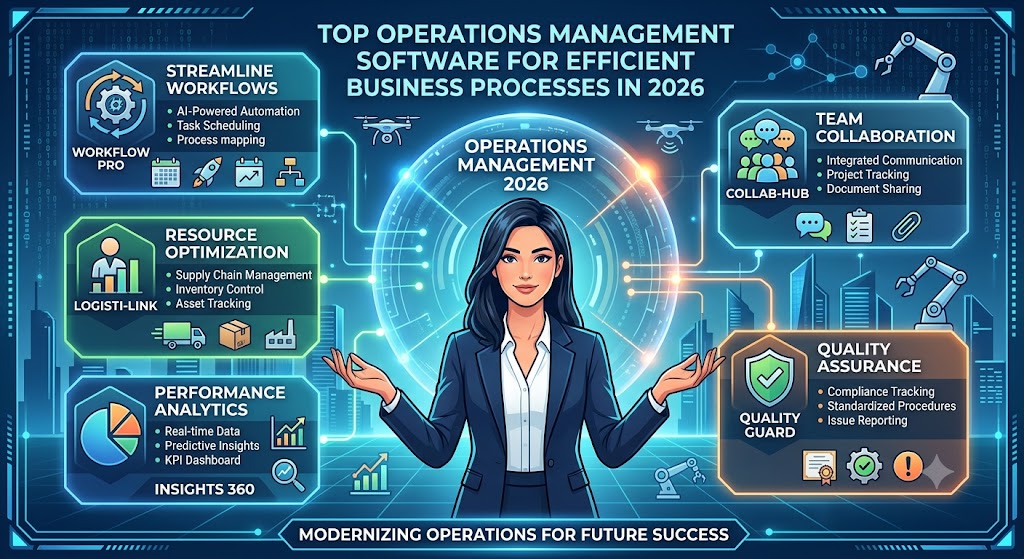
In today’s highly competitive business environment, operational efficiency plays a huge role in long-term success. Organizations face constant pressure to cut costs, boost productivity, deliver great customer experiences, and react swiftly to market shifts.Managing operations manually or with disconnected systems often causes delays, communication gaps, and inefficiencies that hurt profitability.That’s why operations management software has become a must-have investment for businesses in 2026.This software helps organizations streamline workflows, automate repetitive tasks, optimize resources, and improve collaboration. It also gives real-time visibility into business processes.Modern solutions blend artificial intelligence, automation, analytics, and cloud tech to help companies run smarter and faster than ever.Whether you run a manufacturing company, logistics business, retail store, healthcare organization, construction firm, or professional services agency, picking the right operations management platform can seriously boost your performance.This guide dives into the top operations management software solutions in 2026, covering their features, benefits, pricing, and how to choose the best fit for your business.
What Is Operations Management Software?
Operations management software is a digital platform that helps organizations plan, monitor, control, and optimize their daily business operations. It brings together a range of activities into one place.These activities include inventory management and workforce scheduling. It also covers production planning and procurement processes.Supply chain management, project coordination, and resource allocation fall under its scope as well. Plus, it tracks performance and provides reporting and analytics.The main goal? To boost efficiency while cutting down on costs and mistakes.
Why Businesses Need Operations Management Software in 2026
Business operations have gotten more complex with globalization, hybrid work models, and rising customer expectations.Modern operations software helps organizations by providing process automation. Automation cuts down on repetitive manual tasks like approvals, notifications, and report generation.Managers get better visibility by accessing real-time data on operational performance and bottlenecks.Improved collaboration happens when departments communicate and work from a single source of truth.Businesses can reduce costs by optimizing inventory levels, staffing, and resource use.Advanced analytics speed up decision-making by delivering actionable insights right away.
Key Features to Look For
When choosing operations management software, companies should focus on these capabilities:Workflow automation that handles repetitive tasks and business rules.Resource planning to better allocate people, budgets, and equipment.Inventory management that tracks stock and avoids shortages or overstocking.Reporting and analytics offering dashboards and performance indicators.Mobile accessibility so teams can work remotely and stay connected.Integration support to connect with ERP, CRM, accounting, and HR platforms.Artificial intelligence that predicts trends and helps optimize decisions.
1. Oracle NetSuite
Overview
Oracle NetSuite remains one of the most powerful cloud ERP and operations management solutions available in 2026. It combines finance, procurement, inventory management, and supply chain operations into a single system.
Key Features
Financial management
Procurement automation
Demand forecasting
Inventory optimization
Warehouse management
Supply chain visibility
Advantages
Highly scalable
Excellent analytics
Strong international support
Comprehensive ERP functionality
Disadvantages
Higher implementation costs
Requires training for new users
Best For
Large businesses and enterprises.
2. SAP S/4HANA
Overview
SAP continues to lead enterprise operations management with advanced automation and analytics. Its capabilities include real-time operational reporting and AI-powered insights.
Key Features
Real-time operational reporting
Production planning
Procurement management
Asset lifecycle management
Predictive analytics
AI-powered insights
Advantages
Enterprise-grade scalability
Industry-specific modules
Strong security controls
Disadvantages
Complex implementation
Premium pricing
Best For
Multinational corporations and large enterprises.
3. Microsoft Dynamics 365 Operations
Overview
Microsoft Dynamics 365 blends ERP with business intelligence and workflow automation. It offers a familiar user experience, especially for those already in the Microsoft ecosystem.
Key Features
Supply chain management
Warehouse operations
Production scheduling
Financial integration
AI analytics
Business dashboards
Advantages
Seamless Microsoft integration
Familiar user experience
Flexible deployment options
Disadvantages
Advanced features require premium plans.
Best For
Organizations using Microsoft ecosystems.
4. Odoo
Overview
Odoo has grown into a popular modular platform for small and medium businesses. It offers a range of tools that help streamline operations.
Key Features
Inventory management
Manufacturing operations
Procurement workflows
Accounting tools
HR management
CRM integration
Advantages
Affordable pricing
Open-source flexibility
Extensive customization
Disadvantages
You’ll need some technical know-how to customize it effectively.
Best For
Growing businesses and startups.
5. Zoho Operations Suite
Overview
Zoho offers a budget-friendly solution with workflow automation and business management tools.
Key Features
Workflow automation
Inventory management
Customer management
Mobile access
Reporting tools
Advantages
Cost-effective
Easy to implement
User-friendly
Disadvantages
Limited features for enterprise-level needs.
Best For
Small businesses and startups.
6. Monday.com Work OS
Overview
Monday.com started as a project management tool but has grown into a robust operational platform.
Key Features
Workflow automation
Task management
Resource planning
Team collaboration
Reporting dashboards
Advantages
User-friendly
Highly customizable
Powerful automation
Disadvantages
Costs can add up for larger teams.
Best For
Service businesses and agencies.
7. ClickUp
Overview
ClickUp delivers a flexible, all-in-one productivity and operations platform for organizations.
Key Features
Project management
Time tracking
Documentation
Automation rules
Resource planning
Advantages
Packed with features
Competitive pricing
Great collaboration tools
Disadvantages
Beginners might find it tricky at first.
Best For
Technology companies and growing businesses.
8. Smartsheet
Overview
Smartsheet blends spreadsheets with powerful operations management tools.
Key Features
Resource management
Workflow automation
Reporting dashboards
Approval systems
Project tracking
Advantages
It offers a familiar interface and strong reporting features.
Plus, it scales well as your needs grow.
Disadvantages
Some users might find the interface a bit outdated.
Best For
Operations and finance teams.
Benefits of Operations Management Software
Increased Productivity
Employees spend less time on manual tasks and focus more on strategic work.
Improved Collaboration
Departments communicate more smoothly.
Better Customer Service
Businesses respond faster to customer requests and issues.
Reduced Costs
Automation cuts labor and administrative expenses.
Enhanced Compliance
Standardized processes make audits simpler.
Artificial Intelligence in Operations Management
AI has become a major trend in operations software in 2026.
Predictive Maintenance
AI spots equipment failures before they happen.
Demand Forecasting
Businesses can better anticipate future inventory needs.
Intelligent Scheduling
AI automatically assigns resources and staff.
Process Optimization
Machine learning finds inefficiencies and suggests fixes.
Emerging Trends in 2026
Hyperautomation
Companies are automating entire workflows, not just single tasks.
Internet of Things Integration
Connected devices deliver real-time operational data.
Digital Twins
Virtual models let businesses test improvements safely.
Low-Code Platforms
Employees build workflows without needing programming skills.
Sustainability Tracking
Organizations keep an eye on environmental impact and resource use.
How to Choose the Right Operations Management Software
Identify Your Business Needs
Pinpoint which operational challenges need fixing.
Consider Scalability
Pick software that can grow with your business.
Evaluate Integration Capabilities
Make sure it plays well with your current systems.
Analyze Pricing
Factor in implementation and subscription costs.
Review Security Features
Keep your sensitive data protected.
Test User Experience
Go for software your team can adopt quickly.
Comparison Table
Software |
Best For |
Automation |
Scalability |
Ease of Use |
|---|---|---|---|---|
Oracle NetSuite |
Enterprises |
Excellent |
Excellent |
Good |
SAP S/4HANA |
Global Corporations |
Excellent |
Excellent |
Moderate |
Microsoft Dynamics 365 |
Microsoft Users |
Excellent |
Excellent |
Good |
Odoo |
SMBs |
Very Good |
Good |
Very Good |
Zoho Operations Suite |
Startups |
Good |
Good |
Excellent |
Monday.com |
Teams and Agencies |
Excellent |
Good |
Excellent |
ClickUp |
Growing Businesses |
Excellent |
Good |
Good |
Smartsheet |
Operations Teams |
Very Good |
Excellent |
Good |
Frequently Asked Questions
What is operations management software?
It’s software that helps businesses automate and improve their daily operations.
Which software is best for small businesses?
Odoo and Zoho stand out because they’re affordable and flexible.
Which solution is best for enterprises?
Oracle NetSuite and SAP S/4HANA are still the top choices.
Can operations management software reduce costs?
Absolutely. Automation cuts down on labor expenses and streamlines processes.
Does modern operations software include AI?
Yes, most top solutions now come with AI-powered analytics and forecasting tools.

Conclusion
Operations management software has shifted from being a nice-to-have to a must-have. Companies that use modern operational platforms get better visibility, improved teamwork, and smarter decision-making.Choosing the right solution depends a lot on your company’s size, industry, budget, and how complex your operations are. Small businesses might find affordable, flexible tools like Odoo and Zoho a good fit. Meanwhile, larger enterprises often need more robust systems like Oracle NetSuite or SAP S/4HANA.As organizations push forward with digital transformation in 2026, picking the right operations management software could be the edge that boosts efficiency and fuels growth.
