
The way businesses operate has changed dramatically over the past few years, and 2026 marks a turning point where AI-native SaaS platforms have become the default rather than the exception. The global SaaS market has now crossed the $300 billion mark, and companies of every size from solo founders to multinational enterprises are rethinking their software stacks around automation, integration, and artificial intelligence.
But with thousands of tools competing for attention, choosing the right stack has become harder, not easier. Every category, from project management to accounting, has a dozen credible options with different pricing models, AI capabilities, and learning curves. Pick the wrong combination and you end up with “SaaS sprawl” overlapping subscriptions that drain budgets without adding real value. In fact, research shows the average company now uses around 130 SaaS applications but only actively uses about 45% of the features it pays for, wasting roughly $135,000 a year on unused or underused licenses.
This guide breaks down the most important SaaS categories for business automation and productivity in 2026, highlights the leading tools in each, and explains what actually separates a good tool from a great one this year: how intelligently it uses AI, how well it plays with the rest of your stack, and how much manual work it genuinely removes from your team’s day.
Why SaaS Buying Decisions Look Different in 2026
A few years ago, choosing software mostly came down to features and price. Today, three additional factors dominate every serious buying decision:
AI-native capability. Tools that simply bolt on a chatbot are no longer competitive. The platforms winning market share in 2026 use AI to actually reduce human workload generating workflows from plain-language descriptions, predicting bottlenecks before they happen, and learning from a company’s own data to get smarter over time.
Integration depth. No single platform does everything well, so the strength of a tool’s API and its native integrations with the rest of your stack matters as much as its own feature set.
Total cost of ownership. With SaaS sprawl now a recognized budget problem, procurement teams are auditing subscriptions quarterly, consolidating overlapping tools, and increasingly relying on SaaS management platforms just to keep track of what they’re actually paying for.
With that context in mind, here’s a category-by-category look at the tools shaping business automation and productivity this year.
1. Workflow Automation and Integration Platforms
If there’s one category that defines “automation” in the SaaS world, it’s this one the tools that connect your other apps together so information moves without anyone copying and pasting.
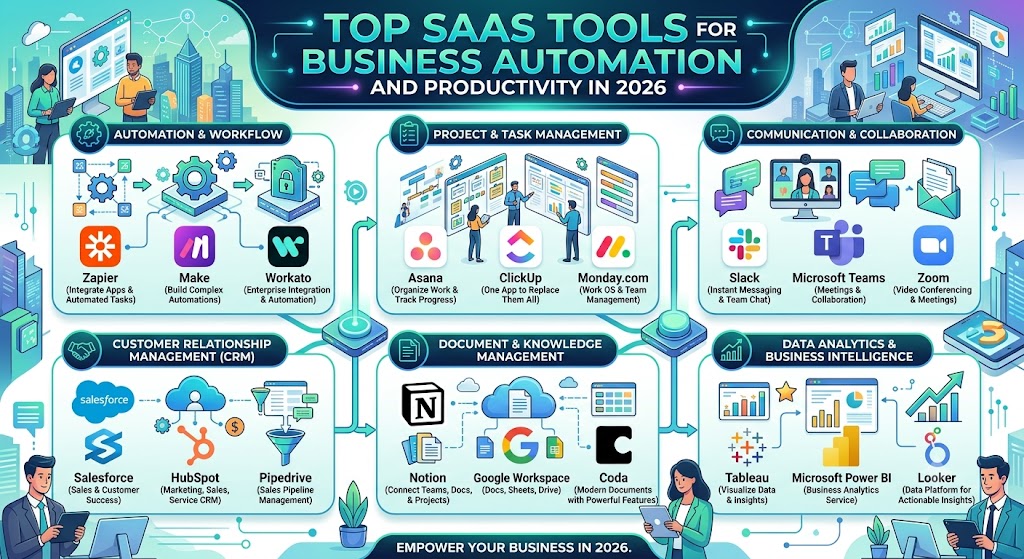
Zapier remains the backbone of no-code automation, connecting thousands of apps so that tasks trigger automatically across a business’s entire toolset. What’s changed in 2026 is how automations get built: instead of manually mapping out steps, users can now describe what they want in plain language and have the workflow generated for them automatically. For a small business juggling ten or more SaaS subscriptions, this kind of platform is what turns a pile of separate apps into one coherent system.
Make (formerly Integromat) continues to be the go-to alternative for teams that want more visual, complex automation logic branching paths, error handling, and multi-step data transformations that go beyond simple trigger-action pairs.
n8n has grown in popularity among technical teams that want the flexibility of self-hosting or more granular control over their automation logic without vendor lock-in.
For any business serious about automation in 2026, one of these integration layers is close to non-negotiable it’s the connective tissue that keeps a growing tool stack from turning into chaos.
2. Project and Work Management
Teams that still coordinate work through email threads, spreadsheets, and scattered chat messages are operating at a real disadvantage. A dedicated project management tool touches nearly every function of a business: who’s doing what, what’s due when, what’s blocked, and what’s finished.
Asana continues to be considered a gold standard for teams that want structure without rigidity. Its workflow builder lets teams automate task assignment, status updates, and notifications based on triggers, and its AI features can now generate entire project plans from a short description, suggest task assignments based on who has capacity, and flag projects that are trending behind schedule before they become a crisis.
Monday.com remains a flexible “work OS” that scales from marketing campaigns to full product roadmaps, with strong built-in automation and templates that make it approachable for teams without a dedicated ops person.
Linear has become the preferred alternative to heavier tools like Jira for software teams that want speed — a fast, keyboard-driven interface with automatic workflows and cycle-based planning built specifically for engineering teams that want to ship without excess process overhead.
Trello still holds its place for smaller teams that just want a simple, visual Kanban board without a steep learning curve.
Lark has emerged as an interesting all-in-one option, bundling chat, documents, and a no-code database (Lark Base) into a single interface appealing to hybrid teams trying to consolidate multiple subscriptions into one place.
3. Customer Relationship Management (CRM)
CRM platforms remain the backbone of sales and customer operations, and in 2026 the category has split fairly clearly between all-in-one suites and pipeline-focused tools.
HubSpot continues to be the closest thing to a “does everything” CRM combining email automation, sales pipelines, live chat, and reporting in one place, which makes it especially strong for inbound marketing and lead management.
Salesforce remains the enterprise standard for organizations that need deep customization, complex reporting, and the ecosystem of add-ons that come with being the largest CRM platform in the world.
Pipedrive stays popular with sales-first teams that want a clean, visual pipeline without the overhead of a full marketing suite letting reps track deals, automate follow-ups, and keep their focus on closing.
Zoho CRM and Bitrix24 continue to appeal to businesses that want CRM bundled tightly with broader operational tools marketing, project management, and analytics inside a single connected ecosystem rather than a standalone product.
4. AI Assistants and Content Generation
Perhaps no category has evolved faster than AI productivity tools. What used to be a novelty asking a chatbot to draft an email has become core infrastructure for research, writing, coding, and decision-making.
ChatGPT remains one of the most widely used AI assistants for drafting content, analyzing data, brainstorming, and automating repetitive workflows, with the ability to build custom assistants tailored to specific business functions.
Claude has built a strong reputation for nuanced analysis, long-document processing, and complex reasoning — particularly for tasks that demand careful attention to detail, like code review, contract analysis, and research synthesis.
Google Gemini and Perplexity round out the top tier of general-purpose AI assistants, each with particular strengths in search-grounded answers and integration with existing productivity suites.
Jasper remains focused specifically on marketing content blog posts, ad copy, product descriptions, and email campaigns that maintain a consistent brand voice, which can meaningfully cut down production time for teams that publish a high volume of content.
Notion AI has become a quiet but powerful layer inside one of the most widely used workspace tools, offering writing help, summarization, and Q&A directly where teams already keep their documentation.

5. Marketing Automation and Email
Marketing teams in 2026 are less focused on any single channel and more focused on unifying data across every touchpoint from the first ad click to the final renewal.
ActiveCampaign continues to lead on deep segmentation and complex customer journeys, letting teams build multi-step campaigns triggered by specific behaviors and tags.
Mailchimp remains a dependable choice for straightforward email marketing campaign design, automation, and performance tracking especially for newsletters and customer follow-ups.
HubSpot Marketing Hub and Bitrix24 continue to bundle email, social scheduling, audience segmentation, and A/B testing into broader all-in-one platforms, giving smaller teams a central place to manage outreach without stitching together five separate tools.
Social Champ and Hootsuite remain the standard choices for social media scheduling, analytics, and AI-assisted caption generation across multiple platforms from a single dashboard.
6. Communication and Collaboration
Remote and hybrid work is no longer a trend it’s simply how most teams operate, which makes communication tooling a permanent fixture of the SaaS stack.
Slack remains the default for instant messaging and cross-team coordination, especially once layered with its growing library of workflow automations.
Zoom continues to anchor video conferencing, particularly for teams that need reliable screen sharing and recording for demos, training, and client calls.
Microsoft 365 remains dominant in enterprise environments where deep integration with existing Office tools, security policies, and compliance requirements matters more than flexibility.
Miro has become a go-to virtual whiteboard for teams that need to brainstorm, map workflows, or plan visually together particularly useful for distributed product and design teams.
Meetgeek and similar AI meeting assistants now handle much of the manual note-taking burden, automatically transcribing calls and turning them into searchable, shareable records so teams can stay present in the conversation instead of typing notes.
7. Finance, Accounting, and HR Automation
Back-office automation has quietly become one of the highest-ROI categories in SaaS, simply because manual data entry is where costly errors and audit failures tend to originate.
QuickBooks and Xero remain the standard choices for small and mid-sized businesses automating invoicing, expense tracking, and financial reporting, with AI features increasingly able to categorize expenses, flag anomalies, and forecast cash flow automatically.
Brex has become a common choice for corporate card management and spend controls, particularly among fast-growing startups.
Rippling continues to expand its footprint by combining HR, payroll, and IT device management into a single system a strong fit for companies that want fewer logins and less manual syncing between departments.
Workday and NetSuite remain the enterprise-grade choices for organizations that need advanced ERP functionality, global payroll compliance, and the ability to handle complex, multi-country labor law requirements automatically.
8. Customer Support and Success
As customer expectations keep rising, support tooling has shifted from simple ticketing systems to full automation layers that handle a meaningful share of inquiries without a human ever getting involved.
Zendesk remains one of the most established platforms for ticketing, live chat, and knowledge base management at scale.
Intercom continues to stand out for product-led companies that want support embedded directly inside their app, combining conversational AI bots, behavior-triggered messaging, and in-app product tours.
Freshdesk remains a clean, approachable option for small and mid-sized support teams that want ticketing and self-service without a steep setup process.
Custify and similar customer success platforms have grown in importance for subscription businesses specifically trying to reduce churn tracking product usage and health scores so teams can intervene before a customer disengages, rather than after they cancel.
9. Data, Analytics, and Business Intelligence
Every automation stack eventually needs a layer that turns raw activity into decisions, and this category has matured significantly in 2026.
Tableau remains a leading choice for visualizing KPIs and building dashboards that non-technical stakeholders can actually use.
Google Analytics continues to anchor most companies’ understanding of web and marketing performance.
Snowflake has become foundational infrastructure for companies that need to consolidate data from product databases, marketing platforms, and billing systems into one queryable layer, letting analytics, AI, and business intelligence tools all pull from the same source of truth.
10. Design and Documentation
Figma remains the standard collaborative design tool for teams building UI/UX, wireframes, and prototypes together in real time.
Notion continues to serve as a flexible documentation and knowledge-base layer, often sitting at the center of a company’s internal operations especially once paired with its AI writing and summarization features.
11. Keeping SaaS Sprawl Under Control
With the average company now running well over a hundred SaaS applications, managing the stack itself has become its own discipline. SaaS sprawl typically happens when different teams adopt tools independently without any central coordination, and it’s expensive: unused licenses, overlapping functionality, and forgotten renewals quietly drain budgets every year.
A few practical habits go a long way toward preventing this:
- Run a quarterly audit of every active subscription across departments.
- Consolidate overlapping tools rather than letting each team keep its own favorite.
- Require approval for new software purchases above a set spending threshold.
- Use a SaaS management platform like Zylo or Productiv to track usage patterns and flag underutilized licenses automatically.
- Assign clear ownership a single person or team responsible for software procurement decisions, rather than leaving it to whoever happens to sign up for a free trial first.
Building Your 2026 Stack: A Practical Approach
There’s no single “correct” stack the right combination depends heavily on company size, industry, and how distributed the team is. That said, a few patterns are worth keeping in mind when building or refreshing a stack this year:
Start with the core. Most businesses need, at minimum, a communication tool (Slack or Microsoft 365), a project management tool (Asana or Monday.com), and a CRM (HubSpot or Pipedrive) before anything else. These three form the operational backbone that everything else connects to.
Add automation early, not last. Many teams treat integration platforms like Zapier as an afterthought once they already have five disconnected tools. It’s far more effective to bring in an automation layer while the stack is still small, so every new tool gets connected properly from day one.
Layer in AI deliberately. Rather than adopting AI tools for their own sake, look for the specific repetitive tasks eating the most time content drafting, meeting notes, expense categorization, lead scoring and choose AI-native tools that directly address those bottlenecks.
Reassess regularly. The tools that made sense for a five-person team rarely make sense for a fifty-person one. Building in a habit of quarterly review keeps the stack aligned with the business rather than a relic of decisions made a year or two earlier.
Final Thoughts
The SaaS landscape in 2026 isn’t really a story about more tools it’s a story about tools finally becoming smart enough to remove real work from people’s plates instead of just organizing it. Automation platforms that build workflows from plain language, CRMs that predict which deals need attention, and AI assistants that draft, summarize, and analyze on demand are no longer futuristic add-ons; they’re baseline expectations.
The businesses getting the most value out of this shift aren’t necessarily the ones with the biggest budgets they’re the ones that choose deliberately, integrate thoughtfully, and revisit their stack often enough to catch the waste before it becomes a real cost. Whether you’re a solo founder picking your first three tools or an operations lead auditing a hundred-app stack, the fundamentals are the same: pick tools that talk to each other, automate the boring parts first, and keep asking whether each subscription is still earning its place.
