
A regional accounting firm found this out the expensive way. A ransomware attack locked their client files for four days, cost real money in ransom negotiation and recovery, and led to a lawsuit from a client whose tax records were exposed in the process. When they called their insurance broker expecting their general liability policy to cover it, the answer was a firm no. Their policy protected them if a client slipped on the office floor. It said nothing about a laptop getting encrypted by an attacker on the other side of the world.
This mix-up happens constantly, and it’s understandable “liability insurance” sounds like it should be one broad category covering anything a business might get sued or held responsible for. In practice, general liability and cyber liability are built to cover almost entirely different categories of risk, and a business carrying only one, assuming it covers both, is carrying a real, often invisible gap until the day something happens and reveals it.
This guide breaks down what each policy actually covers, where the overlap and gaps sit, and how a business should think about whether it needs one, the other, or both.
What General Liability Insurance Actually Covers
General liability insurance is built around the traditional, physical-world risks businesses have dealt with for decades. It typically covers three broad categories.
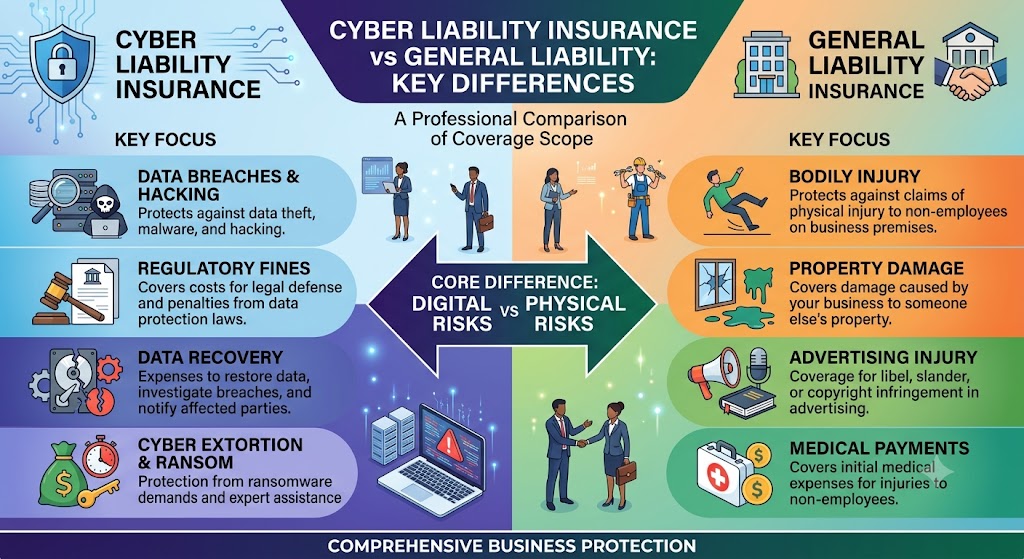
Bodily injury claims — if a customer, vendor, or visitor is physically injured on business premises or as a result of business operations, general liability covers the resulting medical costs and any legal liability.
Property damage claims — if business operations damage someone else’s property, whether a client’s office during a service call or a rented commercial space, general liability typically covers the cost of that damage.
Personal and advertising injury claims — this covers things like libel, slander, copyright infringement in advertising, or other reputational harm claims that don’t involve physical injury or property damage but still create legal liability.
This coverage is foundational for almost every business with any physical presence or in-person interaction with customers, vendors, or the public — retail stores, contractors, restaurants, professional service firms with client meetings, really any business where people physically interact with the company’s operations or property.
What general liability was never designed to cover is anything involving digital data, computer systems, or the specific financial and legal fallout of a data breach or cyberattack. It’s not a matter of a policy being poorly written — data breaches and ransomware simply didn’t exist as a mainstream business risk when general liability coverage frameworks were built, and most standard policies explicitly exclude cyber-related incidents as a result, or at minimum offer extremely limited coverage that falls far short of what an actual breach costs to resolve.
What Cyber Liability Insurance Actually Covers
Cyber liability insurance was built specifically to fill that gap, covering the financial and legal consequences of data breaches, ransomware, and other cyber incidents. Coverage generally splits into two categories.
First-party coverage deals with costs the business itself incurs directly following an incident: forensic investigation to determine what happened, business interruption losses from downtime, ransomware payments (where the policy covers extortion), costs of restoring or recovering data and systems, breach notification costs for informing affected customers, and credit monitoring services offered to those affected.
Third-party coverage deals with claims made against the business by others harmed by the incident: legal defense costs if customers or partners sue over the breach, settlements or judgments from those lawsuits, and in some cases, regulatory fines and penalties where those are legally insurable.
Some cyber policies also include coverage for social engineering fraud where an employee is tricked into wiring funds or sharing sensitive information through a convincing scam and for the costs of managing public relations and reputational fallout after an incident becomes public.
Where the Real Gap Sits
The clearest way to see the difference is through a concrete comparison. If a customer trips over a loose cable in a store and breaks their wrist, that’s a general liability claim — physical injury on the premises. If a hacker breaches the store’s point-of-sale system and steals thousands of customers’ payment card information, that’s a cyber liability claim — no physical injury, no property damage in the traditional sense, but very real financial and legal consequences.
A business that assumes general liability has this covered because “insurance is insurance” discovers the gap at the worst possible time — in the middle of an actual breach, when forensic investigation, legal counsel, and notification costs are piling up with no coverage behind them. This is exactly the situation the accounting firm from the opening example found themselves in, and it’s a remarkably common story precisely because the labels sound similar enough to create false confidence.
Do Small Businesses Actually Need Cyber Liability Coverage?
There’s a persistent assumption that cyberattacks are mainly a large-company problem, aimed at big-name breaches that make the news. In reality, small businesses are frequently targeted specifically because they tend to have weaker security defenses and are less likely to have specialized incident response resources in place. Attackers have also increasingly automated much of their targeting process, making it just as feasible to attack a hundred small businesses as one large corporation.
Any business handling customer payment information, personal data, or health records carries real exposure regardless of size. Even businesses that don’t think of themselves as “tech companies” — a dental office, a small retailer, a local accounting firm — hold exactly the kind of sensitive data that makes a breach costly to resolve and creates real legal exposure if that data gets exposed.
What a Cyber Policy Typically Requires
Because cyber risk is different from physical risk, insurers generally underwrite cyber policies differently than general liability, often requiring a security questionnaire or, for larger policies, a more detailed technical assessment before coverage is issued. Common baseline expectations include multi-factor authentication on email and remote access systems, regular and tested data backups kept separate from the main network, some form of endpoint protection beyond basic antivirus software, and a documented, even if basic, incident response plan.
A business without these baseline practices in place may face higher premiums, more limited coverage, or in some cases difficulty getting coverage at all. This is worth knowing before shopping for a policy, since addressing these basics beforehand can meaningfully affect both the cost and availability of coverage.
Comparing the Costs
General liability insurance is generally one of the more affordable and standard business insurance products, with premiums shaped mostly by industry, revenue, and claims history, reflecting decades of well-understood actuarial data behind it.
Cyber liability premiums vary more widely and tend to run higher relative to coverage amount than general liability, particularly for businesses handling sensitive data types like health records or high transaction volumes of payment card data. Pricing has also shifted meaningfully in recent years as insurers have adjusted to a changing threat landscape, with underwriting requirements tightening in response to the rise in ransomware and large-scale breaches across the industry.
It’s worth noting that most businesses end up needing both types of coverage rather than choosing one over the other, since they protect against fundamentally different categories of risk that a modern business realistically faces simultaneously.
Overlap and Gray Areas
There are a few areas where the line between the two policies gets genuinely blurry, and it’s worth understanding these specifically rather than assuming either policy automatically covers them.
Reputational harm from a data breach sometimes overlaps with the “personal and advertising injury” coverage in a general liability policy, but this typically applies to more traditional reputational harm claims like defamation, not the reputational fallout specifically tied to a cyber incident, which cyber policies are built to address more directly.
Physical damage caused by a cyber incident for example, an attack on industrial control systems that causes actual physical damage to equipment can sometimes trigger a genuinely complicated question of which policy responds, and this is an area where specialized coverage, sometimes a separate technology errors and omissions policy, may be needed depending on the specific industry and risk profile.
Vendor and third-party data exposure if a business’s data is exposed through a breach at a vendor or partner rather than the business’s own systems is another area worth clarifying directly with an insurer, since coverage can depend heavily on the specific contractual relationships and how the policy defines a covered incident.
Because these gray areas exist, working with a broker who specifically understands cyber risk, rather than treating it as an add-on line item on a standard commercial policy application, tends to produce much clearer, more reliable coverage.

Building the Right Combination of Coverage
Rather than treating this as a choice between one policy or the other, most businesses are better served thinking through what a complete, appropriate insurance program actually looks like for their specific operations.
A business with any physical location, employees, or in-person customer interaction almost certainly needs general liability coverage as a baseline, regardless of its digital risk profile.
A business that stores, processes, or transmits any customer or employee data — which describes the overwhelming majority of businesses operating today, even ones that don’t think of themselves as tech-driven should seriously evaluate cyber liability coverage as a genuine necessity rather than an optional add-on.
Businesses in specific higher-risk categories healthcare, financial services, e-commerce, or any business processing significant payment card volume should expect cyber coverage to be a larger, more central part of their overall insurance program given the sensitivity of the data typically involved and the regulatory scrutiny that follows a breach in these industries.
What Happens Without the Right Coverage
The consequences of carrying the wrong policy, or assuming one covers what it doesn’t, tend to surface at the worst possible moment during an actual incident, when the business is already dealing with operational disruption and needs to move quickly. Without cyber coverage, a business facing a breach typically has to cover forensic investigation, legal counsel, notification costs, and any resulting settlements entirely out of pocket, costs that can run into the hundreds of thousands of dollars even for a moderately sized incident, before accounting for the operational disruption and reputational damage that comes alongside it.
For a lot of small and mid-size businesses, an uncovered cyber incident isn’t just an expensive inconvenience — it’s a genuine threat to the business’s continued survival, which is exactly why treating this coverage as optional in 2026, given how routinely small businesses are targeted, is a real gamble rather than a reasonable cost-cutting decision.
The Bottom Line
General liability and cyber liability insurance protect against fundamentally different categories of risk, and neither one is a substitute for the other. General liability handles the traditional physical-world risks of bodily injury, property damage, and certain reputational claims. Cyber liability handles the financial and legal fallout of data breaches, ransomware, and other digital incidents that general liability was never built to cover. Most modern businesses genuinely need both, and understanding exactly where each policy’s coverage starts and stops rather than assuming either one automatically covers the other’s territory is the difference between discovering a coverage gap during a routine policy review and discovering it in the middle of an actual crisis.
FAQs
Does my general liability policy cover a data breach at all? Generally, no, or only in very limited ways. Most standard general liability policies explicitly exclude cyber-related incidents like data breaches and ransomware, since these policies were built around traditional physical risks like bodily injury and property damage, not digital data incidents.
Is cyber liability insurance only necessary for tech companies? No — any business that stores, processes, or transmits customer or employee data carries real cyber risk, regardless of industry. This includes retailers, medical and dental practices, accounting firms, and many other businesses that wouldn’t typically describe themselves as tech-focused but still hold exactly the kind of sensitive data that makes a breach costly.
Can I add cyber coverage as a simple add-on to my existing general liability policy? Some insurers offer limited cyber endorsements that can be added to a general liability policy, but these tend to offer much narrower coverage than a dedicated, standalone cyber liability policy. For businesses with any meaningful cyber risk exposure, a dedicated cyber policy generally provides more complete and reliable protection.
What’s the biggest mistake businesses make regarding these two types of coverage? Assuming general liability insurance already covers cyber incidents, and only discovering the gap during an actual breach, when it’s far too late to add coverage retroactively. The second most common mistake is underestimating cyber risk because the business doesn’t think of itself as a target, when in reality small businesses are frequently targeted precisely because of weaker defenses.
Do I need to meet specific security requirements to get cyber liability coverage? Often yes — many insurers now require baseline security measures like multi-factor authentication and regular data backups before issuing a policy, and some require a security questionnaire or technical assessment as part of underwriting. Businesses without these basics in place may face higher premiums or more limited coverage options.
How much does cyber liability insurance typically cost compared to general liability? Cyber liability premiums tend to run higher relative to coverage amount than general liability, and pricing varies significantly based on industry, the sensitivity of data handled, and existing security practices. General liability premiums are generally more standardized, reflecting decades of established risk data behind that category of coverage.
If I already have cyber liability insurance, do I still need general liability? Yes, in almost all cases. Cyber liability covers digital incidents specifically and doesn’t address traditional risks like a customer injury on business premises or property damage during a service call. Most businesses need both types of coverage together to address the full range of risk they realistically face.
