
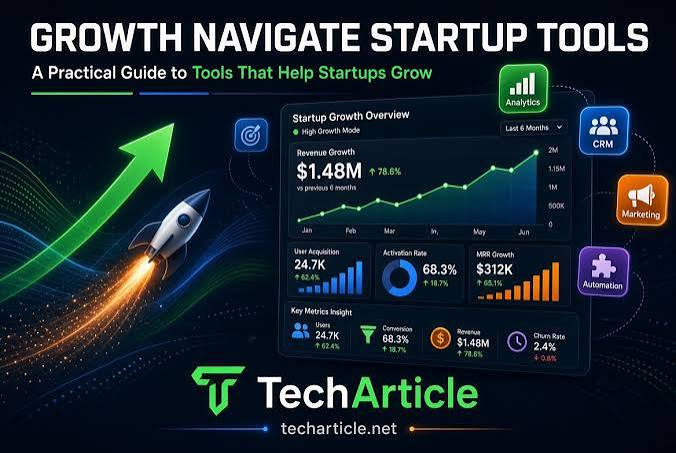
Starting a business is exciting, but growing a startup can be challenging. Early-stage companies often have limited budgets, small teams, and many responsibilities to manage at the same time. Founders may need to handle marketing, customer support, sales, product development, finances, analytics, and team communication while also trying to understand what customers actually want.
This is where startup tools can make a meaningful difference.
The phrase “Growth Navigate Startup Tools” can be understood as a practical approach to finding and using digital tools that help startups organize their work, understand their customers, improve marketing, manage projects, and make better growth decisions. Instead of relying on dozens of complicated platforms, startups can select tools based on their actual needs and stage of development.
This guide explains the main categories of startup tools, how they can support business growth, what founders should consider before choosing software, and how to build a simple technology stack without unnecessary costs.
What Are Growth Navigate Startup Tools?
Growth Navigate Startup Tools refers to software and online resources that can help startups move from an early idea toward a more organized and scalable business.
These tools can support different parts of a startup, including:
- Project management
- Customer relationship management
- Marketing
- Search engine optimization
- Website analytics
- Communication
- Accounting and budgeting
- Customer support
- Product development
- Automation
- Team collaboration
- Market research
There is no single tool that is perfect for every startup. A technology company, online store, consulting business, and mobile app startup may all need different software.
The goal should not be to collect as many tools as possible. The goal is to choose tools that solve real problems.
Why Do Startups Need Digital Tools?
A small team can accomplish a lot, but time and resources are limited. Repetitive tasks can consume hours that could otherwise be spent improving the product or talking to customers.
For example, a startup may use one system to manage customer information, another to schedule tasks, and another to measure website traffic.
The right tools can help by:
- Reducing repetitive work
- Keeping information organized
- Improving communication
- Tracking business performance
- Supporting customer relationships
- Making marketing more measurable
- Helping teams collaborate remotely
- Providing useful data for decision-making
However, software does not automatically create growth. Tools are most useful when they support a clear business strategy.
1. Project Management Tools
Project management is one of the first areas where a growing startup can benefit from software.
A project management platform can help teams organize tasks, assign responsibilities, set deadlines, and monitor progress.
Popular categories include task boards, calendar-based planning systems, and project management platforms.
A startup might create separate projects for:
- Product development
- Website improvements
- Marketing campaigns
- Content creation
- Customer onboarding
- Business operations
The most important feature is not the number of features available. It is whether the team actually uses the system consistently.
For a small startup, a simple task board may be enough. A larger organization may need more advanced project planning, reporting, and permission controls.
2. Customer Relationship Management Tools
Customer relationships are extremely important for startups.
A customer relationship management, or CRM, system helps businesses organize information about leads and customers.
A CRM can potentially help a startup track:
- Contact information
- Sales opportunities
- Previous conversations
- Follow-up dates
- Customer status
- Sales activity
Without a structured system, customer information can become scattered across email accounts, spreadsheets, messaging applications, and personal notes.
A CRM provides a central location for important customer information.
Startups should choose a CRM based on their sales process. A company with a simple sales cycle may only need basic contact and pipeline management. Businesses with larger sales teams may require automation, reporting, and integrations.
3. Website Analytics Tools
Understanding website visitors is essential for many startups.
Analytics tools can provide information about how people interact with a website or application. Depending on the platform and configuration, businesses may be able to understand traffic sources, popular pages, user behavior, conversions, and other performance indicators.
For example, a startup may discover that visitors frequently reach its pricing page but rarely complete the signup process.
That information can lead to useful questions:
- Is the pricing unclear?
- Is the signup process too complicated?
- Are customers missing important information?
- Is the page slow?
- Does the product provide enough value before asking for registration?
Analytics should be used to investigate these questions rather than simply collecting large amounts of data.
4. SEO and Content Tools
Search engine optimization can be valuable for startups that want to attract people through organic search.
SEO tools can assist with areas such as:
- Keyword research
- Competitor research
- Website audits
- Backlink analysis
- Content planning
- Search performance monitoring
Content tools can also help teams plan blog posts, guides, tutorials, comparison pages, and educational resources.
However, using SEO software does not guarantee higher rankings.
Search engines evaluate many signals, and search results can change over time. Startups should focus on creating useful content that genuinely answers users’ questions.
Good startup content should be:
- Accurate
- Original
- Easy to understand
- Relevant to the audience
- Updated when necessary
- Written for people rather than search engines
5. Marketing Automation Tools
As a startup grows, marketing can involve many repetitive tasks.
Marketing automation software can help businesses manage activities such as email campaigns, lead nurturing, audience segmentation, and scheduled communications.
For example, a company might send a welcome email when someone creates an account. Another automated message might explain how to use a product several days later.
Automation can save time, but it should be used carefully.
Too many automated messages can annoy customers. Startups should provide useful information rather than sending messages simply because an automation workflow exists.
6. Email Marketing Tools
Email remains an important communication channel for many businesses.
Email marketing platforms can help startups build subscriber lists, create campaigns, segment audiences, and measure performance.
Common email campaign types include:
- Welcome emails
- Product updates
- Educational newsletters
- Special announcements
- Customer onboarding messages
- Re-engagement campaigns
A good email strategy focuses on relevance and value.
Startups should also follow applicable privacy, consent, and email marketing laws in the regions where they operate.
7. Communication and Collaboration Tools
Remote and hybrid teams need reliable communication systems.
Collaboration tools can support:
- Team messaging
- Video meetings
- File sharing
- Internal announcements
- Project discussions
- Document collaboration
One common problem is having too many communication channels.
If a team uses email, several chat applications, multiple project boards, and different document systems without clear rules, employees may struggle to find important information.
A better approach is to define where different types of communication should happen.
For example:
- Urgent discussions → team messaging
- Formal information → email
- Tasks → project management platform
- Shared documents → cloud storage
- Meetings → video conferencing
The exact setup depends on the organization.

8. Financial and Accounting Tools
Financial management is another important area for startups.
Accounting and budgeting software can help businesses organize income, expenses, invoices, payments, and financial records.
A startup should understand its:
- Monthly expenses
- Revenue
- Cash flow
- Outstanding payments
- Operating costs
- Budget
- Financial runway
Financial software does not replace professional accounting advice where that is required. Businesses should maintain accurate records and follow applicable tax and financial regulations.
A simple financial dashboard can also help founders identify problems early.
9. Customer Support Tools
Customer support becomes increasingly important as a startup gains users.
Support platforms can help organize customer questions and requests. Depending on the system, businesses may have access to ticket management, live chat, knowledge bases, automation, and reporting.
A useful support system should make it easier for customers to get answers.
Startups should monitor recurring questions because they can reveal weaknesses in the product or documentation.
For example, if customers repeatedly ask how to complete the same basic task, the company might improve its onboarding instructions or create a dedicated help article.
10. Product Development Tools
Technology startups often need specialized tools for designing, developing, testing, and managing products.
These may include:
- Code repositories
- Issue tracking systems
- Design platforms
- Prototyping tools
- Testing platforms
- Documentation systems
- Deployment tools
The best development stack depends heavily on the product.
A startup building a simple website does not need the same infrastructure as a company developing a large cloud application.
Founders should avoid choosing technology simply because it is popular. Compatibility, security, cost, scalability, and team experience are all important considerations.
11. Automation and No-Code Tools
Automation can be especially useful for small teams.
No-code and low-code platforms allow businesses to connect different applications and automate repetitive workflows without requiring extensive programming.
For example, a startup might create a workflow where:
- A customer submits a form.
- The information is added to a CRM.
- A notification is sent to the sales team.
- A confirmation email is sent to the customer.
- A task is created for follow-up.
Automation can save time, but every workflow should be reviewed carefully.
An incorrect automation can create duplicate records, send incorrect emails, or move information to the wrong place.
12. AI Tools for Startups
Artificial intelligence tools are becoming increasingly common in startup workflows.
AI can assist with tasks such as:
- Brainstorming
- Research support
- Drafting content
- Summarizing documents
- Customer service assistance
- Data analysis
- Coding support
- Workflow automation
AI should generally be treated as an assistant rather than an unquestioned source of truth.
Information generated by AI can contain errors, outdated information, or unsupported claims. Businesses should review important outputs before publishing or using them in decisions.
This is particularly important for financial, legal, medical, security, and other high-stakes information.
How to Choose the Right Startup Tools
Choosing software can become difficult because there are thousands of options.
A useful process is to start with the problem rather than the software.
Ask:
What problem are we trying to solve?
If the problem is unclear, buying software may not help.
How often does the problem occur?
A task that happens once a month may not justify an expensive platform. A repetitive daily task might.
How many people will use the tool?
Pricing can change significantly as a team grows.
Does the tool integrate with existing software?
Integration can reduce duplicate work and data entry.
Is the data secure?
Startups may handle customer information, payment data, internal documents, or other sensitive business information. Security should be considered before adopting a platform.
Can the business afford it long term?
A tool may look inexpensive at first but become costly as users, contacts, or usage increase.
Avoiding the “Too Many Tools” Problem
One of the biggest mistakes startups can make is adopting too many platforms.
Every new tool can introduce:
- Additional costs
- Training requirements
- Passwords and accounts
- Data management responsibilities
- Integration problems
- Security considerations
A startup might begin with a simple technology stack consisting of:
- One project management system
- One communication platform
- One CRM
- One analytics solution
- One accounting system
- One cloud storage platform
Additional software can be introduced when a genuine need appears.
Measuring Whether a Tool Is Working
After adopting a tool, startups should evaluate whether it is actually producing value.
Useful questions include:
- Is the team using it?
- Has it reduced manual work?
- Has it improved accuracy?
- Is it saving time?
- Has it improved customer service?
- Is it helping generate or retain revenue?
- Are employees finding it easy to use?
A tool that has many advanced features but is rarely used may not be a good investment.
The goal is business improvement, not software accumulation.
Startup Growth Requires More Than Software
Technology can support growth, but it cannot replace a strong business model.
A startup still needs to understand its customers and provide something valuable.
Important growth foundations include:
Customer Understanding
Talk to customers and learn what problems they actually experience.
Product Quality
A large marketing campaign cannot permanently solve a product that does not meet customer expectations.
Clear Positioning
Customers should understand what the company offers and why it matters.
Consistent Marketing
Marketing works better when it is based on a clear audience and measurable objectives.
Financial Discipline
Growth without financial control can create serious problems.
Customer Retention
Acquiring customers is only part of the challenge. Keeping satisfied customers can be equally important.
Creating a Simple Growth Navigate Startup Stack
A startup can create its technology stack in stages.
Stage 1: Idea and Validation
At this stage, focus on:
- Research
- Customer interviews
- Simple documentation
- Basic project management
- Prototype development
There is usually little reason to purchase a large number of enterprise tools.
Stage 2: Early Customers
Once customers arrive, focus on:
- CRM
- Customer support
- Analytics
- Email communication
- Basic accounting
- Product feedback
Stage 3: Growing Team
As the organization grows, consider:
- Advanced project management
- Marketing automation
- More detailed analytics
- Team collaboration systems
- Workflow automation
- Improved security controls
Stage 4: Scaling
A larger company may need:
- Advanced reporting
- Data management
- Enterprise security
- More sophisticated automation
- Role-based permissions
- Specialized financial and operational software
The stack should evolve with the business rather than being built all at once.
Common Mistakes When Selecting Startup Tools
Startups should be careful about several common mistakes.
Choosing Based Only on Popularity
A famous tool may not be the best choice for a particular business.
Ignoring Total Cost
Consider subscription fees, implementation, training, integrations, and future pricing increases.
Buying Before Testing
Whenever possible, test software before committing to a long-term plan.
Ignoring Data Security
Understand where business information is stored and who can access it.
Focusing on Features Instead of Results
More features do not necessarily mean better results.
Failing to Train the Team
Even excellent software can fail if employees do not understand how to use it.
The Future of Startup Tools
Startup technology will likely continue becoming more integrated and automated.
AI-powered features, workflow automation, analytics, and collaborative platforms may reduce the amount of manual work required for many business processes.
However, technology will continue to require human judgment.
Founders still need to decide:
- Which customers to target
- What problems to solve
- Which products to build
- How to price them
- How to communicate with customers
- Where to invest resources
The most successful technology strategy is therefore not necessarily the one with the most advanced software. It is the one that helps people make better decisions and complete important work more efficiently.
Final Thoughts
Growth Navigate Startup Tools can be viewed as a practical framework for selecting technology that supports startup growth.
From project management and CRM systems to analytics, marketing, accounting, customer support, automation, and AI, different tools can solve different business problems.
The key is to start with the business need.
Instead of asking, “Which tool should we buy?” founders should ask, “What problem are we trying to solve, and will this tool provide enough value to justify its cost and complexity?”
A simple, well-organized technology stack can often be more useful than a collection of expensive platforms.
As the startup grows, its tools can grow with it. By regularly reviewing costs, usage, security, integrations, and business results, founders can build a technology environment that supports sustainable growth rather than creating unnecessary complexity.
