
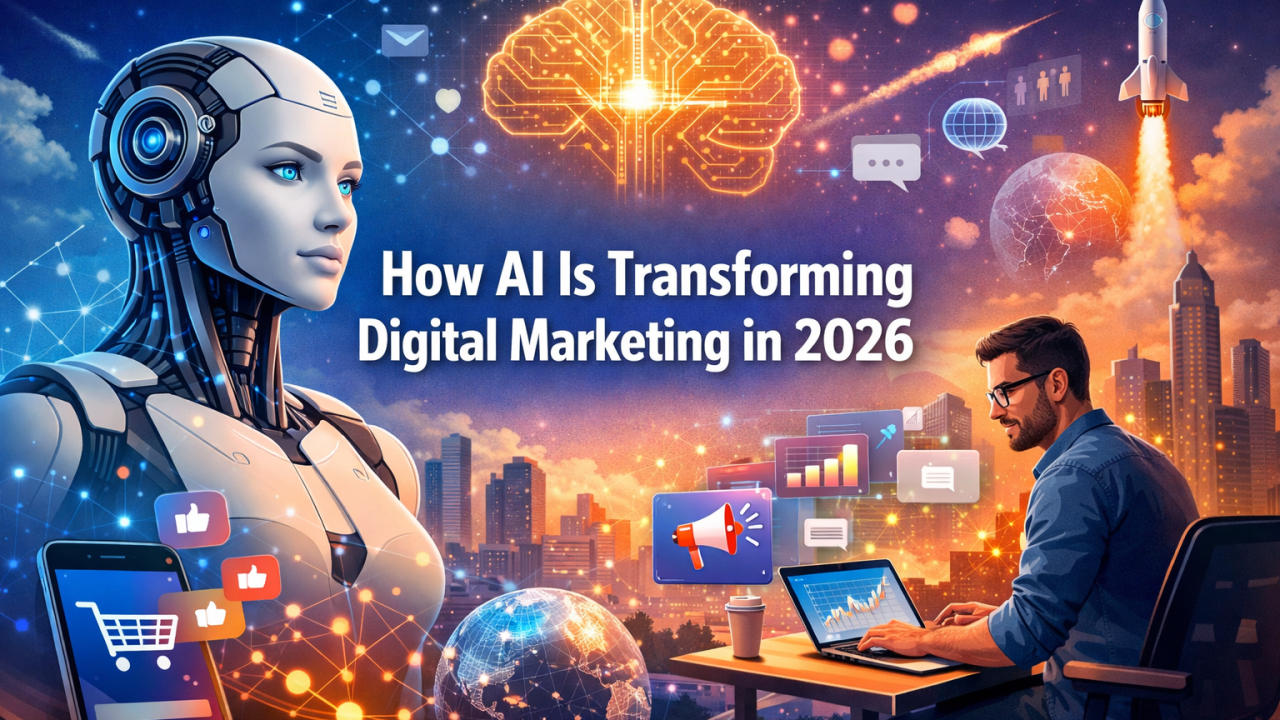
Digital marketing in 2026 looks fundamentally different from just two years ago not because a single new platform emerged, but because AI has moved from experimental add-on to core infrastructure. What started as basic automation and simple data analysis has evolved into systems that can analyze audience behavior in real time, predict what customers will do next, generate content across multiple formats, and optimize campaigns without constant manual intervention.
The shift isn’t just technological it’s changing what marketing jobs actually look like. Instead of focusing purely on execution, marketing professionals are increasingly expected to interpret AI-generated insights, guide strategy, and make judgment calls that automation still can’t make on its own. The brands winning in 2026 aren’t the ones using the most AI tools they’re the ones combining AI efficiency with strong human strategy, automating repetitive execution while keeping creative energy focused on messaging, positioning, and genuine customer understanding.
Here’s a detailed look at how AI is actually reshaping digital marketing this year the trends defining the space, the tools driving it, and the strategies that separate leaders from everyone else.
1. Hyper-Personalization Becomes the Default, Not a Differentiator
Personalization has been part of marketing for years, but in 2026 it’s shifted from a nice-to-have into a baseline expectation. Customers simply expect brands to know what they want, and AI is what makes that possible at scale automated emails, landing pages, and ads now adapt dynamically to individual behavior rather than relying on broad audience segments.
This goes beyond just inserting a customer’s name into an email. AI systems now analyze real-time behavioral data browsing patterns, purchase history, engagement signals to adjust messaging, offers, and even creative assets for each individual user, at a scale that would be impossible for human marketers to manage manually.
2. Autonomous, Agentic Campaign Management
One of the most significant shifts in 2026 is the move toward AI managing entire campaigns end-to-end optimizing creatives, budgets, and targeting in real time without requiring constant manual adjustment. This isn’t just automation of individual tasks anymore; it’s agentic AI making ongoing decisions across a live campaign.
This shift is already becoming a serious planning priority in the advertising industry. IAB’s 2026 Outlook Study found that two-thirds of ad buyers are now focused specifically on agentic AI for ad buying and campaign execution, while 73% are prioritizing content optimized for AI-generated answers reflecting how much this trend has moved from experimental to expected.
3. AI-Generated Video Content at Scale
Video continues to dominate marketing strategy, but what’s changed in 2026 is how it’s produced. AI tools now enable brands to produce cinematic-quality video content in hours instead of weeks, dramatically compressing what used to be a resource-heavy production process. Social media algorithms are also increasingly favoring AI-generated, consistent, high-quality short-form video, pushing brands to treat video content as a volume game rather than a handful of expensive, carefully-planned productions.
4. Multimodal Content Generation From a Single Brief
Rather than generating one type of content at a time, AI tools now generate coordinated assets across multiple formats in minutes from a single creative brief. A product launch, for example, might simultaneously produce a written blog post, social media graphics, a 60-second explainer video, and even an AR-based virtual try-on experience all derived from the same core brief rather than being built separately by different teams.
This shift is driven by two forces: growing consumer preference for visual, interactive content, and AI’s rapidly improving ability to interpret and generate across different content types simultaneously.
5. Predictive Analytics for Smarter Budget Allocation
AI-powered predictive analytics now play a central role in how marketing budgets get allocated. Rather than reacting to results after a campaign runs, marketers increasingly use AI to forecast conversions, customer behavior, and expected ROI ahead of time allowing budgets to be allocated toward what’s predicted to perform best, rather than adjusted only after the fact.
This proactive shift also extends into content strategy. Instead of chasing trends after they’ve already peaked, predictive content marketing analyzes data from keyword trends, social chatter, and industry reports to anticipate what audiences will care about next letting savvy marketers get ahead of a trend rather than reacting to it.
6. Smarter, More Efficient Paid Advertising
Paid advertising has become significantly more efficient through AI-driven automation. Ad platforms now use machine learning to refine bidding strategies, target audiences more precisely, and place advertisements more effectively than manual management typically allows. In practice, this means businesses can reduce the cost of acquiring new customers, make ads more relevant to each viewer, and adjust campaigns in real time as performance data comes in rather than waiting for a weekly or monthly review to make changes.
7. AI Chatbots as a Core Customer Engagement Channel
AI-powered chatbots have improved dramatically in 2026, moving well beyond simple scripted responses. They now provide customer support, suggest relevant products, and assist users across websites and messaging platforms with a level of nuance that feels much closer to a real conversation. Using AI chatbots, brands can respond to customer inquiries faster, automatically qualify leads, and provide round-the-clock support all of which contributes to a smoother, more satisfying customer experience without requiring a proportionally larger support team.
8. Conversational and Visual Search Optimization
Search behavior itself is shifting, and marketing strategy is adapting alongside it. Customers are increasingly using voice assistants and image-based search tools to find products and information, rather than relying solely on traditional typed search queries. As a result, marketers now need to optimize content specifically for voice, image, and natural language queries not just traditional keyword-based SEO to stay visible as these search habits become more mainstream.
9. Smart Audience Segmentation Beyond Demographics
AI is also changing how audiences get segmented in the first place. Rather than relying primarily on basic demographic categories (age, location, income bracket), smart segmentation now targets audiences based on actual behavior browsing patterns, purchase history, and engagement signals resulting in more accurate targeting and, ultimately, better campaign performance.
10. Human Judgment Remains the Essential Layer
Despite how far AI has come, one theme runs consistently through 2026’s marketing landscape: AI can draft, summarize, generate, and optimize, but humans still need to decide what’s accurate, appropriate, original, and strategically sound. Businesses are becoming more aware of AI’s limits questions around bias, compliance, and originality mean human judgment remains essential, not optional.
The value in 2026 lies less in simply having access to AI tools, and more in knowing how to direct them effectively. The most successful marketing teams treat AI as an accelerant for execution, not a replacement for strategic thinking they still rely on human insight to interpret AI-generated data, set direction, and safeguard brand voice and authenticity.
The Tools Powering AI Marketing in 2026
While the specific tool landscape shifts constantly, most AI marketing stacks in 2026 tend to fall into a few core categories:
- Content generation tools – AI writing assistants and multimodal generators that produce blog posts, ad copy, social captions, and video content from a single brief
- Predictive analytics platforms – tools that forecast customer behavior, conversions, and ROI to guide budget allocation before a campaign launches
- Ad automation platforms – machine-learning-driven ad management systems that handle bidding, targeting, and real-time optimization across paid channels
- Conversational AI tools – chatbots and virtual assistants integrated into websites and messaging apps for customer support and lead qualification
- SEO and search optimization tools – platforms that help brands optimize for AI-generated answers, voice search, and visual search alongside traditional keyword SEO
For an AI tool to actually be useful, marketing teams also need clean, accessible data behind it — CRM records, product feeds, customer segments, consent records, campaign taxonomy, and content metadata all need to be in good shape, since AI tools are only as effective as the information they’re able to access.
Growth Strategies That Actually Deliver Results
Beyond individual trends and tools, a few overarching strategies separate the businesses seeing real results from those simply experimenting:
- Smart segmentation – targeting audiences by actual behavior rather than just broad demographics
- Personalized campaigns at scale – using AI to attract the right customer with the right message at the right moment
- Enhanced, dynamic interaction – content that responds and adapts to audience behavior in real time, rather than staying static
- Scaling without proportional manual work – automating repetitive execution so campaigns can run enterprise-wide without a matching increase in headcount
- Continuous ROI optimization – using real-time feedback loops to make ongoing adjustments rather than waiting for post-campaign reviews
Quick Comparison: 2026 AI Marketing Trends at a Glance
Trend |
What It Changes |
Why It Matters |
|---|---|---|
Hyper-personalization |
Broad segments → individual targeting |
Personalization is now expected, not a differentiator |
Autonomous/agentic campaigns |
Manual optimization → real-time AI management |
Two-thirds of ad buyers prioritizing this shift |
AI-generated video |
Weeks-long production → hours |
Video still dominates engagement and reach |
Multimodal content generation |
Single-format assets → coordinated multi-format output |
One brief now produces text, image, video, and AR |
Predictive analytics |
Reactive reporting → forward-looking budget allocation |
Improves ROI by acting before results come in |
Smarter paid ads |
Manual bidding → ML-optimized targeting |
Lowers customer acquisition costs |
AI chatbots |
Basic scripts → nuanced, real-time support |
Faster response times, automatic lead qualification |
Conversational/visual search |
Keyword-only SEO → voice and image optimization |
Matches how customers are actually searching now |
Behavior-based segmentation |
Demographics → actual behavior signals |
More accurate targeting and better performance |
Human oversight |
AI as full replacement → AI as accelerant |
Prevents bias, compliance, and originality issues |
Conclusion
AI has firmly moved from an experimental marketing tool to the operating infrastructure of digital marketing in 2026. Hyper-personalization, agentic campaign management, AI-generated video, predictive analytics, and multimodal content creation are no longer emerging ideas they’re the standard expectations customers and platforms now hold brands to. The businesses seeing the strongest results aren’t necessarily the ones with access to the most advanced tools; they’re the ones that understand how to direct those tools effectively while keeping human judgment firmly in the loop for strategy, originality, and brand authenticity.
The clearest lesson from this year’s shift is that AI amplifies good strategy it doesn’t replace the need for one. Teams that treat AI purely as a shortcut for thinking tend to produce generic, forgettable content at scale, while teams that use AI to handle repetitive execution freeing up time for genuine creative and strategic work are the ones actually pulling ahead. As search behavior shifts toward voice and visual queries, as agentic AI takes on more of campaign execution, and as customers come to expect deeply personalized experiences by default, the marketers who succeed in 2026 will be the ones who combine AI’s speed and scale with the judgment only a human strategist can provide.
FAQs
1. How is AI changing digital marketing in 2026? AI has moved from a basic automation tool to a strategic layer supporting content creation, performance optimization, and customer targeting across the entire customer journey — enabling hyper-personalization, predictive analytics, and even autonomous campaign management.
2. What is agentic AI in marketing? Agentic AI refers to AI systems that can plan, execute, analyze, and optimize parts of a marketing campaign with minimal manual intervention — for example, adjusting ad targeting and budgets in real time rather than waiting for a human to review performance data first.
3. Is AI-generated video content actually good enough for professional marketing? Increasingly, yes. AI tools now allow brands to produce cinematic-quality video content in hours rather than weeks, and social platforms are favoring this kind of consistent, high-quality short-form video in their algorithms.
4. Will AI replace digital marketers? Not entirely. While AI can draft, generate, and optimize content and campaigns, human judgment remains essential for deciding what’s accurate, original, and strategically appropriate. Marketers are shifting toward interpreting AI-driven insights and guiding strategy rather than doing purely manual execution.
5. What is hyper-personalization, and why does it matter in 2026? Hyper-personalization uses AI to adapt emails, landing pages, and ads to individual customer behavior in real time, rather than relying on broad audience segments. It matters because customers now expect this level of tailored experience as a baseline, not a special feature.
6. How is search behavior changing because of AI? Customers are increasingly using voice assistants and image-based search tools instead of relying solely on typed keyword searches. This is pushing marketers to optimize content for conversational and visual search, alongside traditional SEO.
7. What role do AI chatbots play in digital marketing now? AI chatbots have become significantly more capable in 2026, offering customer support, product suggestions, and lead qualification across websites and messaging platforms — helping brands respond faster and provide support around the clock.
8. How does predictive analytics improve marketing ROI? Predictive analytics allows marketers to forecast conversions, customer behavior, and expected ROI before a campaign launches, enabling budgets to be allocated toward what’s predicted to perform well rather than adjusted only after results come in.
9. What data do businesses need to make AI marketing tools effective? AI tools are only as useful as the information they can access — including CRM records, product feeds, customer segments, consent records, campaign taxonomy, and content metadata. Clean, well-organized data is essential for AI tools to produce accurate, useful outputs.
10. What’s the biggest mistake businesses make when adopting AI in marketing? Treating AI purely as a shortcut for thinking, rather than a tool to direct strategically. The most effective marketing teams in 2026 combine AI automation with strong human judgment, creativity, and strategic oversight rather than handing over decision-making entirely.
