
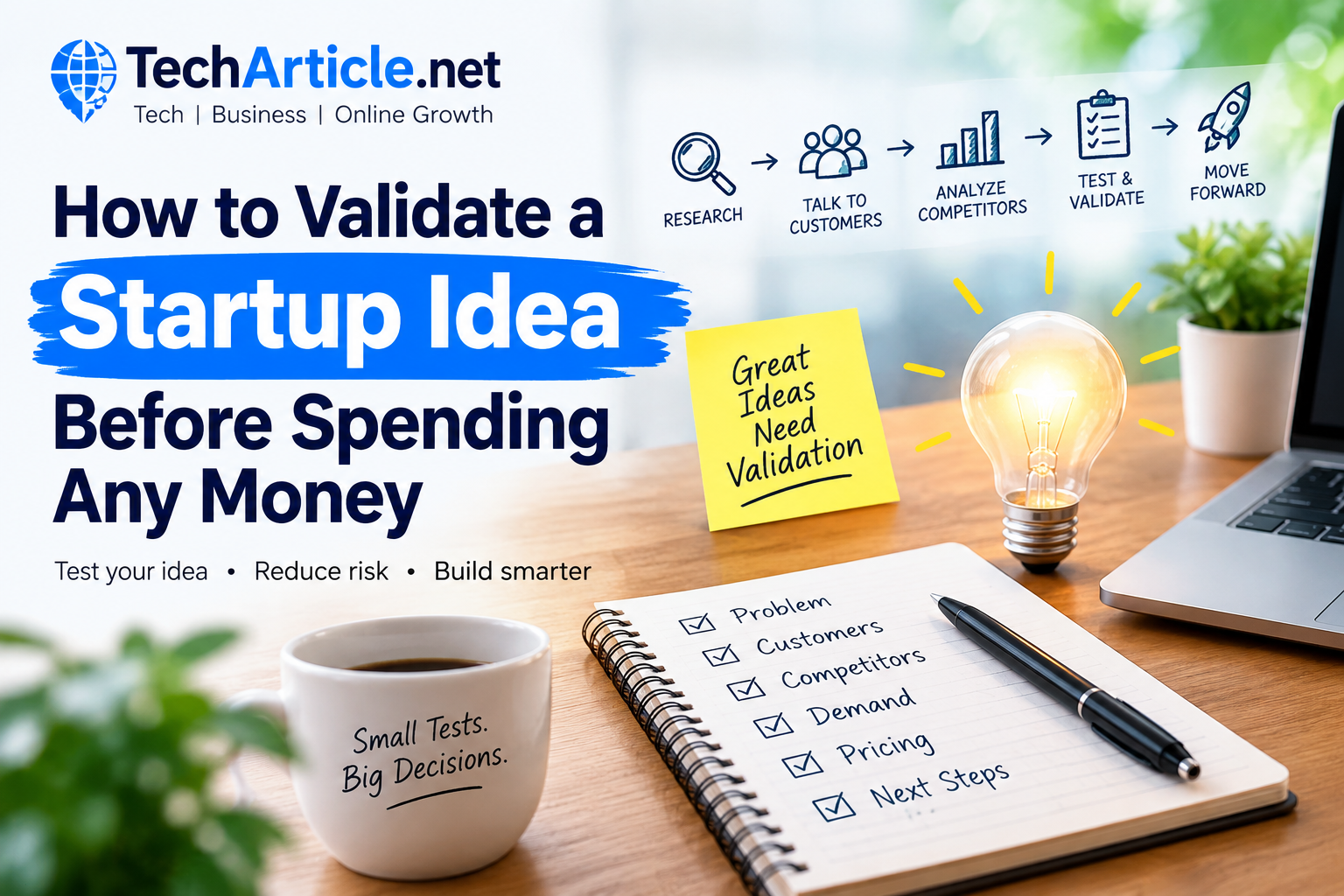
Starting a business can be exciting, but turning an idea into a real company requires more than enthusiasm. Many entrepreneurs spend money on websites, software, advertising, branding, inventory, or office space before confirming that people actually want what they plan to offer.
The good news is that you do not need a large budget to test whether a startup idea has potential. You can often learn a great deal by researching the market, talking to potential customers, studying competitors, and creating a simple version of your proposed product or service.
Startup validation is the process of gathering evidence to determine whether a business idea solves a real problem for a specific group of people. The goal is not to prove that an idea will definitely succeed. Instead, validation helps reduce unnecessary risk and gives you better information before you commit significant time or money.
Here is a practical step-by-step approach to validating a startup idea before making a major investment.
1. Clearly Define the Problem
Before thinking about logos, business names, websites, or advertising, identify the problem your startup is supposed to solve.
A strong business idea usually begins with a specific problem rather than a vague desire to create a product.
Ask yourself:
- What problem am I solving?
- Who experiences this problem?
- How frequently does it occur?
- How are people currently solving it?
- Why might they want a better solution?
- Is the problem important enough for someone to spend money solving?
For example, saying “I want to create a productivity app” is too broad. A more specific idea might be “I want to help small freelance teams organize client deadlines without complicated project-management software.”
The second statement identifies a potential audience and a particular need. That makes the idea easier to research and test.
2. Identify Your Target Customer
One of the most common mistakes new entrepreneurs make is trying to sell to everyone.
A startup should have a reasonably clear initial audience. Your potential customers could be students, small businesses, parents, freelancers, online sellers, homeowners, or another specific group.
Create a simple customer profile that describes:
- Age range or general life stage
- Occupation or type of business
- Location, if relevant
- Common challenges
- Current alternatives
- Buying habits
- What they value when choosing a solution
You do not need to create a complicated marketing persona. The purpose is simply to understand who might realistically become your first customer.
The more clearly you understand the customer, the easier it becomes to test whether your idea addresses a meaningful need.
3. Research Existing Competitors
Competition is not necessarily a reason to abandon a startup idea. In many cases, competitors demonstrate that customers already spend money in the category.
Search for companies offering similar products or services. Look at their websites, pricing, features, customer reviews, social media activity, and marketing messages.
Pay particular attention to customer complaints.
Reviews can reveal things that competitors may not mention in their advertising. Customers might complain about complicated software, poor customer service, expensive subscriptions, slow delivery, limited features, or another recurring problem.
These complaints can help you identify opportunities for differentiation.
Instead of asking, “Does anyone else do this?” ask:
“What could I do differently or better for a clearly defined customer?”
4. Search for Evidence of Existing Demand
Before spending money, look for signs that people are already interested in solving the problem.
Useful sources of evidence can include:
- Search results
- Online forums
- Customer reviews
- Social media discussions
- Industry communities
- Product marketplaces
- Question-and-answer websites
- Competitor websites
- Industry reports
- Public discussions about the problem
You are looking for repeated evidence rather than one person’s opinion.
If many people independently describe the same problem, ask for recommendations, compare available solutions, or complain about existing options, that may indicate genuine demand.
However, online interest does not automatically mean commercial success. People may search for information without intending to purchase anything. That is why additional validation is important.
5. Talk to Potential Customers
Customer conversations can provide information that online research cannot.
Find people who fit your target audience and ask them about the problem you are investigating.
Avoid immediately asking:
People often give positive answers because they want to be encouraging. Their answers may not accurately predict future purchasing behavior.
Instead, ask questions about their existing experience.
For example:
- How do you currently solve this problem?
- How often does this happen?
- What is the most frustrating part?
- Have you paid for a solution before?
- What alternatives have you tried?
- What do you dislike about those alternatives?
- How much time or money does the problem currently cost you?
These questions focus on actual behavior rather than hypothetical opinions.
If several potential customers describe the same pain point independently, you have stronger evidence that the problem deserves further investigation.
6. Create a Simple Value Proposition
Once you understand the problem and customer, explain your proposed solution in one or two sentences.
A useful value proposition should make three things reasonably clear:
- Who the product is for
- What problem it addresses
- What benefit it provides
For example:
“An easy scheduling platform for independent consultants that helps them manage client appointments without complicated software.”
This statement is more useful than a vague description such as “The future of professional productivity.”
Clear communication also makes customer testing easier because people can quickly understand what you are proposing.
7. Build the Smallest Possible Test
You do not always need to build a complete product to test an idea.
Instead, create the simplest version that allows you to test your most important assumption.
Depending on the startup, this could be:
- A basic landing page
- A clickable prototype
- A simple form
- A manual service
- A sample product
- A short demonstration
- A waitlist
- A small pilot program
This approach is often associated with the idea of a minimum viable product, or MVP.
The purpose of an MVP is not to create a low-quality final product. It is to learn whether the core concept deserves further investment.
For example, if you want to build an automated service, you might initially provide the service manually to a small number of customers. This can help you understand the workflow before spending money on custom software.
8. Test Whether People Will Take Action
Interest is useful, but action provides stronger evidence.
Someone saying “That sounds like a great idea” is different from someone signing up for a waiting list, requesting a demonstration, submitting contact information, booking a consultation, or making a legitimate purchase.
Choose an appropriate action for your business model.
For a software product, you might test:
- Email sign-ups
- Demo requests
- Prototype usage
- Trial registrations
For a service business, you might test:
- Consultation bookings
- Service inquiries
- Pilot customers
For a physical product, you might test:
- Pre-orders, where appropriate
- Product inquiries
- Sample requests
- Interest from potential retailers
The exact measurement will depend on the business, but the principle is the same: look for behavior rather than relying only on compliments.
9. Test Pricing Carefully
A startup can have demand and still fail to become a sustainable business if customers are unwilling to pay enough to support the costs.
Pricing should therefore be part of validation.
Research competitor pricing and consider what customers currently pay for alternative solutions.
You can test different price points through legitimate offers or customer interviews, but avoid misleading customers about availability or pricing.
Ask questions such as:
- What do you currently pay for a similar solution?
- What would make a solution worth paying for?
- Which features matter most?
- What would make you switch providers?
Actual purchases are generally stronger evidence than hypothetical statements about what someone might pay.

10. Use a Landing Page as a Low-Cost Experiment
A simple landing page can be an inexpensive way to communicate your idea and measure interest.
The page could include:
- A clear headline
- The problem being addressed
- A concise explanation of the solution
- Key benefits
- Relevant examples
- Frequently asked questions
- A clear call to action
The call to action might invite visitors to join a waitlist, request information, book a consultation, or explore a legitimate early-access offer.
Avoid making exaggerated claims such as “guaranteed results” or “the world’s best solution” unless you can substantiate them.
Clear and accurate information is more useful for both customers and long-term marketing.
11. Run a Small Experiment Before a Large Campaign
Paid advertising can generate data, but spending heavily before understanding your audience can be expensive.
If you decide to use advertising, start with a controlled experiment rather than committing a large budget immediately.
Define what you want to learn.
For example:
- Which audience responds?
- Which message attracts attention?
- Which landing page receives more sign-ups?
- Are visitors taking the desired action?
- What questions do potential customers ask?
Keep the experiment small enough that the results provide useful information without creating unnecessary financial risk.
12. Measure the Right Signals
Validation requires measurable evidence.
Depending on your startup, useful metrics may include:
- Number of qualified inquiries
- Sign-up rate
- Demo requests
- Conversion rate
- Repeat usage
- Customer retention
- Purchase rate
- Customer acquisition cost
- Revenue per customer
- Refund or cancellation rate
Do not focus only on website traffic or social media likes.
A thousand visitors who do nothing may be less useful than a small group of highly relevant visitors who sign up or purchase.
The right metric is the one that helps answer your main business question.
13. Look for Patterns, Not Individual Opinions
One enthusiastic customer can be encouraging, but one conversation is rarely enough to validate an entire business.
Try to identify patterns across multiple potential customers.
For example, suppose you interview 20 people and discover that:
- Most experience the same problem.
- Many currently use an inconvenient alternative.
- Several have already paid for another solution.
- A number of them are interested in trying your proposed approach.
That collection of evidence is more meaningful than a single positive comment.
At the same time, negative feedback is valuable. If potential customers repeatedly reject the same part of your concept, investigate why.
Validation is about learning, not simply collecting confirmation.
14. Identify Your Biggest Assumption
Every startup idea contains assumptions.
You might assume that:
- Customers have the problem.
- They care enough to solve it.
- They can afford the solution.
- They can find your product.
- They trust your company.
- They will continue using the product.
- The business can serve customers profitably.
Identify the assumption that could cause the biggest failure if it turns out to be wrong.
Then test that assumption first.
For example, if your entire business depends on customers paying a particular price, pricing may be more important to test than the color of your website.
This approach helps entrepreneurs spend their limited resources on the questions that matter most.
15. Decide Whether to Continue, Change, or Stop
Validation does not always end with a “yes.”
Sometimes research shows that the original idea needs modification.
You may discover that:
- The target audience is different from what you expected.
- Customers want a different feature.
- The pricing is unrealistic.
- The problem is not important enough.
- Competitors already provide a better solution.
- Another customer segment has a stronger need.
This information is valuable because it can prevent you from spending significant money on an idea that needs major changes.
You can then adjust the concept and test it again.
This process is sometimes called pivoting, although not every change requires a complete change of direction.
16. Create a Simple Validation Checklist
Before investing heavily, ask yourself:
Problem
- Is there a specific problem?
- Who experiences it?
- How frequently does it occur?
Customer
- Can I clearly describe my target customer?
- Have I spoken to real people in this group?
Competition
- What alternatives already exist?
- What do customers like and dislike about them?
Demand
- Is there evidence of genuine interest?
- Are people taking meaningful actions?
Pricing
- Do customers appear willing to pay?
- Can the expected revenue support the business costs?
Testing
- Can I test the idea with a simple prototype or manual service?
- What is the biggest assumption I still need to verify?
Next Step
- What evidence would justify additional investment?
If several important questions remain unanswered, more validation may be worthwhile before committing substantial resources.
Conclusion
Validating a startup idea before spending money is essentially a learning process. Instead of assuming that an idea will work, entrepreneurs can gather evidence from customers, competitors, market research, small experiments, and real-world behavior.
The objective is not to eliminate every possible risk. No amount of research can guarantee that a startup will succeed. The objective is to make decisions using better information and avoid spending heavily before the most important assumptions have been tested.
Start with the problem. Identify a specific customer. Research existing alternatives. Talk to potential users. Build the simplest practical test. Measure real actions, examine pricing, and learn from both positive and negative feedback.
If the evidence supports the idea, you can gradually increase your investment. If the evidence reveals weaknesses, you can adjust the concept before those weaknesses become expensive problems.
A careful validation process can turn a startup idea from a guess into a business hypothesis that can be tested, improved, and evaluated with real evidence.
Frequently Asked Questions (FAQ)
1. What does startup validation mean?
Startup validation is the process of testing a business idea to determine whether it solves a real problem and whether potential customers are interested in the proposed solution.
2. Can I validate a startup idea without spending money?
Yes. You can start with free methods such as customer interviews, competitor research, online communities, surveys, and basic market research before investing in a product or advertising.
3. How do I know if my startup idea solves a real problem?
Talk to people who experience the problem and ask about their current solutions, frustrations, frequency of the problem, and whether they have already spent money trying to solve it.
4. Should I build a product before validating my idea?
Not necessarily. A landing page, prototype, manual service, or small pilot can often test the core idea before you invest in developing a complete product.
5. Why is competitor research important?
Competitor research shows what solutions already exist, what customers like or dislike about them, and where there may be opportunities to offer something different.
6. How many customers should I talk to before launching?
There is no universal number. The goal is to speak with enough relevant people to identify recurring patterns rather than relying on one or two opinions.
7. How can I test whether people will pay?
You can test legitimate pricing through early customer offers, pilot programs, service inquiries, pre-orders where appropriate, or other real purchase-related actions.
8. What should I do if people do not like my startup idea?
Treat negative feedback as useful information. Find out why they are not interested and consider changing the target customer, problem, pricing, or proposed solution before investing further.
9. What is an MVP?
An MVP, or minimum viable product, is a simple version of a product that allows you to test its core value with real users without building every planned feature.
10. When should I invest more money in my startup?
Consider increasing your investment when you have collected meaningful evidence that customers have the problem, understand your solution, are willing to take action, and the business model has a reasonable path to sustainability.
