
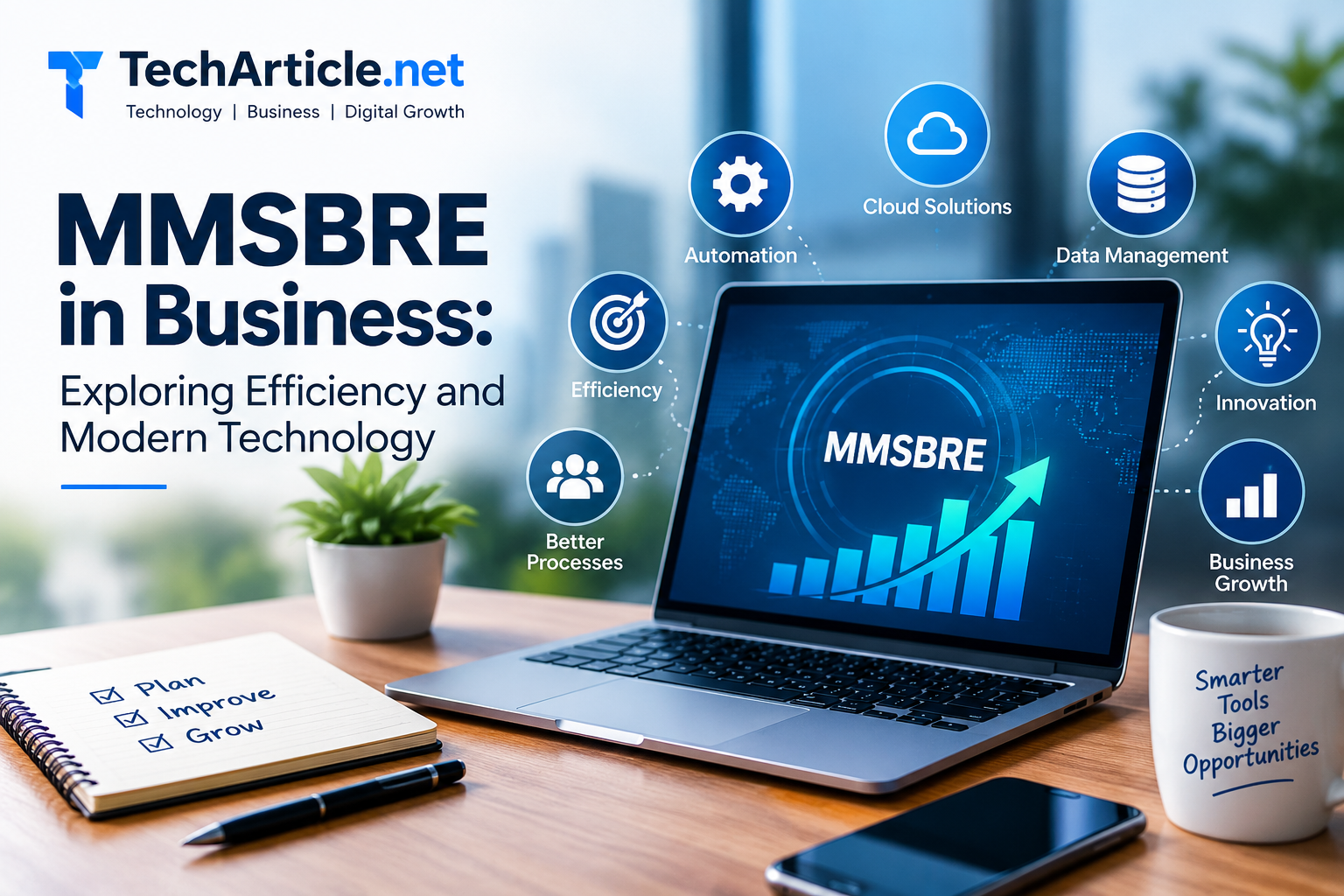
Businesses today rely on technology, data, communication, and efficient processes to achieve their goals. Whether a company operates online or manages a physical workplace, it needs practical ways to organize its work, serve customers, control costs, and respond to changing demands. This is where discussions about digital efficiency and business growth become important.
MMSBRE is a term that has appeared in online discussions about business operations, digital systems, and efficiency. However, it does not have one universally accepted definition or a clearly established meaning across the technology industry. Different online sources associate it with different concepts, so readers should consider the context in which the term is used.
For the purposes of this guide, MMSBRE is discussed as a business-oriented concept connected with digital efficiency, resource management, and sustainable growth. It should not be confused with a verified software product, official business standard, or established technology framework.
Understanding the ideas associated with MMSBRE can help readers explore practical ways to improve everyday business operations. This article explains the concept, its potential applications, its limitations, and the steps organizations can take to use digital tools more effectively.
What Is MMSBRE?
MMSBRE is an uncommon acronym whose meaning varies across online sources. There is no single verified definition that can be applied to every reference.
In a business context, the term can be used to discuss ideas such as improving workflows, organizing resources, using technology effectively, and making decisions based on useful information. These are established business practices, even though MMSBRE itself is not a universally recognized framework.
The central idea behind this interpretation is straightforward: organizations can often improve their performance by reviewing how they work and identifying opportunities to reduce unnecessary effort.
For example, a small business might use digital scheduling software to organize appointments, customer management tools to maintain records, and analytics to understand which products perform well. These tools can help employees spend less time on repetitive administrative work and more time on activities that support customers.
However, the results depend on the quality of the tools, the needs of the business, and how effectively the systems are implemented. Simply adopting new technology does not guarantee better performance.
When researching MMSBRE, it is therefore important to separate the general principles of digital efficiency from claims about a specific product or formal methodology.
Why Is MMSBRE Associated With Digital Efficiency?
Digital efficiency means using technology and organized processes to complete work accurately, consistently, and with less unnecessary effort.
Many businesses struggle with repetitive tasks, disconnected software, unclear responsibilities, and delays in communication. These problems can affect productivity and customer satisfaction.
Consider a small online retailer that manages orders through emails, tracks stock in separate spreadsheets, and answers customer questions manually. As the business grows, this approach can become difficult to maintain.
The owner might introduce an integrated order management system, automated stock alerts, and a shared customer support platform. These changes can reduce duplicate work and make important information easier to find.
This example illustrates how digital efficiency works in practice. The improvement comes from identifying a real problem and selecting suitable tools, rather than from following an unfamiliar acronym.
An MMSBRE-oriented discussion can serve as a starting point for examining these opportunities, provided that its meaning is clearly explained and its claims are not presented as established facts without evidence.
Key Areas Connected With MMSBRE
Although MMSBRE does not have a standardized set of components, several established business practices are relevant when discussing digital efficiency and growth.
1. Business Planning and Clear Objectives
Every successful improvement project needs a clear purpose. Before investing in technology or changing an existing process, a business should identify the problem it wants to solve.
For example, a company may want to reduce order processing time, improve customer response rates, or make its website easier to navigate.
Specific objectives help teams understand what they are working toward. They also provide a basis for evaluating whether a change has produced useful results.
Businesses should avoid adopting tools simply because competitors use them. A solution that works well for one organization may not suit another because of differences in size, budget, customers, and working methods.
2. Workflow Improvement
A workflow describes the steps involved in completing a task. Workflows may include approving documents, processing payments, publishing website content, or responding to customer requests.
Poorly designed workflows often contain unnecessary steps, repeated data entry, or unclear handoffs between employees.
Reviewing a workflow can reveal where delays occur and which tasks could be simplified. Automation may help with repetitive, rule-based activities, while tasks requiring judgment may still need human involvement.
For example, a content team might use a project management tool to assign articles, set deadlines, track revisions, and manage publication schedules. This makes responsibilities clearer and reduces the need for repeated status updates.
The best workflow is not necessarily the most automated one. It is the one that supports accurate, reliable work without introducing unnecessary complexity.
3. Effective Use of Digital Tools
Digital tools can support communication, accounting, customer service, marketing, inventory management, and many other business functions.
The challenge is choosing tools that work together and address genuine needs.
A company using multiple applications may discover that employees repeatedly transfer information between systems. In this situation, better integration or a simpler software setup may be more useful than purchasing another application.
Before adopting a tool, decision-makers should consider its cost, usability, security features, support options, and compatibility with existing systems.
They should also plan employee training. Even a capable application can deliver poor results when users do not understand how to operate it properly.
4. Data Management and Better Decisions
Data can help businesses understand performance, customer behavior, and operational problems. However, information is valuable only when it is accurate, relevant, and interpreted appropriately.
An online store, for instance, might review conversion rates, product returns, delivery times, and customer feedback. Together, these indicators can help identify areas that need attention.
Businesses should avoid making major decisions based on a single metric. An increase in website traffic does not automatically mean an increase in revenue, and a high number of customer inquiries does not necessarily indicate customer satisfaction.
Data should support human judgment rather than replace it entirely.
Organizations must also handle customer information responsibly, restrict unnecessary access, and follow applicable privacy and data protection requirements.
5. Customer Experience
Business growth depends partly on how well a company meets customer needs. Customers generally expect clear information, reliable service, reasonable response times, and straightforward ways to resolve problems.
Digital systems can help meet these expectations by making information easier to access and reducing avoidable delays.
For example, an online service provider might introduce a frequently asked questions page, an appointment booking system, or automated order confirmations.
These features can improve convenience when they are designed around genuine customer needs. However, automated replies should not prevent customers from contacting a person when they need additional assistance.
A customer-focused approach considers both efficiency for the business and usefulness for the customer.
How MMSBRE Can Support Business Growth
Growth involves more than increasing sales. A business also needs to manage its costs, maintain service quality, and ensure that its operations can handle additional demand.
The principles associated with digital efficiency can contribute to this process in several ways.
Reducing Unnecessary Costs
Businesses can review subscriptions, repetitive tasks, administrative procedures, and resource usage to identify avoidable expenses.
For example, removing duplicate software subscriptions may reduce monthly costs without affecting productivity.
However, cutting costs indiscriminately can create new problems. Removing essential security tools or reducing customer support too much may harm the business in the long run.
The objective should be to improve value, not simply spend less.
Improving Productivity
Employees can often achieve more when they have clear instructions, appropriate tools, and fewer unnecessary interruptions.
Standard operating procedures, shared calendars, task management systems, and automated reminders can help teams organize their work.
Productivity improvements should be evaluated carefully. Completing more tasks is not useful if accuracy declines or employees become overloaded.
Businesses should consider quality, employee well-being, and customer outcomes alongside the amount of work completed.
Supporting Scalability
Scalability refers to a business’s ability to handle growth without its operations becoming unmanageable.
A company that processes ten orders a day may manage everything manually. If demand increases substantially, the same process might create delays and errors.
Documented procedures, suitable software, and clear responsibilities can help prepare the business for higher demand.
Nevertheless, scalability depends on several factors, including staffing, infrastructure, cash flow, supply chains, and customer demand. Digital tools can support growth, but they cannot resolve every operational challenge.
Encouraging Continuous Improvement
Business needs change over time. A tool that works well today may become unsuitable as a company expands or enters a new market.
Regular reviews help organizations identify new problems, evaluate existing systems, and make informed adjustments.
This process does not require a complete transformation every few months. Small, measured improvements can be more manageable and easier to evaluate than major changes made without sufficient planning.
Practical Examples of Digital Efficiency
The following examples show how established digital practices can be applied in different business environments. They illustrate general principles rather than verified applications of an official MMSBRE system.
Small business: A local service provider introduces online booking and automatic appointment reminders. Staff spend less time coordinating schedules, while customers receive clearer information about their appointments.
E-commerce company: An online retailer connects order processing with inventory records. This can reduce manual updates and make it easier to identify products that need restocking.
Digital marketing team: A marketing agency uses a shared content calendar and reporting dashboard. Team members can track campaign progress, review results, and identify tasks that require attention.
Remote team: A distributed company documents its procedures and uses a shared project management platform. Employees can understand responsibilities and deadlines without relying entirely on meetings.
In each example, the benefits depend on the problem being addressed and the quality of implementation. Businesses should evaluate actual results rather than assume that a particular tool will automatically improve performance.
Challenges and Limitations to Consider
Digital efficiency initiatives can create problems when organizations focus on technology without considering the people and processes involved.
Implementation Costs
Software subscriptions, employee training, system integration, and maintenance can require significant investment. Smaller organizations should compare the expected benefits with the total cost before committing to a solution.
Free or low-cost tools may be sufficient for basic needs, although businesses should still evaluate their limitations and security practices.
Employee Training
Employees need time and support to learn new systems. Introducing several unfamiliar applications at once may reduce productivity rather than improve it.
A gradual rollout, clear documentation, and opportunities to provide feedback can make the transition easier.
Data Security and Privacy
Digital operations often involve customer details, financial records, and internal business information. Weak passwords, excessive permissions, outdated software, and poorly managed integrations can increase security risks.
Businesses should use appropriate access controls, keep systems updated, maintain backups, and establish procedures for handling security incidents.
They should also assess the privacy implications of any automation or artificial intelligence tools that process personal information.
Overdependence on Automation
Automation can save time, but it is not suitable for every task. Systems may produce errors, misunderstand unusual situations, or fail when information is incomplete.
Important workflows should include appropriate human oversight, testing, and a way to handle exceptions.
Unclear Definitions and Unsupported Claims
Because MMSBRE lacks a single universally accepted definition, readers should be cautious when a website describes it as a proven framework, guaranteed growth method, or specialized technology.
Before purchasing a product or relying on a technical claim, look for credible documentation, a clearly identified provider, transparent pricing, and independent evidence where available.
The acronym alone does not establish that a service is effective, reliable, or legitimate.

How to Apply Digital Efficiency Principles Step by Step
Businesses interested in improving their operations can start with a straightforward process.
Step 1: Identify one problem. Choose a specific issue, such as slow customer responses, repeated data entry, or missed deadlines.
Step 2: Review the existing process. Document the current steps and identify where time, money, or effort is being wasted.
Step 3: Set a measurable goal. For example, aim to reduce average response time from eight hours to four hours over a defined period. The target should be realistic for the organization.
Step 4: Compare possible solutions. Consider whether the problem can be solved by improving an existing process, changing responsibilities, or introducing a suitable digital tool.
Step 5: Test the change. Start with a small team or limited workflow when practical. Check whether the solution works as intended before expanding its use.
Step 6: Measure the results. Compare performance before and after implementation. Review costs, accuracy, customer feedback, and employee experience where relevant.
Step 7: Make adjustments. Keep what works, correct problems, and discontinue solutions that do not provide sufficient value.
This approach helps organizations make decisions based on evidence rather than assumptions. It also reduces the risk of investing heavily in a solution before understanding its practical benefits.
What Is the Future of MMSBRE?
The future meaning and adoption of MMSBRE remain uncertain because the term does not have a universally established definition or a clearly documented governing framework.
However, the broader subjects associated with it remain relevant. Businesses continue to explore automation, cloud-based applications, data analysis, artificial intelligence, cybersecurity, and integrated digital workflows.
These technologies may help organizations improve efficiency when they address genuine needs. At the same time, their use requires thoughtful planning, appropriate security measures, and realistic expectations.
Artificial intelligence, for example, can assist with repetitive administrative tasks and information analysis. It still requires oversight when accuracy, privacy, or consequential decisions are involved.
Likewise, integrating software can improve information sharing, but poorly planned integration may introduce additional costs and operational risks.
Rather than predicting that MMSBRE will become a major industry standard, it is more useful to focus on how established digital practices evolve and whether the term develops a consistent, documented meaning over time.
Conclusion
MMSBRE is an emerging online term associated with different interpretations of business operations, digital systems, and efficiency. It does not currently have one universally accepted definition, so it is important to understand the context in which it appears.
The practical ideas connected with digital efficiency are more established. Businesses can improve their operations by simplifying workflows, selecting suitable technology, managing information responsibly, understanding customer needs, and measuring results.
These practices do not guarantee growth, but they can help organizations identify inefficiencies and make better-informed decisions.
For readers researching MMSBRE, the most useful approach is to verify specific claims and distinguish established business practices from interpretations of the acronym. In the end, meaningful progress comes from solving real problems, evaluating outcomes, and adapting to changing needs rather than relying on a label alone.
Frequently Asked Questions (FAQs)
1. What is MMSBRE?
MMSBRE is an uncommon acronym used online in different business and technology contexts. It has no single universally accepted definition, so its meaning depends on the source and surrounding discussion.
2. What does MMSBRE stand for?
There is no universally verified full form of MMSBRE. Different online sources associate it with different concepts, and readers should not assume that any particular expansion is official without supporting documentation.
3. Is MMSBRE an official business framework?
MMSBRE is not a widely recognized, standardized business framework based on the available documentation. It is important to distinguish the term from established practices such as workflow optimization and resource management.
4. How is MMSBRE related to digital efficiency?
Some online discussions connect MMSBRE with improving workflows, using digital tools, managing resources, and supporting business operations. These underlying practices are established, although MMSBRE itself does not have a standardized methodology.
5. Can MMSBRE help small businesses grow?
The term itself does not guarantee business growth. However, small businesses may benefit from practical improvements such as automating repetitive tasks, organizing customer information, and monitoring operating costs.
6. Is MMSBRE a software product?
There is no clear evidence establishing MMSBRE as one universally recognized software product. If you encounter a service using this name, check its official documentation, provider details, features, and security information.
7. What are the main benefits of digital efficiency?
Potential benefits include less repetitive work, improved organization, more consistent processes, easier access to information, and better use of resources. Actual results depend on the business and the solution implemented.
8. Is MMSBRE suitable for every business?
Digital efficiency practices can be useful across many industries, but individual solutions should reflect the organization’s needs, budget, workforce, and operational requirements. Not every business needs the same tools or level of automation.
9. How can a business measure digital efficiency?
Businesses can monitor indicators such as task completion time, error rates, operating costs, customer response times, and satisfaction levels. Measurements should relate directly to the problem being addressed.
10. What should readers check before trusting information about MMSBRE?
Look for a clear definition, credible sources, verifiable technical documentation, and transparent claims. Be cautious of guaranteed results or claims that an undefined acronym represents an officially approved technology or framework.
