
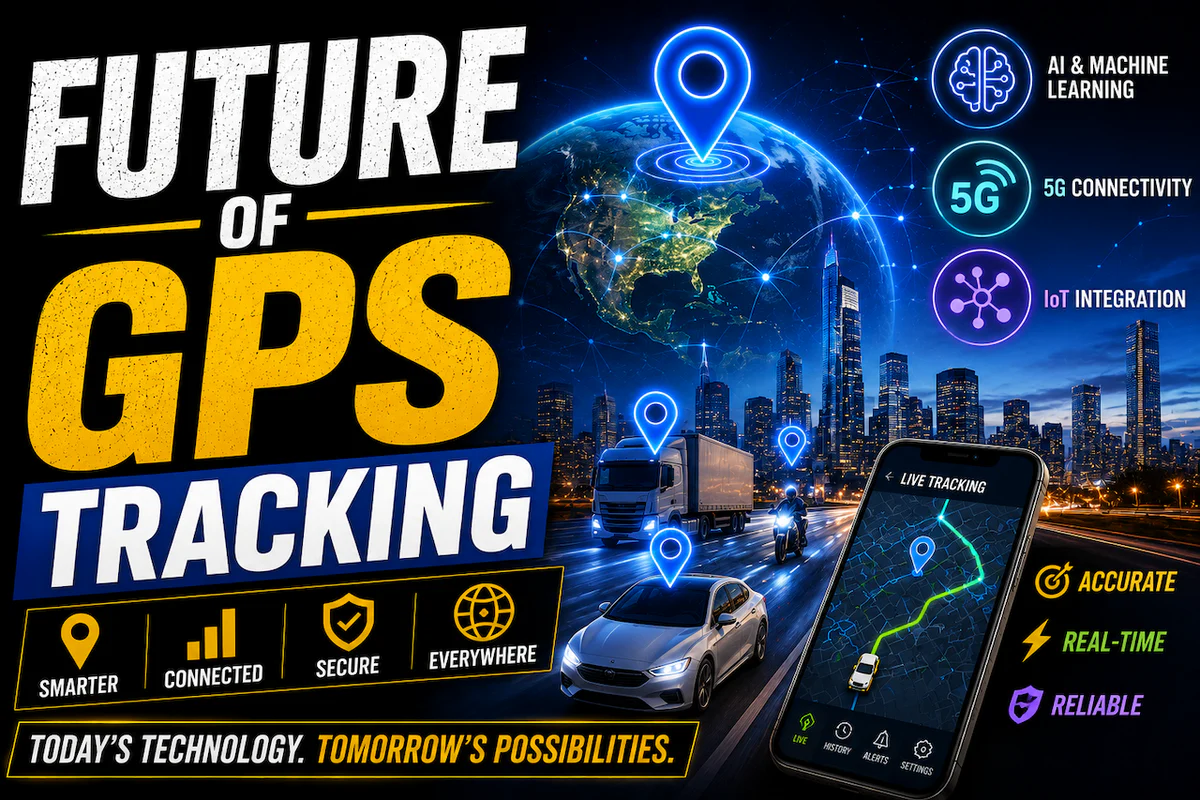
GPS tracking has quietly become one of those technologies that most people interact with dozens of times a day without ever thinking about how it actually works. It’s in the app that tells you when your ride is arriving, the tracker on your car, the wearable strapped to your dog’s collar, and the fleet management dashboard a logistics company uses to route hundreds of delivery vehicles. What started as military and aviation technology decades ago has become invisible infrastructure woven into daily life.
But the technology itself hasn’t stood still. The GPS tracking of 2026 looks meaningfully different from what existed even five years ago more accurate, less power-hungry, and increasingly combined with other data sources to do things that pure satellite positioning alone never could. This article walks through the biggest trends shaping where GPS tracking technology is headed, and why they matter beyond just the tech enthusiast crowd.
Beyond GPS: The Rise of Multi-Constellation Positioning
For most of GPS’s history, “GPS” and “satellite positioning” were basically synonymous, relying entirely on the U.S. Global Positioning System satellite network. That’s changed significantly. Modern devices increasingly draw on multiple satellite constellations simultaneously GPS (United States), GLONASS (Russia), Galileo (European Union), and BeiDou (China) a combination often referred to as GNSS, or Global Navigation Satellite System, rather than GPS specifically.
Using multiple constellations at once means a device can pull in signals from a much larger pool of satellites overhead at any given moment, which translates directly into faster location locks and meaningfully better accuracy, especially in challenging environments like dense urban areas or under heavy tree cover where signals from any single constellation might be partially blocked.
This shift matters more than it sounds. A tracker that used to take 30 seconds to get a reliable fix, or that struggled in a downtown area surrounded by tall buildings, now typically locks on in just a few seconds with far more consistent accuracy, simply because it’s no longer dependent on a single satellite network.
Ultra-Low-Power Tracking and the Battery Life Breakthrough
Battery life has always been the practical bottleneck for GPS tracking devices, particularly for compact trackers not connected to a vehicle’s power system. Continuous GPS tracking is power-intensive, which historically forced a tradeoff: frequent, accurate location updates that drained a battery in days, or infrequent updates that stretched battery life but left long gaps in tracking data.
Newer low-power positioning chips, combined with smarter software that adjusts update frequency based on movement, have started to close that gap. A tracker sitting motionless doesn’t need to constantly re-verify its GPS position; modern devices increasingly use accelerometer data to detect movement first, only waking up the power-hungry GPS radio when the device actually starts moving. This kind of motion-aware tracking has meaningfully extended battery life on portable trackers, turning devices that once needed weekly charging into ones that last for months on a single charge.
The Growing Role of Bluetooth and Ultra Wideband for Short-Range Precision
While satellite-based GPS remains essential for wide-area tracking, short-range precision — finding an item within a room or a few feet increasingly relies on Bluetooth and Ultra Wideband (UWB) technology rather than GPS at all. This is part of why consumer trackers like AirTag and Samsung’s SmartTag have leaned so heavily into these technologies rather than trying to squeeze GPS chips into small, battery-constrained devices.
UWB in particular has become a notable trend, offering centimeter-level precision and directional finding that GPS, which typically has an accuracy range of several meters, simply can’t match at short range. Expect this hybrid approach GPS or cellular positioning for wide-area tracking, paired with UWB or Bluetooth for close-range precision to become increasingly standard across both consumer trackers and commercial asset tracking equipment.
AI-Enhanced Predictive Tracking
One of the more significant shifts in recent years has been the move from GPS tracking as a purely reactive tool showing you where something is right now toward predictive systems that use historical movement data and machine learning to anticipate where something will be, or flag when a movement pattern looks abnormal.
In fleet management, this shows up as predictive ETA calculations that account for historical traffic patterns, driver behavior, and even weather conditions, rather than just calculating a straight-line estimate. In personal and family safety trackers, it shows up as anomaly detection flagging when a family member’s location pattern deviates significantly from their usual routine, which can serve as an early signal worth a check-in, without requiring constant manual monitoring.
This predictive layer is arguably a bigger shift than any single hardware improvement, since it changes GPS tracking from a passive data feed into something closer to an active assistant that surfaces relevant information rather than requiring someone to interpret raw location data themselves.
Satellite Connectivity for True Off-Grid Tracking
For years, GPS tracking devices had a significant blind spot: they could determine their own location using satellites, but transmitting that location back to a user typically still relied on cellular networks, which meant tracking simply stopped working in remote areas without cell coverage.
Direct-to-satellite connectivity is closing that gap. Building on the same technology that powers satellite messaging features now common on flagship smartphones, a growing number of trackers can transmit location data directly via satellite when cellular networks aren’t available, rather than just storing data locally until connectivity returns. This has particularly significant implications for outdoor recreation, maritime tracking, and remote fleet operations hikers, boaters, and off-road vehicles operating far outside cellular range can now maintain genuine real-time tracking rather than losing visibility entirely until they’re back in range.

Integration with Broader IoT Ecosystems
GPS tracking is increasingly less of a standalone feature and more of one data stream feeding into a much larger connected ecosystem. A modern fleet vehicle, for example, doesn’t just report location it feeds that data alongside fuel consumption, engine diagnostics, driver behavior, and cargo condition sensors into a single unified dashboard, allowing far more sophisticated decisions than location data alone could support.
This same pattern shows up at a consumer level. A pet tracker increasingly does more than show a dot on a map — it might also track activity levels and flag unusual inactivity that could indicate injury or illness. A car tracker might combine location with tire pressure and battery health data. As sensor costs continue to drop, expect GPS tracking to keep showing up as one component within broader smart device ecosystems, rather than existing as a dedicated, single-purpose category.
Privacy-First Design Becoming a Competitive Feature
As GPS tracking has become more powerful and more embedded in daily life, it’s also drawn increasing scrutiny around privacy, particularly following high-profile concerns about trackers being misused for stalking. This has pushed privacy protections from an afterthought into a genuine competitive feature that companies actively market.
Expect continued development in areas like unwanted tracker detection (alerting a phone user if an unfamiliar tracker appears to be traveling with them), more granular user consent controls, and clearer data retention policies around who can access historical location data and for how long. Regulatory pressure in multiple regions has also pushed manufacturers toward building these protections in by default rather than as opt-in features, a trend likely to continue and expand as tracking technology becomes even more precise and ubiquitous.
What This Means for Everyday Users
For most people, these shifts translate into a few very practical improvements without needing to understand the underlying technology at all:
- Faster, more reliable location locks, especially in cities or areas with spotty single-constellation coverage
- Longer battery life on personal trackers, wearables, and asset tracking devices
- More precise short-range finding for lost items, thanks to UWB adoption
- Tracking that works in genuinely remote areas, not just wherever cell service happens to reach
- Smarter alerts that surface meaningful information rather than requiring constant manual checking
- Stronger built-in protections against covert or unwanted tracking
Frequently Asked Questions
1. What’s the difference between GPS and GNSS? GPS refers specifically to the United States’ satellite positioning system, while GNSS (Global Navigation Satellite System) is the broader term covering multiple satellite constellations, including GPS, GLONASS, Galileo, and BeiDou. Most modern devices use GNSS, combining signals from several constellations for better accuracy.
2. Why do some trackers use Bluetooth or UWB instead of GPS? GPS chips require more power and physical space than Bluetooth or Ultra Wideband radios, making them less practical for very small, battery-constrained devices. Bluetooth and UWB also offer better short-range precision than GPS, which is more suited to wide-area tracking rather than pinpointing an item within a few feet.
3. How does satellite messaging work for trackers without cell service? Devices with direct-to-satellite capability transmit location data using low-earth-orbit satellite networks rather than relying on traditional cell towers, allowing them to maintain connectivity in remote areas where cellular coverage doesn’t reach, though typically with more limited bandwidth than a standard cellular connection.
4. Will GPS tracking devices eventually not need batteries at all? While fully battery-free GPS tracking isn’t mainstream yet, energy harvesting technology, such as small solar cells or kinetic charging, is being explored for certain tracking applications, particularly for devices that stay in consistent light or motion, though most consumer devices still rely on traditional batteries for now.
5. How accurate is modern GPS tracking? Standard consumer GPS accuracy typically falls within a few meters under open-sky conditions, while multi-constellation GNSS receivers and UWB-assisted short-range tracking can improve accuracy significantly, down to centimeter-level precision in ideal short-range conditions.
6. Are newer GPS trackers more resistant to signal jamming or spoofing? Multi-constellation receivers offer some inherent resilience since they aren’t dependent on a single satellite network, but dedicated anti-jamming and anti-spoofing technology remains a more specialized feature primarily found in commercial, aviation, and defense-grade equipment rather than typical consumer trackers.
7. How is AI actually being used in GPS tracking beyond just showing a location? AI is increasingly used for predictive ETA calculations, anomaly detection in movement patterns, and route optimization based on historical data, shifting tracking systems from purely reactive tools into ones that can flag relevant information or predict outcomes rather than just displaying a static location.
Final Thoughts
GPS tracking technology has moved well past simply showing a dot on a map. Multi-constellation positioning, ultra-low-power chips, UWB precision, satellite connectivity for off-grid areas, and AI-driven predictive features are converging to make tracking faster, more accurate, longer-lasting, and more genuinely useful across everything from personal safety to global fleet logistics. As these technologies continue to mature and privacy protections keep pace with growing capability, GPS tracking is likely to become even more deeply embedded into everyday devices — not as a standalone feature to think about, but as invisible infrastructure quietly working in the background, the same way it already does for millions of people every single day.
