
Every business eventually hits the same wall with email marketing software: the free plan that felt generous at 200 subscribers suddenly feels restrictive at 2,000, the automation builder that seemed advanced two years ago now feels clunky next to competitors, or the platform simply doesn’t talk to the e-commerce store or CRM the business actually runs on. Picking the wrong tool early doesn’t just waste money it means a painful migration later, dragging years of subscriber history and automation logic to a new platform under time pressure.
The good news is that the email marketing software category has matured a lot. Deliverability infrastructure is better across the board than it was a few years ago, automation builders have gotten genuinely intuitive instead of requiring a manual to operate, and AI-assisted features subject line suggestions, send-time optimization, content generation have moved from novelty to standard expectation. The challenge now isn’t finding a capable tool; it’s finding the one that actually fits a specific business’s size, industry, and technical setup.
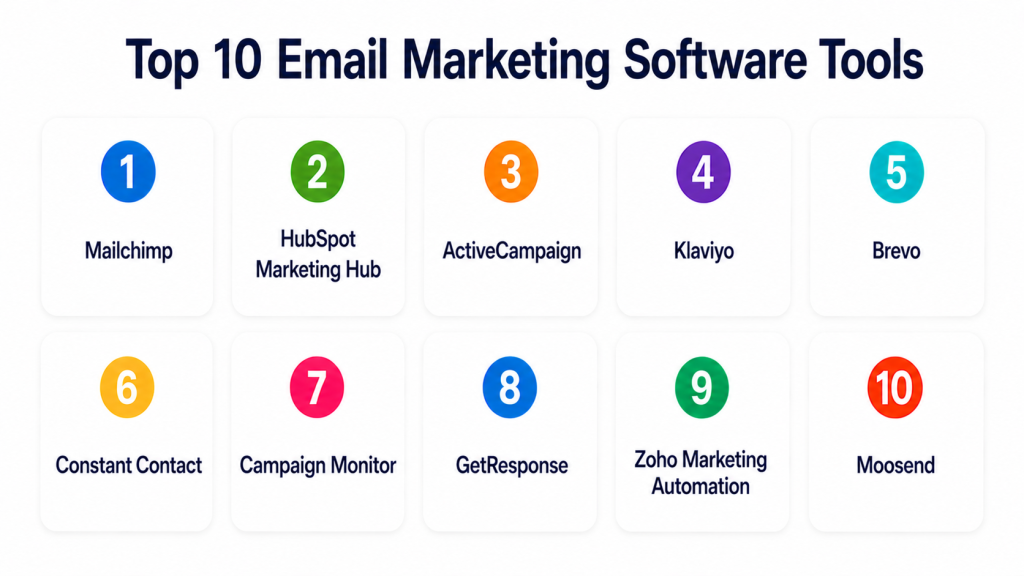
This guide walks through ten platforms worth serious consideration in 2026, what each one is genuinely built for, and a practical framework for choosing between them, followed by a straightforward.
What to Actually Evaluate Before Choosing
Before getting into specific platforms, it’s worth being clear about what actually separates a good fit from a bad one, since the “best” platform varies enormously depending on the business.
Deliverability — whether emails actually land in the inbox rather than spam matters more than almost any feature list. A platform with weak sender reputation infrastructure can undermine an otherwise excellent campaign before a single subscriber ever sees it.
Automation depth covers how sophisticated the workflow builder is whether it can handle multi-step sequences with conditional branching (if a customer clicks this, do that; if they don’t open within three days, send a different follow-up), or whether it’s limited to simple, linear drip sequences.
Pricing structure varies significantly between platforms some price by number of contacts, others by email volume sent, and this distinction matters a lot depending on whether a business has a large list it emails infrequently or a smaller list it emails constantly.
Integration ecosystem determines how easily the platform connects to whatever e-commerce platform, CRM, or other tools the business already relies on, since a platform requiring custom development work to connect basic systems adds real hidden cost.
Ease of use matters especially for smaller teams without a dedicated marketing operations person, where a steep learning curve can mean a powerful tool that never actually gets used to its potential.
1. Mailchimp
Mailchimp remains the most widely recognized name in the category, and its scale shows in its integration ecosystem it connects natively with a huge range of e-commerce and business tools, which makes it a comfortable default for businesses already running lean on technical resources. It’s a reasonable starting point for small businesses just getting into email marketing, particularly those wanting an all-in-one tool with a wide integration footprint.
Where it falls short for growing businesses: pricing tends to climb noticeably as contact lists scale past a few thousand subscribers, and some of its more advanced automation features sit behind higher-tier plans, which can make it feel less cost-competitive for a business with a large list but relatively simple automation needs.
Best for: Small businesses wanting broad integrations and brand familiarity over deep automation sophistication.
2. Klaviyo
Klaviyo has built its reputation almost entirely around e-commerce, and it shows its data integration with platforms like Shopify runs deep, letting businesses build highly specific segments and automated flows based on actual purchase behavior, browsing history, and product-level data rather than generic engagement metrics. Revenue attribution reporting, showing exactly how much revenue a given campaign or flow generated, is a particular strength.
The tradeoff is a genuinely steeper learning curve than more general-purpose platforms, and pricing that can climb quickly for larger lists, which makes it a stronger fit for e-commerce businesses serious about squeezing real revenue out of email than for a business wanting something simple to set up in an afternoon.
Best for: E-commerce businesses that want deep behavioral segmentation and revenue tracking tied directly to campaigns.
3. ActiveCampaign
ActiveCampaign has positioned itself as the automation-first platform, with a workflow builder capable of genuinely complex, multi-branch customer journeys that go well beyond basic welcome sequences. It bundles in CRM functionality, letting sales and marketing activity live in the same system rather than requiring separate tools that don’t talk to each other well.
This depth comes with a real learning curve, and it’s generally priced higher than simpler competitors, which makes it a better fit for businesses with an actual automation strategy in mind rather than ones just looking to send a monthly newsletter.
Best for: Businesses that want sophisticated, behavior-triggered automation and don’t mind a steeper setup process to get there.
4. HubSpot
HubSpot’s email marketing tools live inside a much larger ecosystem the same Marketing Hub connects to HubSpot’s CRM, sales tools, and customer service features, all sharing the same underlying contact data. For a business already using or considering HubSpot for its broader CRM and marketing needs, this makes email a natural extension rather than a separate system to manage.
For a business that just needs email marketing on its own, HubSpot is often more platform than necessary, and pricing reflects that broader scope rather than being competitive purely as a standalone email tool.
Best for: Businesses already invested in or considering the HubSpot ecosystem for CRM and broader marketing needs.
5. Brevo
Brevo (formerly Sendinblue) has built a reputation around generous free-tier limits and pricing based on email volume rather than contact list size, which makes it a genuinely strong option for businesses with a large contact list they don’t email constantly. It bundles in SMS marketing and basic CRM features alongside email, giving smaller businesses a reasonably complete toolkit without needing to stitch together separate platforms.
Its automation builder, while solid, doesn’t reach the same depth as more automation-focused platforms, making it a better fit for businesses wanting broad functionality at a fair price rather than the most sophisticated workflow logic available.
Best for: Businesses with large contact lists and moderate sending frequency who want volume-based pricing.
6. Omnisend
Omnisend, like Klaviyo, is built specifically for e-commerce, with tightly integrated omnichannel workflows spanning email, SMS, and push notifications from a single automation builder. Its revenue attribution reporting is a genuine strength, and it’s generally positioned as a more affordable alternative to Klaviyo for e-commerce businesses that want strong automation without quite the same price tag.
It’s a less natural fit for non-e-commerce businesses, since much of its feature set and messaging is built specifically around product catalogs, cart behavior, and purchase-driven flows.
Best for: E-commerce businesses wanting strong omnichannel automation at a more moderate price point than premium e-commerce-specific competitors.
7. GetResponse
GetResponse has positioned itself as a genuine all-rounder, bundling email marketing, automation, and landing page building into one platform at a competitive entry price point, with a free tier that gives smaller businesses room to start without an immediate financial commitment. This breadth makes it appealing for a business wanting one platform to handle several adjacent marketing needs rather than juggling separate tools.
The tradeoff of covering so much ground is that no single piece — email, automation, or landing pages — tends to be quite as deep or polished as a platform built specifically around just one of those functions.
Best for: Small businesses wanting one platform to handle email, basic automation, and landing pages without paying for several separate tools.
8. Kit (formerly ConvertKit)
Kit has built a dedicated following among creators, newsletter writers, and solo entrepreneurs specifically, with a simpler, more content-focused interface than platforms built around traditional business marketing. Its free tier extends to a meaningfully larger subscriber count than most competitors, making it an easy entry point for individuals and small content-driven businesses.
It’s a less natural fit for businesses needing heavy e-commerce integration or highly complex, multi-branch automation, since its feature set leans toward straightforward audience growth and content delivery rather than deep behavioral segmentation.
Best for: Creators, newsletter writers, and small content-driven businesses prioritizing simplicity and audience growth over complex automation.
9. MailerLite
MailerLite has built a reputation around a clean, genuinely easy-to-use interface paired with a fair, straightforward pricing structure, making it a popular choice for small businesses and creators who want a capable tool without a steep learning curve. Its automation builder covers the essentials well — welcome sequences, basic behavioral triggers — without overwhelming a first-time user.
For businesses that eventually need deeper, more complex automation logic or advanced e-commerce-specific features, MailerLite’s simplicity can become a limitation, making it more of a strong starting platform than a long-term fit for a business planning significant marketing sophistication down the line.
Best for: Small businesses and creators wanting simplicity and value without a steep setup curve.
10. Constant Contact
Constant Contact is one of the more established, longer-running platforms in the category, and it’s often positioned toward businesses wanting a straightforward, traditional email marketing tool without a lot of the more modern automation complexity found in newer competitors. It includes solid basic templates, list management, and event marketing features that appeal particularly to local businesses, nonprofits, and organizations running relatively simple campaigns.
Its interface and feature set can feel a bit dated next to more modern competitors, and its automation capabilities are generally more basic, making it a better fit for businesses prioritizing simplicity and reliability over cutting-edge automation sophistication.
Best for: Local businesses, nonprofits, and organizations wanting a straightforward, reliable tool without a steep learning curve.
How to Actually Choose
With ten legitimate options, the decision usually comes down to a few practical questions rather than trying to find one single “best” platform.
Is the business e-commerce-focused? If so, Klaviyo or Omnisend generally offer the deepest, most revenue-relevant automation, with Omnisend typically the more budget-friendly option of the two.
Does the business need heavy CRM integration? HubSpot or ActiveCampaign make the most sense if email needs to work tightly alongside sales and broader customer relationship data.
Is simplicity and low cost the priority? MailerLite, Kit, or GetResponse tend to fit best for smaller teams or solo operators wanting something usable without a steep setup process.
Does the business have a large list but modest sending frequency? Brevo’s volume-based pricing model tends to be more cost-effective than contact-based pricing in this scenario.
Is broad brand recognition and integration breadth the priority? Mailchimp remains a reasonable, familiar default, particularly for businesses without strong opinions about automation depth.
A Practical Evaluation Process
Rather than committing based on a features list alone, it’s worth actually testing a shortlist of two or three platforms with real data before fully committing:
- Import a real (or realistic sample) segment of the contact list and check how the platform’s segmentation and tagging actually feels to use.
- Build one real automation sequence the business plans to use, not just a demo template, to get a genuine sense of the workflow builder’s usability.
- Check actual integration with the business’s existing e-commerce platform, CRM, or other core tools, rather than trusting a marketing page’s list of “integrations.”
- Compare pricing at the contact volume the business expects to reach in a year, not just its current size, since some platforms that look affordable early on scale poorly in cost.
The Bottom Line
There’s no single best email marketing platform in 2026 there’s a best fit for a specific business’s size, industry, and technical setup. E-commerce businesses generally do best with Klaviyo or Omnisend, businesses wanting deep automation and CRM integration lean toward ActiveCampaign or HubSpot, and smaller teams prioritizing simplicity and cost tend to do well with MailerLite, Kit, or GetResponse. Testing a real shortlist with actual data, rather than choosing based on a features page alone, remains the most reliable way to avoid a costly platform switch a year or two down the line.
FAQs
Which email marketing software is best for a small business just getting started? For most small businesses starting out, MailerLite, GetResponse, or Mailchimp offer a reasonable balance of ease of use, affordability, and enough features to grow into. The right choice within that group often comes down to whether the business wants an all-in-one platform (GetResponse), maximum simplicity (MailerLite), or the widest integration ecosystem (Mailchimp).
What’s the difference between pricing based on contacts versus pricing based on email volume? Contact-based pricing charges according to the size of the subscriber list, regardless of how often campaigns are sent. Volume-based pricing charges based on the number of emails actually sent, regardless of list size. A business with a large list it emails infrequently often saves money with volume-based pricing (like Brevo), while a business with a smaller, highly engaged list it emails frequently may find contact-based pricing more predictable.
Is Klaviyo worth the higher price compared to Mailchimp or Brevo for e-commerce? For e-commerce businesses serious about squeezing revenue out of email through detailed behavioral segmentation and purchase-driven automation, many find the deeper functionality worth the added cost. For a smaller e-commerce business just starting out with simpler needs, a more affordable option like Omnisend or Brevo may deliver enough value without the steeper learning curve and price.
How important is deliverability when choosing a platform? Extremely important — a platform with weak sender reputation infrastructure can mean campaigns land in spam folders regardless of how good the content or design is. Established, larger platforms generally have more mature deliverability infrastructure, though actual results also depend on list hygiene, sending practices, and content quality on the sender’s side.
Can we switch email marketing platforms later without losing our subscriber data? Yes, most platforms support exporting contact lists, though automation workflows and some engagement history typically don’t transfer automatically and need to be rebuilt on the new platform. This is exactly why choosing carefully upfront matters — a later switch is possible but involves real setup work to recreate automations and segmentation logic.
Do we need separate tools for email marketing and SMS marketing? Not necessarily. Several platforms, including Brevo and Omnisend, bundle SMS marketing alongside email in the same platform and automation builder, which can simplify management for businesses wanting both channels working together rather than as separate, disconnected systems.
How much should a small business expect to budget for email marketing software? This varies widely based on list size, sending frequency, and feature needs, but many platforms offer usable entry-level plans in the range of a modest monthly fee for a few thousand contacts, with several offering meaningful free tiers to start. Costs generally scale up from there as list size and automation complexity grow, which is why checking pricing at the list size expected a year out, not just current size, matters when comparing platforms.
